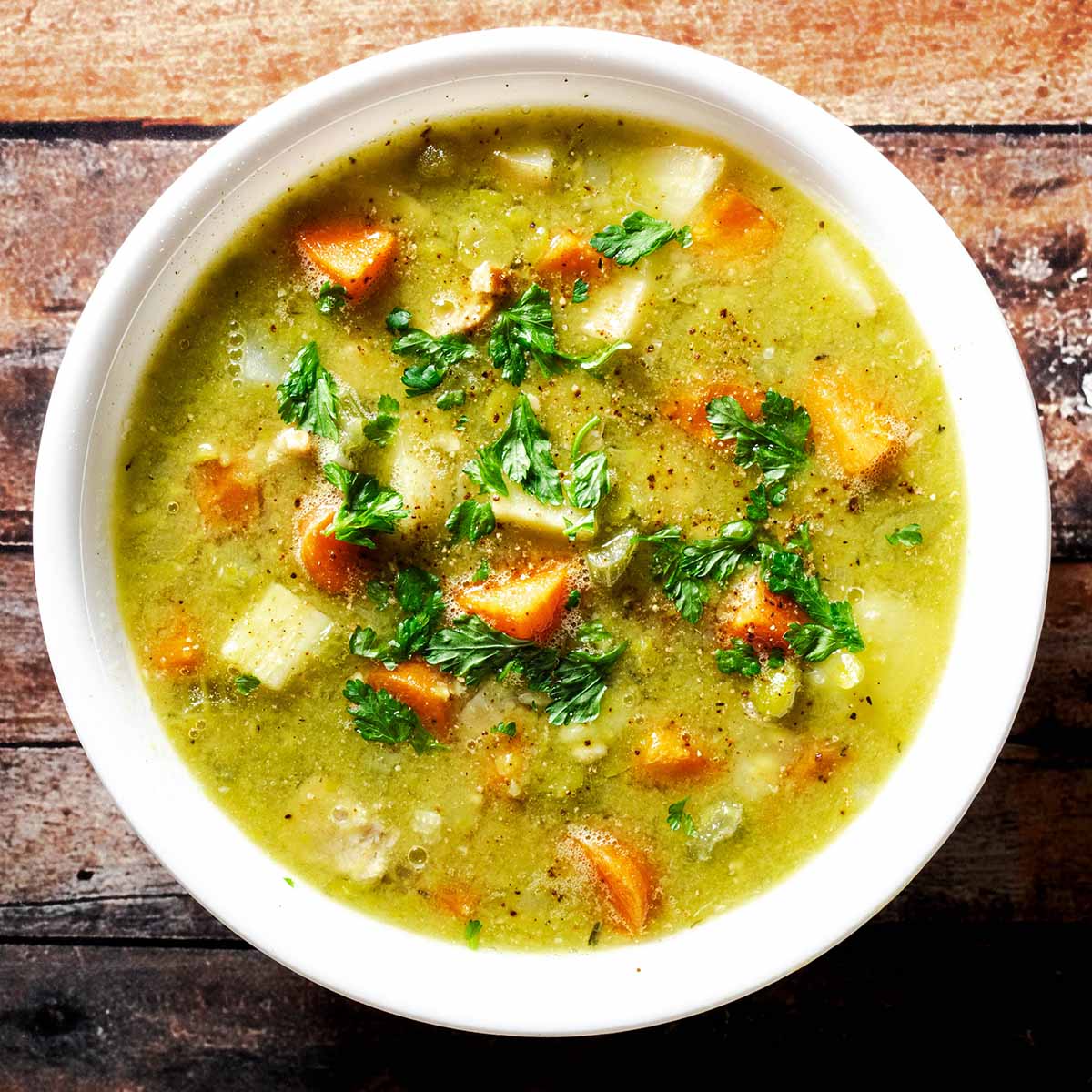
I doubled the amount of vegetables in this hearty split pea soup recipe, compared to more traditional versions. That includes classic winter root vegetables like carrots and potatoes as well as the option for uncommon ones, like parsley root or sunchokes.
Here are some vegetables to try adding to your split pea soup:
- Carrots
- Parsnips
- Potatoes
- Parsley root
- Sunchokes
- Celery root
A ham hock or leftover ham from the holidays (like Easter or Christmas) is added to the broth where the marrow and collagen break down to add a ton of flavor and body.
This split pea soup recipe is easy, but takes 45 minutes to cook in a dutch oven. It's mostly hands-off while you wait for the split peas to break down.
Jump to:
Recipe
Ingredients
Soup
- 1 pound split peas 1 16-ounce bag
- 4 cups broth
- 3-4 cups water see note
- 2 bay leaves
- 5 sprigs fresh thyme or 1 teaspoon dried
- 1 ham hock see note
- 8-16 ounces ham see note
Base flavor
- 2 tablespoon olive oil
- 1 medium yellow onion
- 3 stalks celery
- 2 cloves garlic
Vegetables
- 4 carrots
- 2 parsnips
- 2 parsley root or other root vegetables: sunchokes, celery root, or sub with extra carrots, parsnips, or potatoes
- 2 yukon gold potatoes sub with red potatoes
Garnish
- 3 tablespoon fresh parsley optional
- 1 teaspoon fresh cracked pepper optional
- 1 cup croutons optional
Instructions
Prepare the vegetables
- Dice onions and celery, and finely dice garlic.Taste the carrots and parsnips, if they taste bitter, peel them. Otherwise, leave the skin on for added nutrients. Dice all of the vegetables into bite-sized pieces for soup.1 medium yellow onion, 3 stalks celery, 2 cloves garlic, 4 carrots, 2 parsnips, 2 parsley root, 2 yukon gold potatoes
Make the split pea soup
- Cook aromatics: Heat 2 tablespoons of olive oil in a dutch oven or large soup pot. Add in diced onions and celery, saute for 5 minutes. Add garlic and cook for 1-2 more minutes.
- Cook split peas: Add the split peas, broth, water, bay leaves, thyme, and ham hock. Bring to a boil, then reduce to a simmer, cover, and cook for 30 minutes. (Don't add the vegetables yet, or they will turn to mush too).Fresh split peas start to break down after 20-25 minutes, staler ones can take 45+. You don't want to add vegetables before this point, or they will cook too long and turn mushy.1 pound split peas, 4 cups broth, 3-4 cups water, 2 bay leaves, 5 sprigs fresh thyme, 1 ham hock
- Remove the ham hock & thyme sprigs. Cut any good meat off the ham bone after it cools, and add it back in when you are done.
- Add vegetables only once the split peas have started to break down. Add the vegetables and extra ham (if using). Cook for another 15-20 minutes, until they are soft. The split peas should be falling apart, turning to mush.
Finish & serve
- Stir the soup well, to break up any remaining split peas, blending into the soup. Add more water if it's too thick (or broth if it's not too salty already).
- Taste & add salt: homemade split pea soup can vary in saltiness, it depends on the broth used, saltiness of the ham, and how much ham. I use a regular (not reduced) sodium broth that makes the soup just perfectly salty (for me). If it needs more salt, start by adding a ½ teaspoon and go up from there.
- Top with fresh parsley, cracked pepper. Add in croutons or eat with a hearty, rustic bread. I like a good loaf with caraway or rye.
Notes
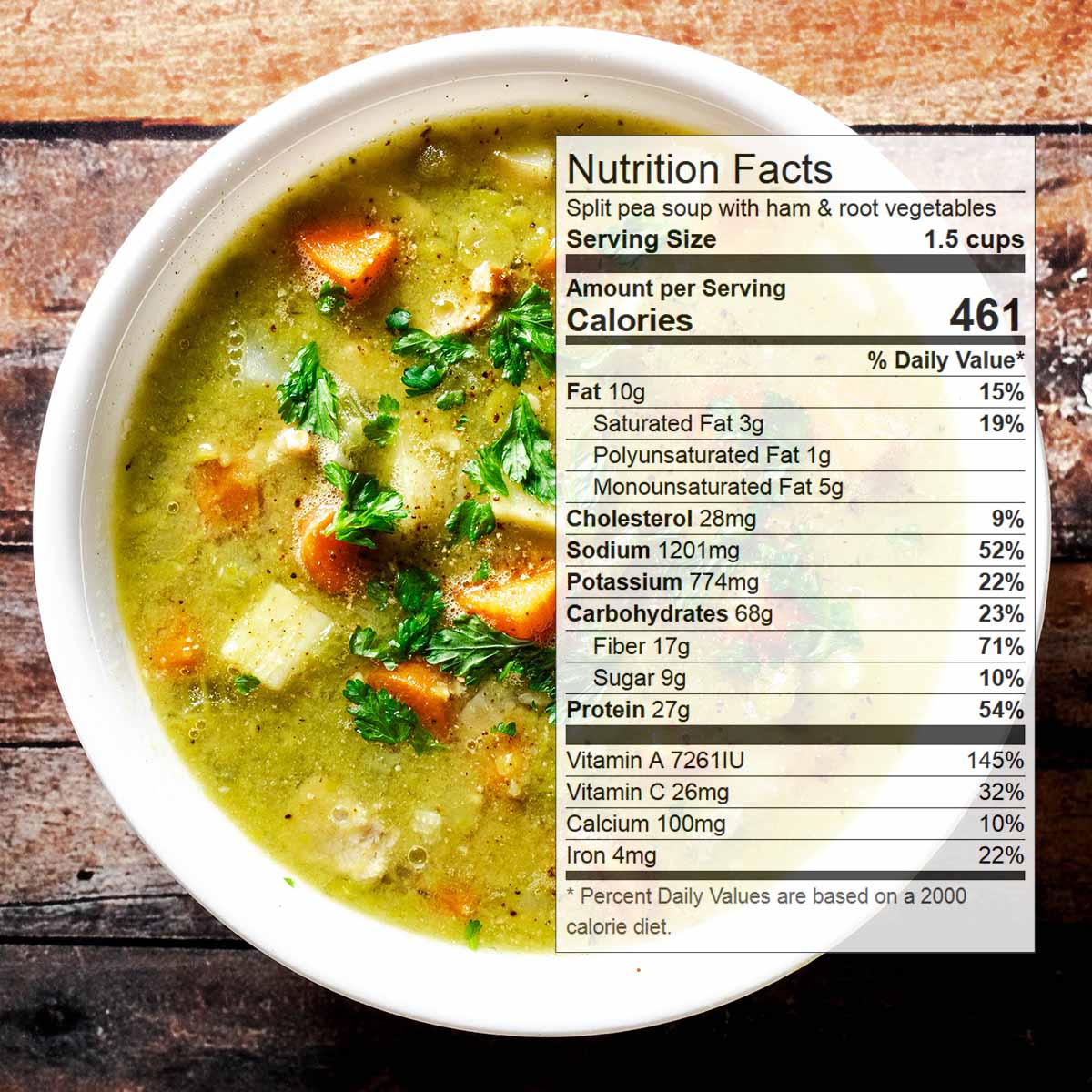
Nutrition
More nutrition details
Most split pea soup recipes are between 425 and 500 calories. The variance mostly depends on how much ham you use, what type of ham (is it a fattier or leaner ham bone).
Other ingredients have a minor impact on calories, but the amount and type of vegetables can add a fair amount of extra fiber, vitamins, and nutrition.

Vegetables for split pea soup
Most split pea soup recipes use 2-3 carrots in the entire recipe (for a similar sized batch). That's it - no other vegetables.
I like adding in a lot more vegetables which makes this a hearty, chunky soup. This recipe has more than double what other (also delicious) recipes use.
Split pea soup is typically a cool-weather soup, so winter vegetables are the best choice. At a minimum, I routinely include carrots, parsnips, and potatoes.
To keep the soup interesting, I also keep an eye out for parsley root, celery root, and sunchokes. They won't dramatically change the flavor or texture of the soup, but they do add subtle notes and their own nutrition.
Parsnips are sweeter than carrots
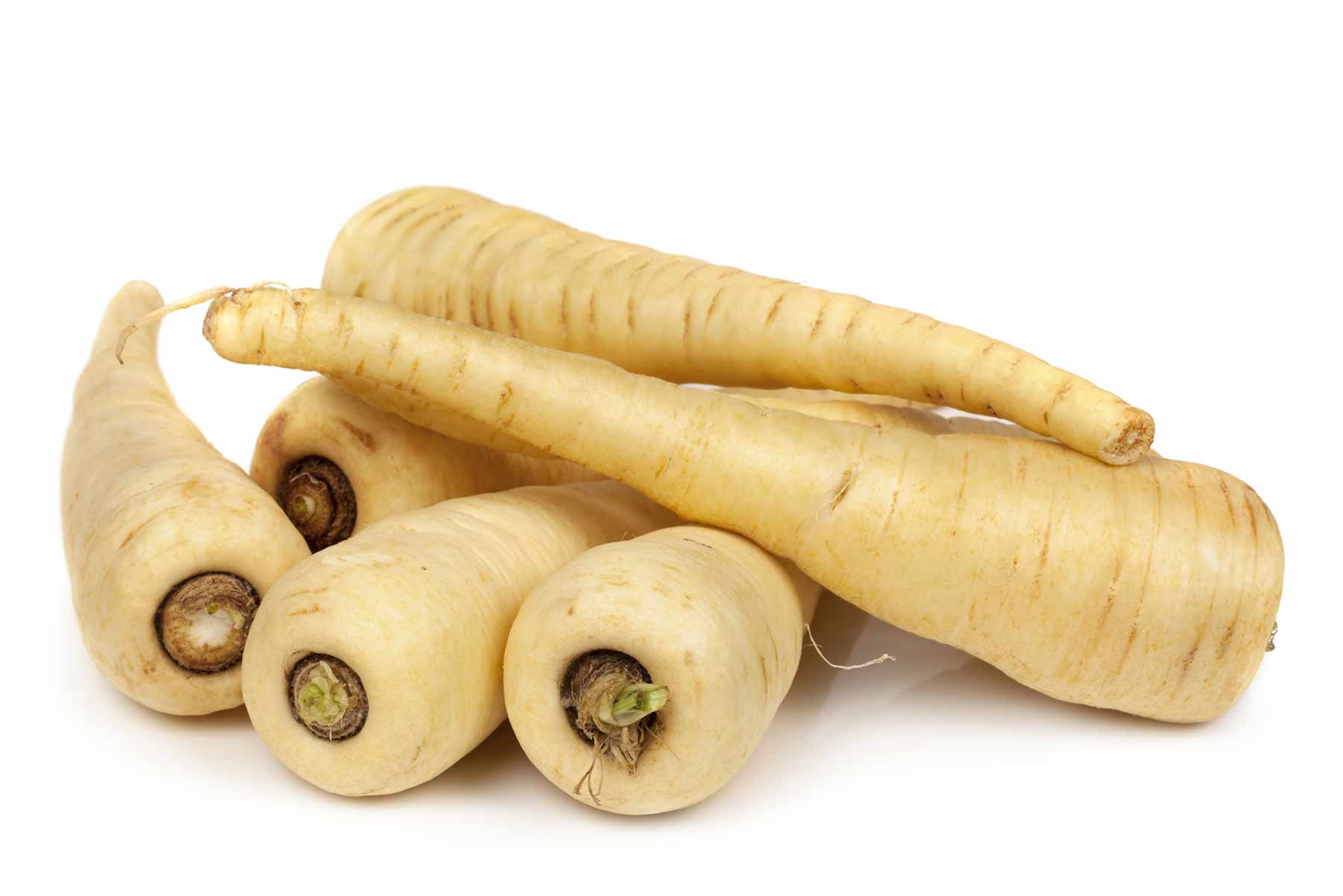
Parsnips are a nuttier, earthier, and sweeter member of the carrot's family. They pair easily with carrots in split pea soup.
They do have a distinct taste that not everyone enjoys. Sometimes what people don't like is the bitterness of the skin, which is found in varying degrees. That can be easily fixed by peeling them.
Parsnips can also have bitter, woody cores - which shouldn't be confused with their actual flavor. Woody cores are common on large, thick parsnips.
Remove a woody core by cutting around it, like you would cut around the core of an apple. The core is easy to spot, as there is usually a ring or a different texture differentiating it from the rest of the parsnip.

Parsley root has a mild celery-parsley flavor
Parsley root is what it sounds like - the root of a parsley plant. However, different varieties are grown for the leafy herb portion and for the roots.
They look incredibly similar to parsnips, but are usually a little twisted and smaller. Stores usually sell them with some of the tops attached, which you can use for herbs as a garnish.
I really enjoy parsley root in split pea soup (and other soups that use root vegetables). They taste like a mix of celery and parsley, with the texture of a carrot.

Carrots are a classic
Carrots are the classic split pea soup vegetable. Their sweet flavor and bright orange color make a beautiful soup.
Both large and small carrots work well, just cut them into bite sized pieces that fit on your spoon. I've never had to core a woody carrot - they soften enough when cooked in soups and don't impact the flavor.
If you don't have other root vegetables, or fall short. Add more carrots.

Yukon gold and red potatoes work best
Another classic split pea soup vegetable, potatoes add a bunch of nutrition. They add a good amount of vitamin C, potassium, and fiber, assuming you keep the skin on.
Potatoes get a bad reputation, but that's mostly because we tend to make potatoes unhealthy by deep frying into french fries or potato chips, or loading up with bacon, cheese and sour cream.
What are the best potatoes for soup? In this case, red potatoes or yukon golds are best because they retain their shape. Russets work too, but will tend to fall apart a little more, and that's ok. If they fall apart, they add to a creamier soup base.
I've used both types of potatoes - it depends on what I have on hand.
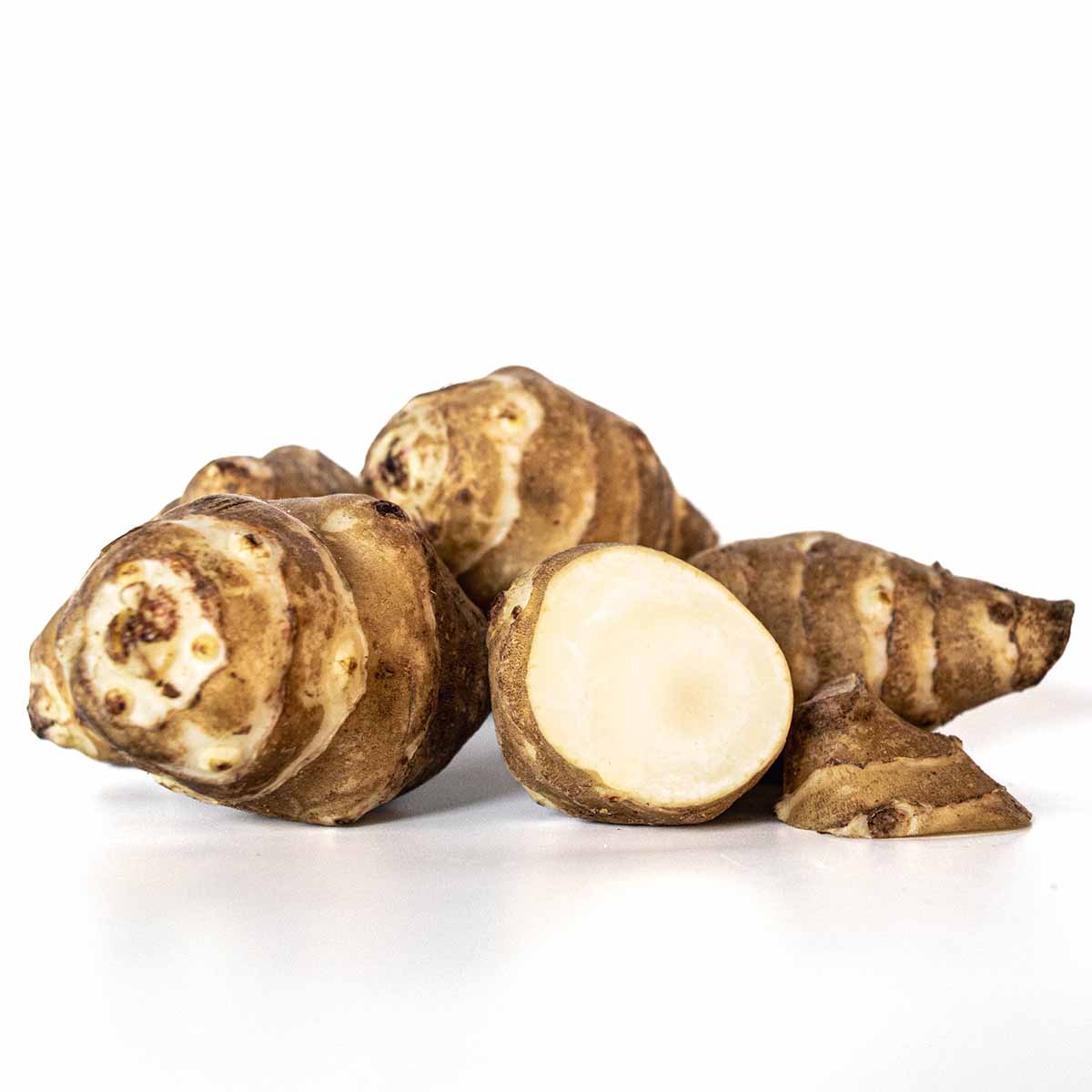
Sunchokes are mild and nutty
Sunchokes are a member of the sunflower family - a tuber that looks like ginger on the outside but tastes nothing like it. They also go by the name Jerusalem artichokes.
They have a mild flavor that's sweet and crunchy, like a cross between and walnut and potato, with a hint of sunflower seed. When roasted or boiled in a soup, they are soft with a similar texture to parsnips.
The skin is edible - just be sure to scrub any dirt off the outside. If you do want to peel them, cut off knobby areas, then use a vegetable peeler.
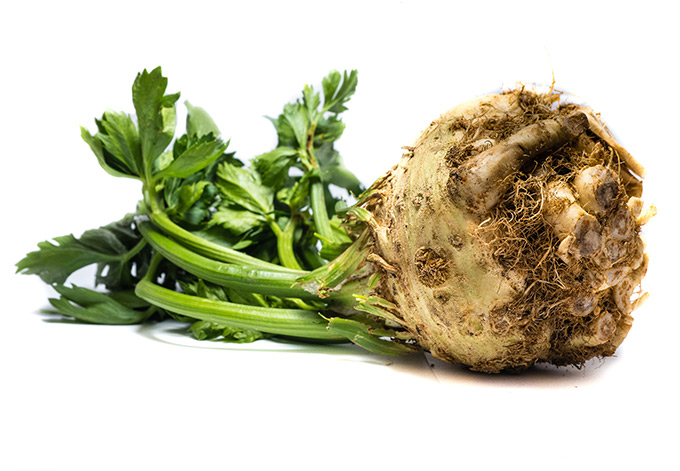
Celery root is soft once boiled, and mild
Celery root is like parsley root, in that it's the root of the celery plant. A different variety is also grown for the root vs the stalks.
It has a mild flavor that's a cross between celery and potatoes. Their texture is soft when simmered in a soup, similar to parsnips.
Celery roots are gnarly and a bit tough to work with. You first have to cut off the outer skin which has a bunch of bumps and knots. Then you can dice it up. If you get these in your CSA or farm-share box, soup is a great way to use them.

Best types of ham
It's my opinion that any type of ham makes a delicious split pea soup. However, there's one exception that's hard to beat - a ham bone.
Ham bones add extra flavor and texture to soup. The bones contain marrow and collagen that melt into the broth to add both flavor and body.
Adding the bone to the beginning of the soup-making process essentially creates a ham broth.
Ham hocks add incredible flavor
You can use store bought ham hocks, which are the knuckle bonen at the end of the leg. They are usually cured and smoked, imparting a bacon-like flavor (and a lot of salt).
Ham hocks also don't have much meat on them, so you'll want to buy some ham steaks or have another source of extra ham.
Ham bones from leftovers are a go-to
If you've recently cooked a ham and have leftover ham bones - save them for split pea soup!
If the ham bone still has a lot of usable meat on it, toss the whole thing in the soup pot. After 20 minutes, remove the ham bone and cut the meat off once it's cool enough to handle.
Add the leftover meat back into the soup pot.
Ham steaks add extra ham chunks
Ham steaks are a very easy way to add ham to split pea soup. They are just thick enough to cut into perfectly bite-sized cubes. No additional cooking or prep work required.
However, those won't flavor the soup like a ham bone or ham hock will. If you can't find those at the store, grab some bacon.
Add 3-4 pieces of raw bacon to the soup pot while you saute the onions and celery. Leave the bacon in while the soup simmers. It will be rubbery and not appetizing, so remove it before adding in the vegetables (it's easy to fish out before the vegetables are added, crowding the soup pot).
Alternatively, you can add use leftover bacon fat to saute the aromatics. If you want more flavor and are okay with the extra saturated fat, add in four tablespoons instead of just two.
Leftover holiday ham from Easter or Christmas
After cooking a big holiday ham, use the leftover meat and bones in this soup. There's no need to buy any extra ham hocks or meat, just the joy of using up your leftovers.
Easter ham is usually glazed with bright and tangy flavors, like honey, pineapple, or mustard. Taste the ham first to make sure it will complement the soup. Sometimes the glaze is only on the outer portion and the interior ham near the bone is much more neutral flavored.
Christmas hams are usually flavored with richer glazes with cloves and brown sugar. Just like with Easter hams, taste the meat to make sure it will work in the soup.
Regardless of their flavors, the holiday ham bones can always be used as they won't be holding onto the glazed flavors. Instead, it will release it's own rich, umami flavors into the split pea broth.
Other ways to spice up split pea soup
The classic spices for split pea soup are bay leaves and thyme. Bolder seasonings, like smoked paprika or curry powder, give the soup a new flavor.
- Smoked paprika - use 1-2 teaspoon for a bolder, smokier flavor
- Chipotles in adobo - add 1-2 peppers in with the onions and celery
- A can of green chiles - add a 4oz can of green chiles along with the broth for a spicier soup
- Curry powder - add 1-2 Tablespoons of curry powder (or follow this curry split pea soup recipe from Feasting at Home).
- Beer & mustard - replace some of the water with a bottle of beer and add 1 tablespoon of spicy mustard, or follow this recipe from Taste of Home
- Fried herbs: add some fried sage or rosemary as a garnish - you won't regret it.
You can also try using smoked or roasted pork shoulder that's been shredded. This apple cider braised pork shoulder would be especially tasty.

Split peas require a long cooking time to break down
Split peas take a long time to cook before they totally break down. Most split pea packages indicate they cook in 20-30 minutes. That's true - if you want them to still be whole and chewy.
For soup, the split peas need to cook a lot longer. They totally break down after 40-45 minutes.
If the split peas are really old, they can take longer to break down, up to 90 minutes. Really stale split peas might not even soften after that much time.
There's no need to use a blender or an immersion blender to make split pea soup creamy. Once the peas break down, they easily combine with the broth from simmering and stirring.
It's also very hard to overcook the split peas. Cooking them longer up front gives you a chance to add the vegetables later on, without the risk of overcooking them.

Leftovers
This soup stores well for several days in the fridge. It will get really thick but loosen up once heated. It will still be thicker than the first day, so you might need to add extra broth or water.
Thin the soup with extra water if it's already pretty salty. If it's not too salty, you can add broth instead so the soup doesn't taste watered down.
Split pea soup also freezes well. Leave a little space at the top of the container when you freeze it, to allow for some expansion. Thaw overnight in the fridge and reheat in a saucepan.

More recipes & resources
If you want to make split pea soup in a crockpot or instant pot, follow the instructions over at Cooking Classy. You can still add in the extra vegetables that I use and it will turn out great.
You might also be interested in some of my other winter soups.
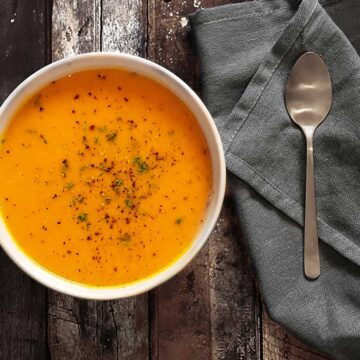
- Roasted butternut squash soup with bacon
- Zuppa Toscana soup with butternut squash
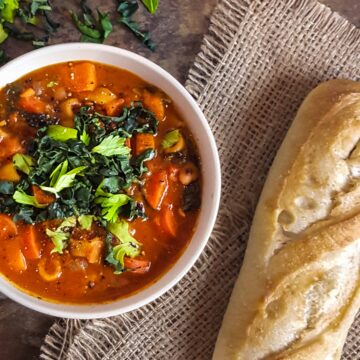
- Winter minestrone with seasonal vegetables
- Sweet Potato Soup
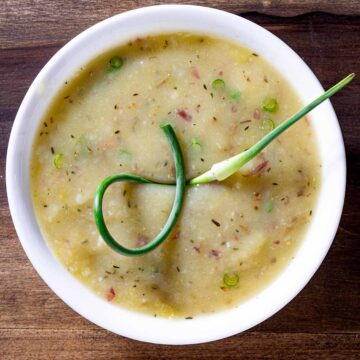
- Garlicky potato & leek soup (without cream)
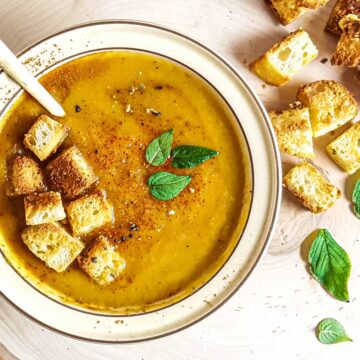
- Roasted butternut squash soup with sage croutons
If you're wondering what else is currently in season, check out my calendars to see what produce is in season each month (and coming up soon).

Leave a Reply