I grow too many tomatoes every year and use up the paste tomatoes for canning pizza sauce. I like this recipe because tastes better than other canned recipes I've tried and it requires very little work.
- No peeling the tomatoes
- No need to remove seeds
- No running through a food mill
This pizza sauce recipes is adapted from the Ball Book of Canning and Preserving (2016), a trusted source. The adaptations include changes to the dried herbs, and I cut the recipe in half as a starting point, keeping all ratios the same for safe canning.
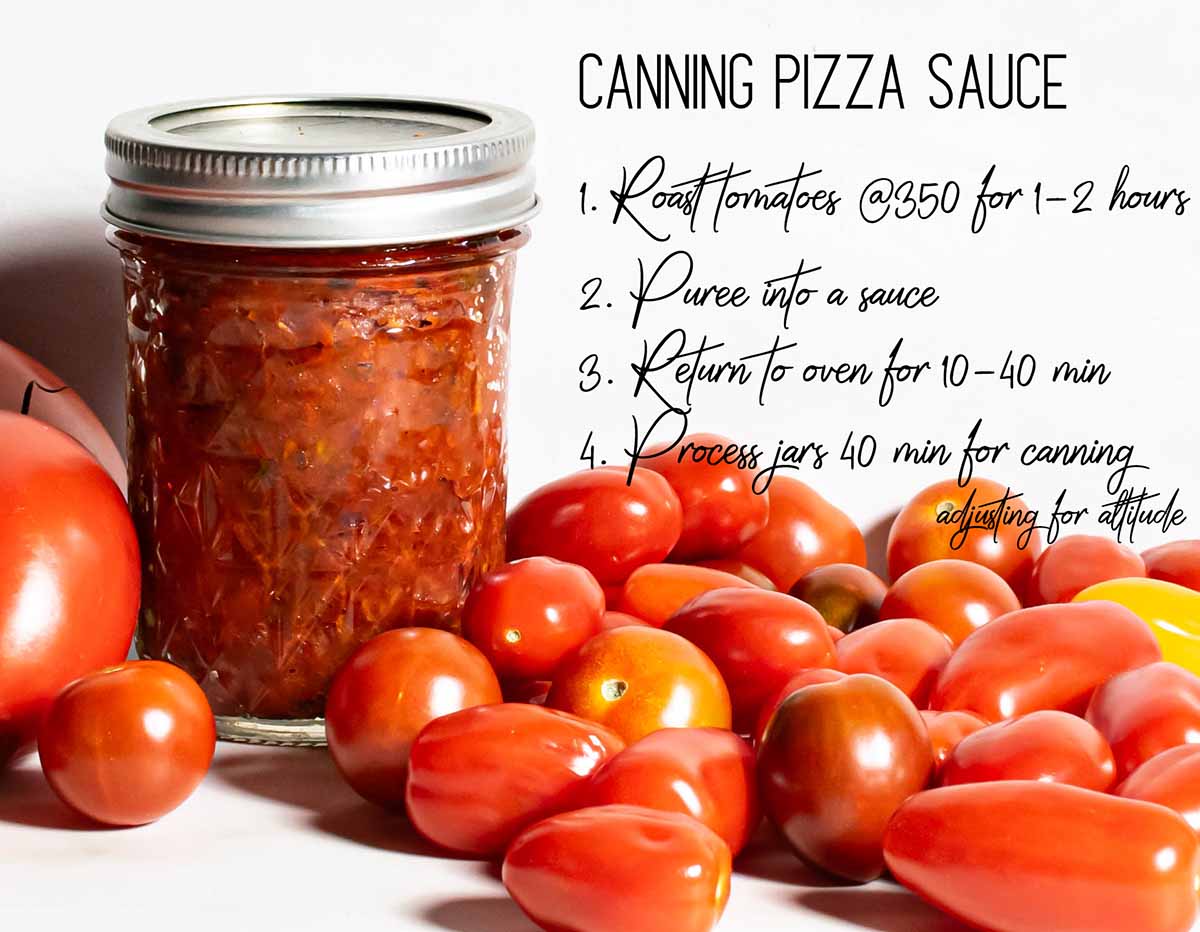
To make the pizza sauce, you simply halve (or quarter) the tomatoes and roast them. This concentrates the flavors and dries them out. Then you puree the tomatoes, add in some dried herbs, fill your jars, and start the canning process.
Each pound of tomatoes makes about ½ a cup of thick pizza sauce, which is enough to generously cover one 12" pizza.
Jump to:
Recipe
Equipment
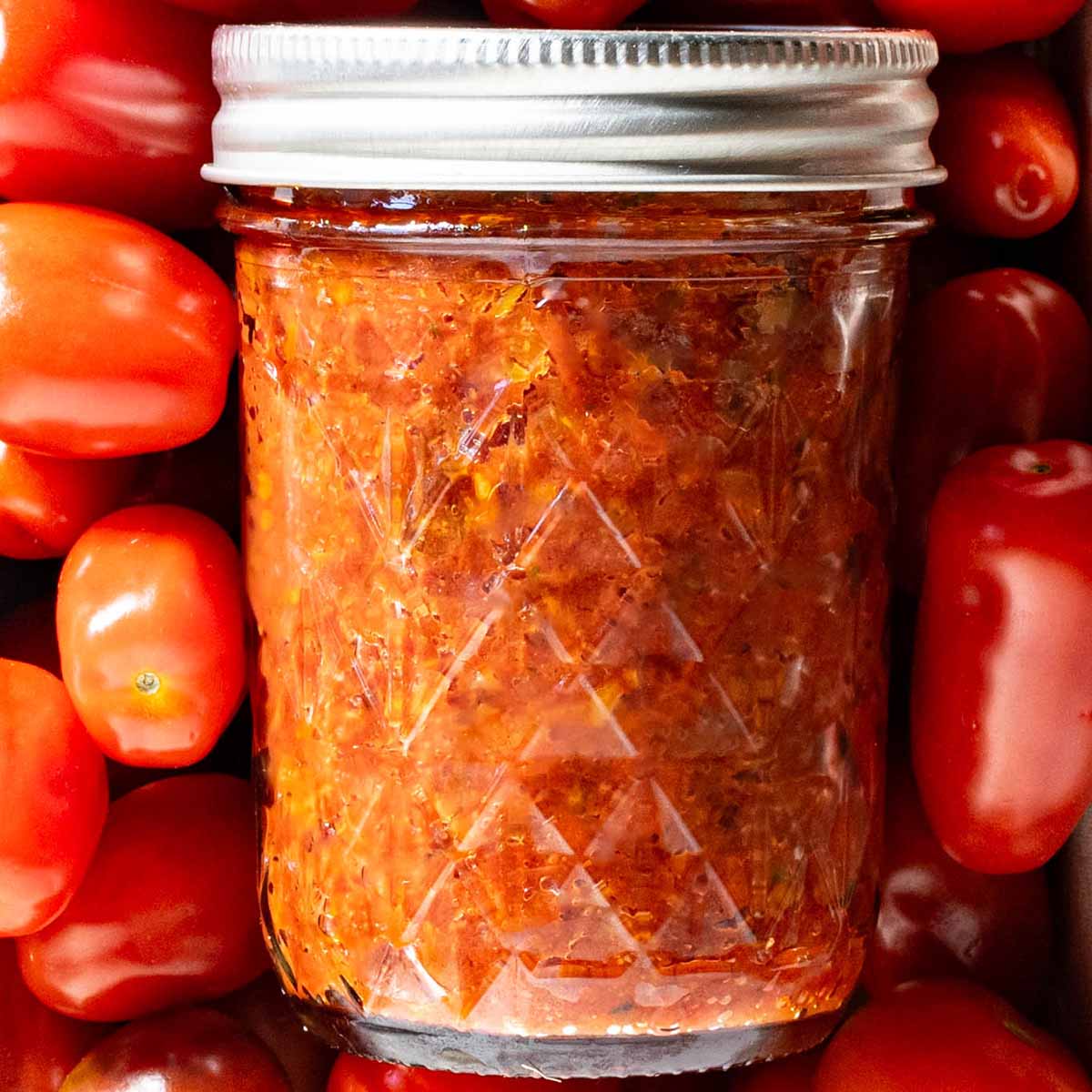
- Canning jars and new lids
Ingredients
- 6 lbs fresh tomatoes paste type preferred, like Roma, San Marzano, or Amish Paste
- 1.5 teaspoon salt
- 2 teaspoon dried Italian herbs do not use fresh
- ½ teaspoon citric acid or ¼ cup bottled lemon juice
Instructions
ROAST TOMATOES
- Preheat the oven to 350℉. Cut tomatoes in half or quarters (depending on their size) and place on a rimmed baking sheet. Sprinkle with salt (optional).
- Roast tomatoes until they start to dry out, about 60-90 minutes, checking on them periodically. Remove from oven and let cool enough to handle.
MAKING THE PIZZA SAUCE
- Add tomatoes and herbs into a blender and puree until smooth - you may need to do this in batches. Taste, adding more salt or herbs as necessary. NOTE FOR CANNING: Penn State Extension says it's ok to adjust the amount of dried herbs in canning recipes (see note for source).
- Return to oven to continue baking for 10 to 40 minutes, until the desired consistency is reached. Meanwhile, get a pot of water boiling and your sterile jars warmed. Make sure the pot is deep enough that jars are submerged with 1-2 inches of water above them while sitting on the canning rack.
CANNING
- Spoon hot pizza sauce into warm, sterilized 4 or 8 ounce jars, leaving ¼" or ½" headspace respectively. Remove air bubbles and wipe rims of jars. Apply canning lids and rings (fingertip-tight).
- Process 4 ounce jars in a boiling water bath for 40 minutes, adjusting for altitude (see note). Make sure the jars are covered by 1-2 inches of water while processing.Process 8 ounce jars for 45 minutes, adjusted for altitude. Turn off heat and let stand for 5 minutes, then remove jars and let cool.
Notes
- Jar size: 4 ounce and 8 ounce (half-pint) jars are used by recipes from Ball and the National Center for Home Food Preservation. Processing times differ based on jar size, since larger jars take longer to heat up.
- Don't use fresh herbs when canning. Use dried herbs and add at the end. Penn State's Extension office says, "The types and amounts of dried spices and herbs may be changed, but do not add extra fresh herbs to recipes."
- Acidity: Make sure to add the exact amount of citric acid or lemon juice stated. Based of Ball's Book of Canning & Preserving for a safe, tested recipe.
Nutrition
Canning questions
If you're new to canning or don't do it enough to feel like an expert - I'm here to help! Let's go over a few things that might not be clear as a beginner.
First, let's talk about using a trusted canning recipe. This recipe is based on the Ball Book of Canning & Preserving recipe for Roasted Tomato Paste. I used that recipe because I like a thick pizza sauce, and the thickness of what you put in the jar can affect the canning processing times.
A thicker sauce takes longer to heat up for safe canning, so it requires longer processing time. Because of this, following a paste recipe is better than a sauce recipe.
The Ball recipe uses the following ingredients, which I have also used in the same ratios:
- 12 lb paste tomatoes
- 1 tablespoon salt (optional)
- 1 teaspoon citric acid or ¼ cup bottled lemon juice
- Process 4 oz jars for 40 minutes, letting sit for 5 minutes at the end (which heat turned off) before removing the jars
Adding other flavors
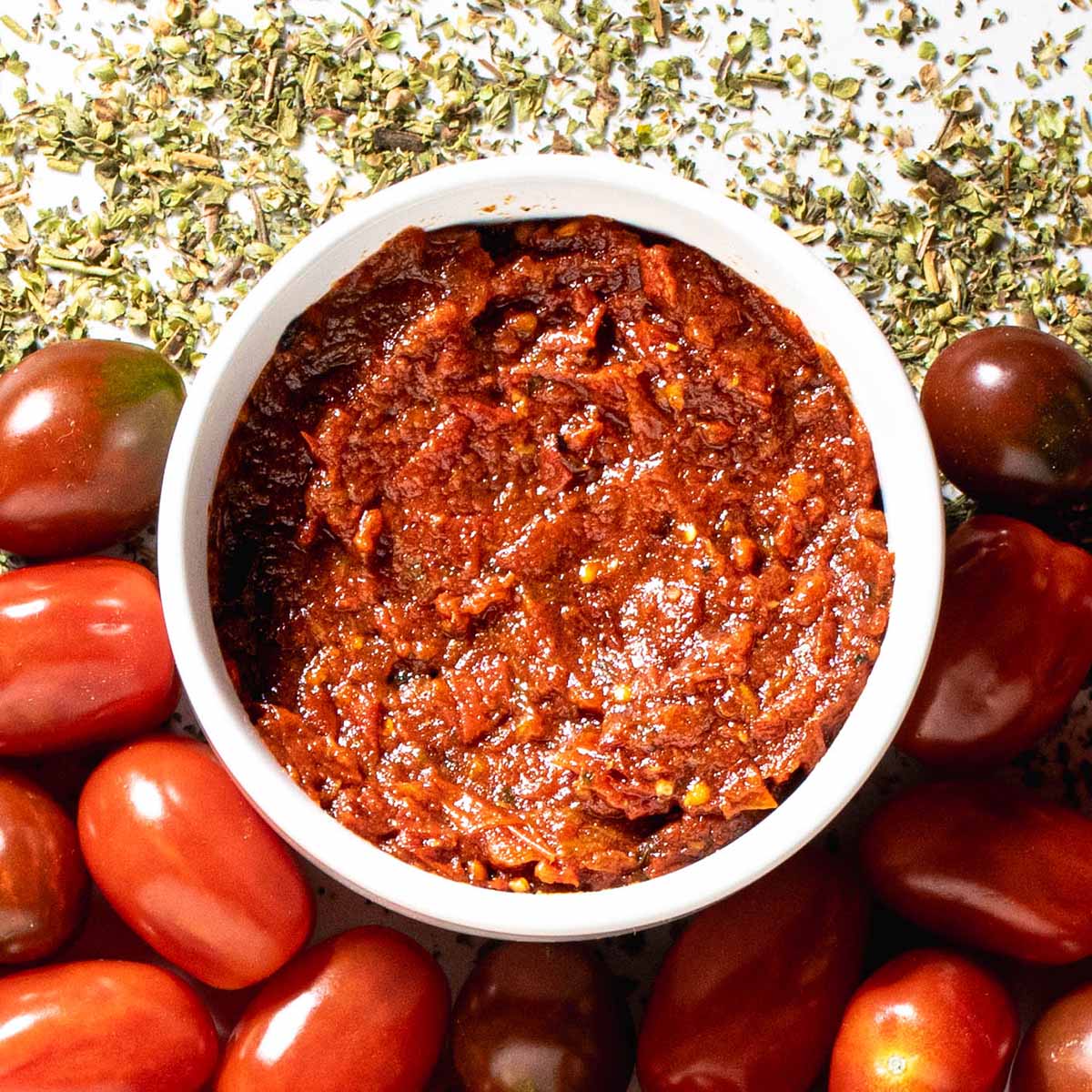
As you probably already know, canning recipes should not be altered outside of a few guidelines from trusted sources. With this recipe, you can adjust the amount and types of dried herbs and the amount of salt.
Use dried herbs (not fresh herbs!). Penn State's Extension office says, "The types and amounts of dried spices and herbs may be changed, but do not add extra fresh herbs to recipes."
Salt is also optional in this recipe, as stated in the Ball book, and a collaborative University publication says that you can "safely reduce or eliminate salt or sugar in tested home-canned tomato recipes."
Unfortunately, you can't add garlic, olive oil, onions or any other vegetable if you are canning this pizza sauce. They can alter the pH and make water-bath canning unsafe.
If you are interested in a tomato sauce recipe with garlic, onions, and fresh herbs, Ball actually has a recipe for that, with jars that are processed for 90 minutes. But to be clear, my recipe is NOT tested (and potentially unsafe) for the addition of any of those extra ingredients when canning.
Removing air bubbles
For a thicker pizza sauce, it can be tricky to remove the air bubbles. Pack the pizza sauce well into the jar and look for air bubbles on the sides, doing what you can to remove them.
What happens if you don't get all of the air bubbles? Someone asked the same question regarding tomato paste on an Extension site supported by the USDA. An expert responded:
"Leaving air bubbles in can affect the head space when they boil up during processing and leave too large a head space that might result in higher incident of spoilage. Much more important when canning things like fruits where air traps between the pieces than in a thick product like tomato paste where the air is mostly cooked out before you put it in the jars." - Nellie Oehler
How to tighten metal bands
Every canning recipe tells you to screw the metal bands on until "fingertip tight." Cool, so what does that mean, exactly?
Nellie Oehler, a food safety specialist at Oregon State University, has a helpful description. She says, "I like to screw on my rings until I feel resistance and then give it a short extra twist. If you tighten it too tight the lids will buckle as the air escapes from the jar. It is normal to have loose rings after you process and the jars cool. They are called self-sealing which means that the metal expands as it heats to allow the air to come out of the jar and then it sort of tightens when it cools but most are a little loose at the end."
The reason you don't tighten them all of the way is that you want air to have a little bit of space to escape as it heats up. When you remove the jars and they cool, there's a slight vacuum inside the jar, helping the lid seal for preservation.
Jars that didn't seal
Sometimes a jar or two won't seal. There can be any number of reasons:
- The rim was dirty so the lid couldn't form a vacuum
- The jar rim has a tiny chip in the glass
- There wasn't enough head space
- The metal bands were screwed on too tight
If the jar didn't seal, there are a few things you can do to save your pizza sauce - choose one of them.
- Fridge: you can put it in the fridge and use it within a week or two, before it spoils. It will grow mold after a while, ask me how I know 😉
- Freezer: you can freeze it right in the canning jars, then thaw overnight before using it
- Re-process for canning: you can repeat the canning process within 24 hours. As University of Nebraska says, "If a jar does not seal but has been correctly processed according to safe processing methods, it can be re-canned if identified within 24-hours."
The University of Minnesota also has more information on dealing with jars that didn't seal and the possible causes.
Jar sizes
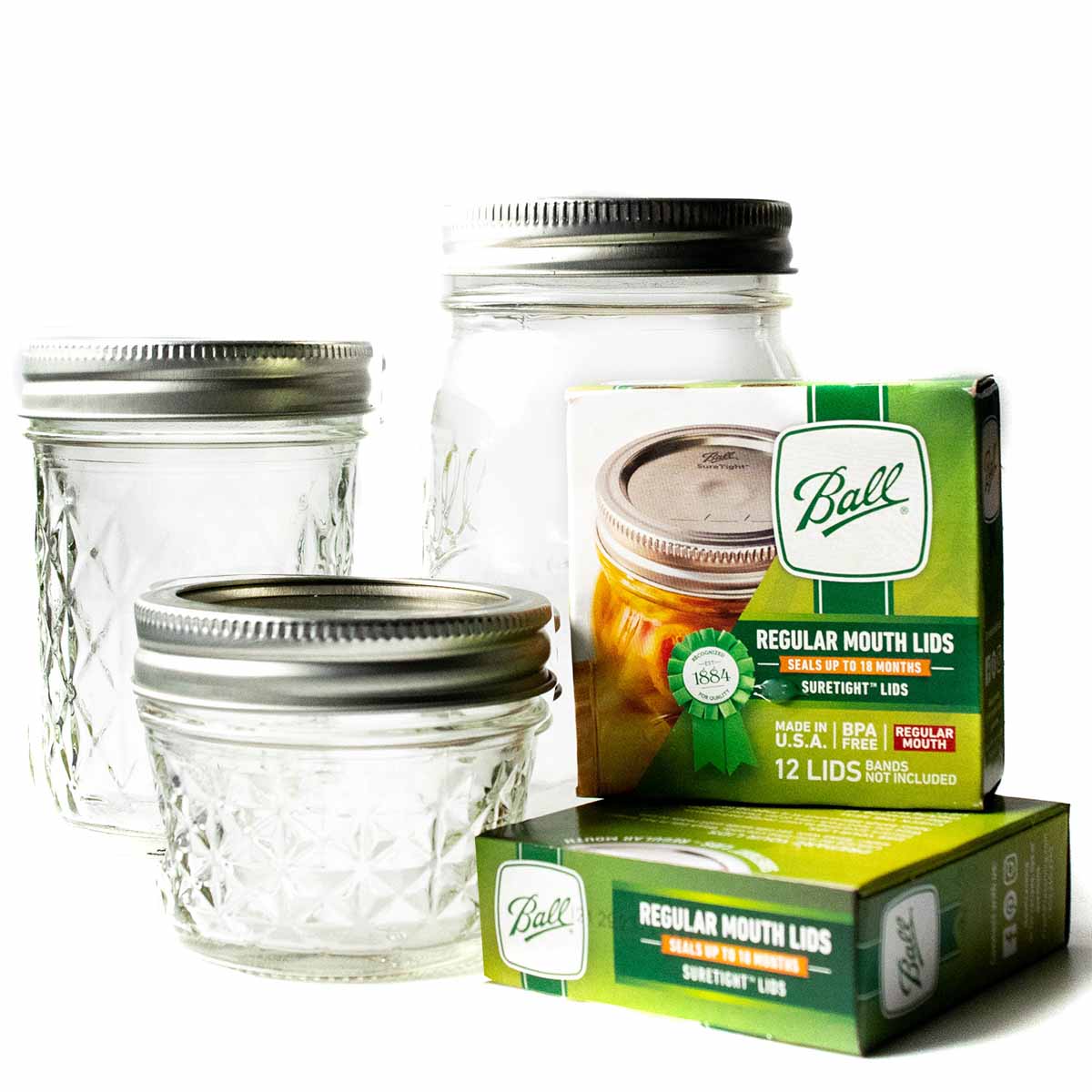
Stick to 4 or 8 ounce jars for canning this recipe, as those are the two jar sizes listed for safely canning a tomato sauce this thick.
Recipes from official sources list acceptable jar sizes. Don't choose a larger size than stated because it might lead to unsafe canning. Larger jars take longer to heat up, so a larger jar might not have been processed long enough to safely kill the bacteria and molds.
This recipe is based on the Ball Book of Canning & Preserving recipe for roasted tomato paste (page 206) and the National Center for Home Food Preservation recipe for tomato paste.
I chose tomato paste recipes because I wanted a thick pizza sauce and these recipes are designed for safely canning a thicker sauce. The Ball recipe uses 4 ounce jars and the Home Food Preservation recipe uses half-pint jars.
Furthermore, the Ball website suggests 8 ounce (half-pint) jars for pizza sauce, specifically.
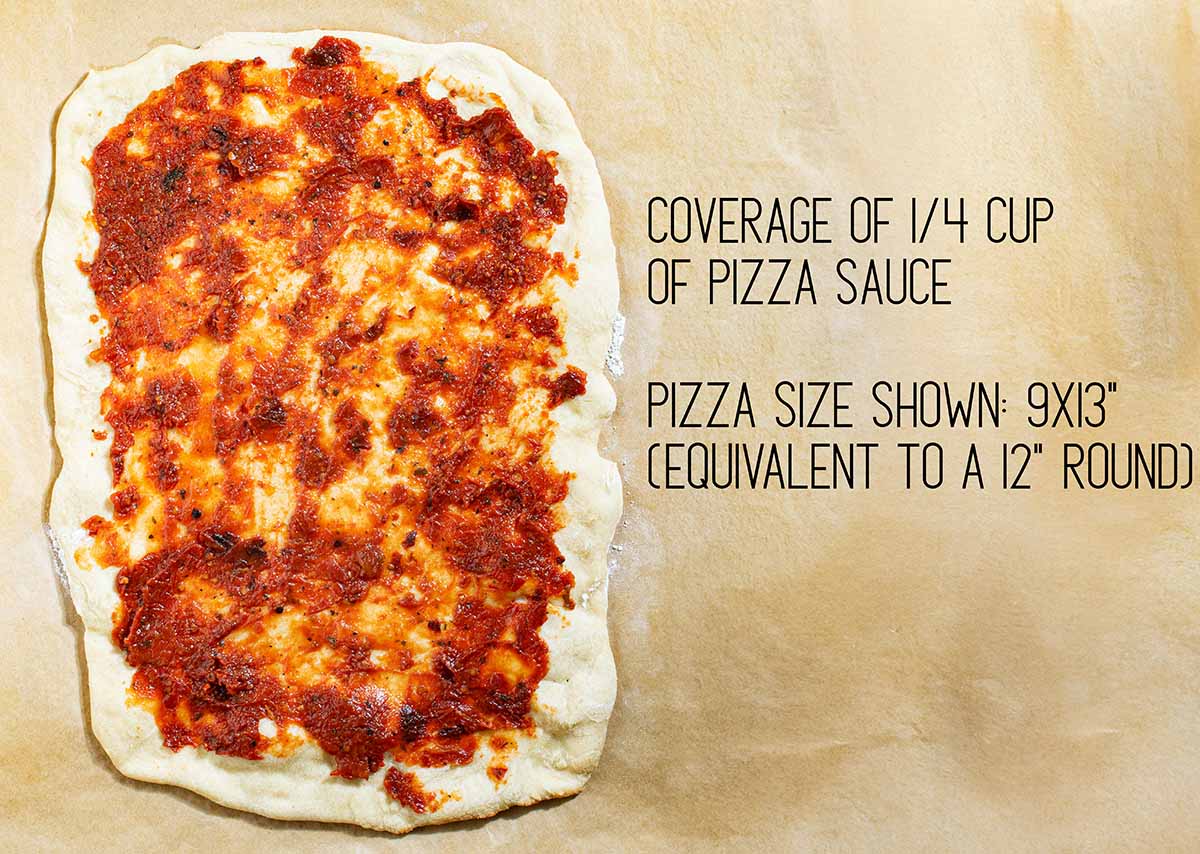
Servings per jar
I've shown what a ¼ cup of sauce looks like in the photo above, so you can decide if you'd like more than that or not. If you use a half-cup per pizza, here are your serving sizes:
- Half-pint jar (8 oz): enough for 2 pizzas
- Jelly jar (4 oz): enough for 1 pizza
A pound of paste tomatoes turns into about ½ a cup of sauce, which I detail more in the next section.

Using up your garden tomatoes
One of the things I like best about using my surplus of tomatoes for making pizza sauce - the (relatively) low effort. You don't need to peel them, run them through a food mill, or monitor them on the stovetop. Just cut, roast, and puree.
How many tomatoes
You can make this pizza sauce with whatever garden tomatoes you have around. Sometimes you can't scale canning recipes too big because they might not cook or heat the same as a smaller batch. But since the tomatoes are roasted, you can make as many as will fit on your baking trays and in your oven.
Each pound of paste tomatoes makes about ½ of a cup of sauce, which is enough for a 12" pizza, and will fit into a 4-ounce canning jar. Ball Book of Canning recipe for tomato pasta uses 12 pounds of tomatoes, which I scaled down as a starting point for this recipe.
| Tomatoes | Cups of sauce | Number of pizzas |
|---|---|---|
| 1 pound | 0.5 cups | 1 |
| 3 pounds | 1.5 cups | 3 |
| 6 pounds | 3 cups | 6 |
| 10 pounds | 5 cups | 10 |
| 12 pounds | 6 cups | 12 |
Types of tomatoes
As you're probably already guessed, paste tomato varieties are best for making sauces. Their meaty flesh dries out faster and provides a better ratio of flesh to skin and seeds.
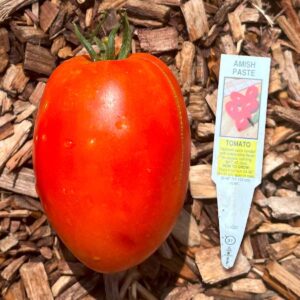
Many of the popular paste tomato varieties, including San Marzano and Amish Paste, are indeterminate plants. This means they'll produce all season long instead of all at once. If you don't have enough tomatoes, throw them in the freezer, whole, in an airtight container.
The freezer alters the texture (which doesn't matter in this case), and it also releases more water (not a problem either!). Just thaw overnight before roasting.

However, if you're hoping to be able to use up some other garden tomatoes to make a big batch of this pizza sauce, you have my permission. Here are a few things to consider:
- Cut small tomatoes in half so the water can evaporate (it will take much longer if left whole)
- Cut larger tomatoes into smaller chunks to help them dry out faster
- Keep each type of tomato together on the baking tray (rather than mixing them all up). If some cook faster than others, this helps you remove them in batches if needed.
Another reason you might be happy using some of your other garden tomatoes is the flavor. Paste tomatoes are typically less flavorful than many other varieties. By adding in some of your favorite flavorful tomatoes, you'll improve the flavor (you'll just likely be roasting them longer).
Leave the skin on
In a fresh tomato sauce for pasta, the peels can be noticeable which is why a lot of recipes use a food mill or sieve. I can assure you that's not the case for a pizza sauce like this.
Once the pizza sauce is spread onto a pizza, with all of the other toppings, you won't notice the peels at all. They blend right into the texture of the sauce. It also tastes better, since the peels typically have a higher concentration of flavor compounds and nutrients than the flesh.
No need to remove seeds
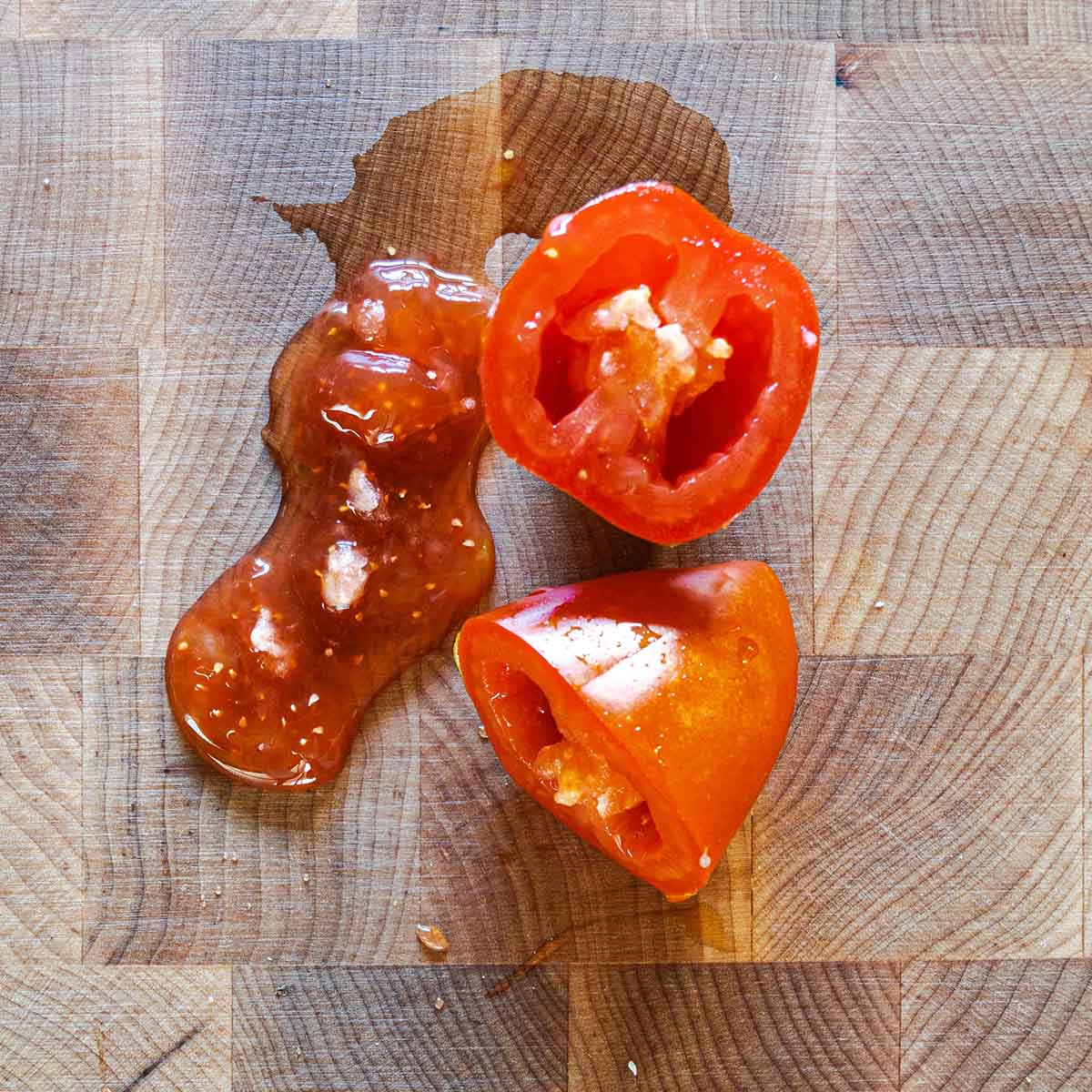
Paste tomatoes don't have a lot of seeds compared to other varieties - another reason gardeners grow them for sauce. For the seeds they do have, they are soft and unnoticeable after roasting.
If you're using larger tomatoes that have more seeds, I've found that those also blend into the texture. That many seeds aren't great in some dishes (I've definitely made a pureed marinara sauce that was really seedy!), but pizza is definitely exempt.
Another reason to leave the seeds in is that they also add a savory, umami character to the pizza sauce. Tomato seeds contain about 10x more glutamic acid (an umami compound) than the flesh.
Should I squeeze out extra water from the tomatoes?
Some recipes suggest squeezing the jelly-like juices from paste tomatoes before making a sauce, likely so they cook down faster. However, they roast fast enough that squeezing out the juices probably takes as much time as you'd save during roasting.
That jelly like substance also happens to contain a good amount of flavor. In paste tomatoes, there's so little extra moisture that it's not necessary to remove it. The water evaporates, leaving behind a bunch of the tasty flavor molecules.
Making the pizza sauce
You have probably noticed that a tomato from your garden tastes different when eaten raw versus cooked. I've found that simmering tomatoes into a sauce on the stovetop makes them taste more acidic, while roasting brings out a richer, caramelized flavor.
That's why I like roasting the tomatoes based on the Ball's roasted tomato paste recipe over the National Center for Home Food Preservation's tomato paste recipe simmered on the stovetop. Roasting also dries them out twice as fast as simmering in a pot.
Paste tomatoes will cook down enough in about an hour and a half in a 350°F oven. But it's worth checking on them after about 45 minutes in case your oven cooks hotter, your tomatoes are dryer to begin with, or you cut them smaller than I did.
Here's some photos of how I roasted a mix of San Marzano and Martino's Roma tomatoes.
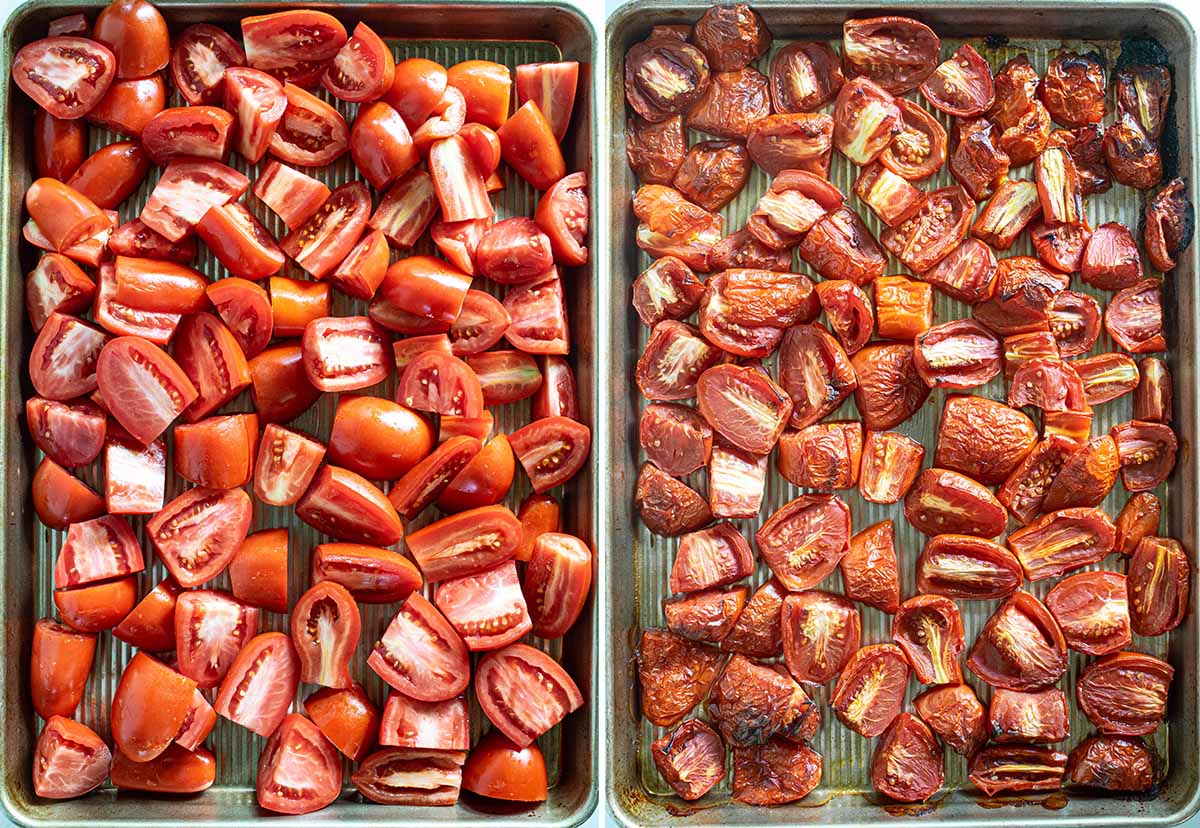
I cut the tomatoes in halves or quarters, depending on the size, pictured above, left. On the right is how they looked after roasting. You can see they are drying out, but some moisture still remains.
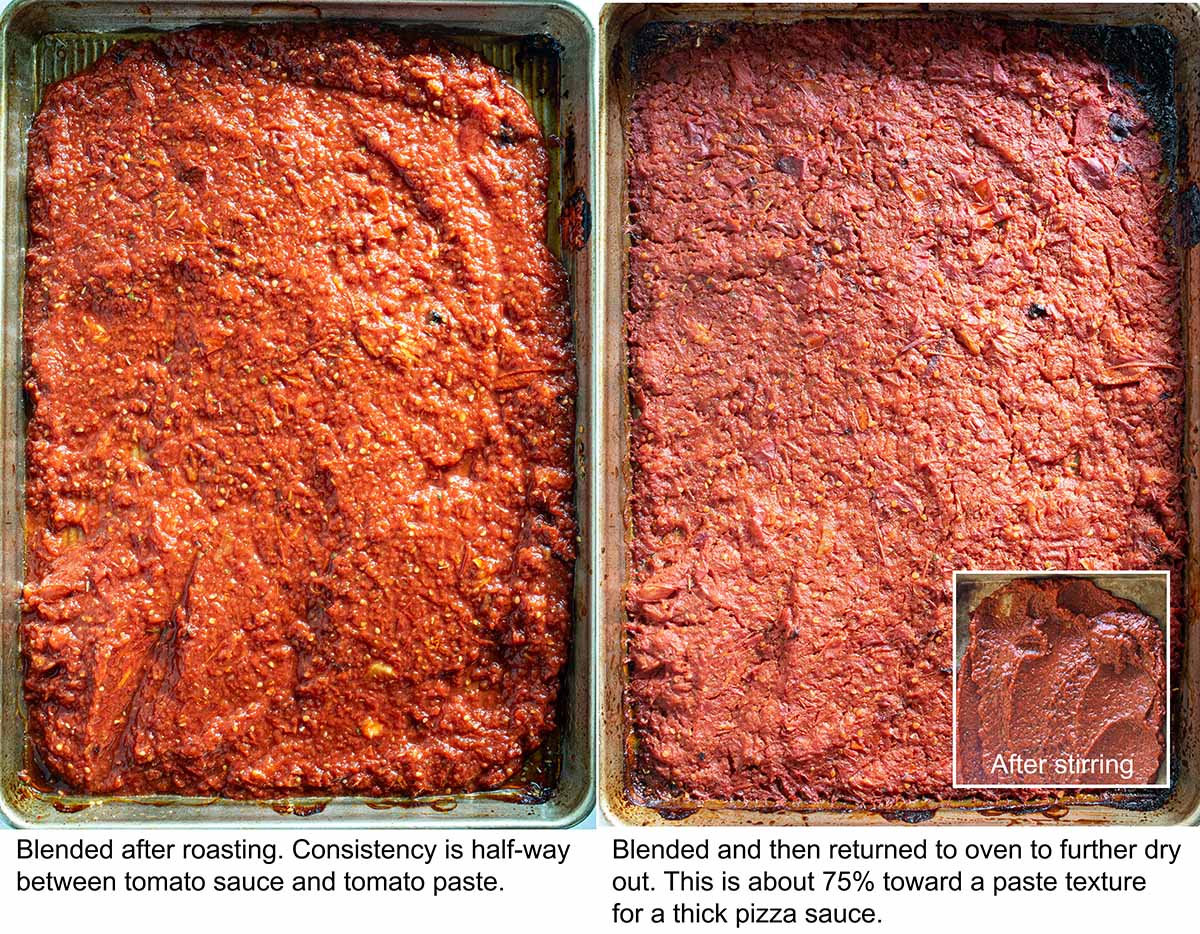
I took the tray of roasted tomatoes from that picture and blended them up, as shown above. The texture is perfect for some of you, half way between a sauce and a paste. In that case, stop here - you're done.
However, I like the thicker sauce, which is just a personal preference. One reason I make homemade pizza sauce is to be able to get a nice, concentrated tomato flavor on my pizzas. A thick sauce adds more flavor without creating a soggy crust.

To make the sauce thicker, I took that tray of blended tomatoes and put it back in the oven to dry out some more. This was also in Ball's tomato paste recipe and it worked like a charm. It looks really dry coming right out of the oven, but there is a fair amount of moisture beneath the surface. You can see the real consistency after stirring it in the photo above.
Canning vs freezing
Pizza sauce is easy to can, but it also freezes well. When I have a large batch and don't want to process the jars for canning, I make a batch for freezing, adding garlic and fresh herbs too. I also live in the Midwest so I have a freezer in the basement (I think it's a requirement to live here, ha!). And I get that not everyone has that option and modern freezer spaces are tiny.
Let's compare freezing vs canning pizza sauce:
- Canning gives you shelf-stable jars that you can store in your pantry and pop open when you feel like making pizza (as opposed to thawing a frozen jar and planning ahead). You can also give them to friends and family without worrying about transport (or their freezer space).
- Freezing allows you to add any flavors you want, like roasting garlic and onions alongside the tomatoes. You can also use fresh herbs (a huge plus if you're growing them in your garden). The flavor is also slightly better because it isn't subjected to the extra heat from boiling in the water bath canner.
The recipe on this page is suitable for canning or freezing. However, if you plan to freeze your pizza sauce, I have a very similar recipe that roasts fresh tomatoes along with garlic and fresh herbs.


More recipes & resources
In case you're interested in other pizza sauce recipes to use up your tomatoes, I found a couple other options for canning:
- Pizza sauce with onions & garlic, a Ball Blue Book tomato sauce adaptation from Oregon Cottage for canning: "the adaptations do not involve ratios of fresh ingredients, only the cooking/straining method and the addition of dry spices, keeping it safe to can."
- Pizza sauce on the stovetop, for canning, by Ball Mason Jars
And here are some if you plan to use it right away or freeze it (not safe for canning).
- Quick & easy: toss fresh tomatoes, herbs, and a can of tomato paste in a blender and puree until smooth. That's it! This will also preserve the fresh tomato flavor, so it's a win-win. Recipe from Kitchen Treaty.
- On the stovetop: puree tomatoes in a blender, then cook on the stovetop for about 20 minutes (be careful of splatter as it thickens). From Swathi's Recipes.
- Chunky pizza sauce on the stovetop cooks the tomatoes down without pureeing them. Recipe from Inspired Taste.
If you're making a large batch and want ideas on using up that pizza sauce (besides pizza!), try some of these recipe ideas:
- 25 recipes that start with pizza sauce, by Taste of Home
- 22 ways to use up pizza sauce, by Crust Kingdom
- Pizza baked pasta by Rachel Cooks
- Chicken parmigiana by A Simple Palate
- Meatball sub sandwich by Modern Proper
Looking for other ways to use up your garden tomatoes?
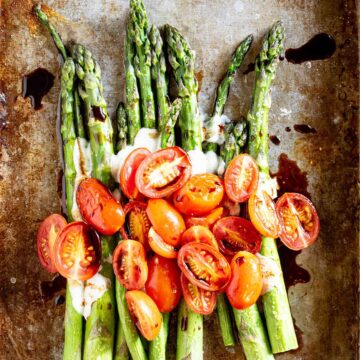

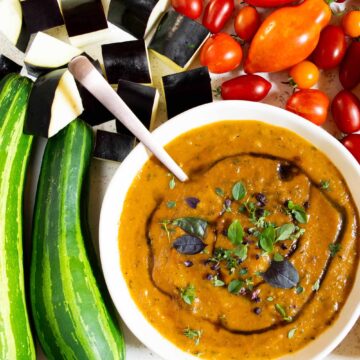
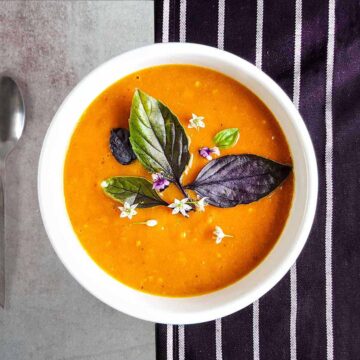
If you're wondering what else is currently in season, check out my calendars to see what produce is in season each month (and coming up soon).

Leave a Reply