I used to grow herbs year-round when I lived in the Bay Area (California). Then I moved back to the Midwest and had to start growing herbs indoors if I wanted to enjoy them in the winter too.
In order to successfully grow them inside, I took a full semester plant biology class at UCLA where I focused my course project on grow lights. Yep, I'm a bit of a geek.
And that benefits you.
I don't just repeat manufacturers claims for the best grow lights, I've actually measured them myself to find the best setups specifically for each type of herb indoors.
Jump to:
- How much light do herbs need?
- What matters when buying a grow light for herbs
- How to position herbs under grow lights
- About my grow light recommendations
- Cheapest way to light a single herb plant
- Highest output bulb for a bunch of herbs: Sansi 30-watt
- Best bulb for a room you spend time in: Soltech Vita
- Best all-in-one grow light: Glowrium 48 watt lamp
- Best grow light for a large herb collection
- Best grow light for shelves: Glowrium G6 strip lights
- Do herbs in a window still need grow lights?
- More growing guides
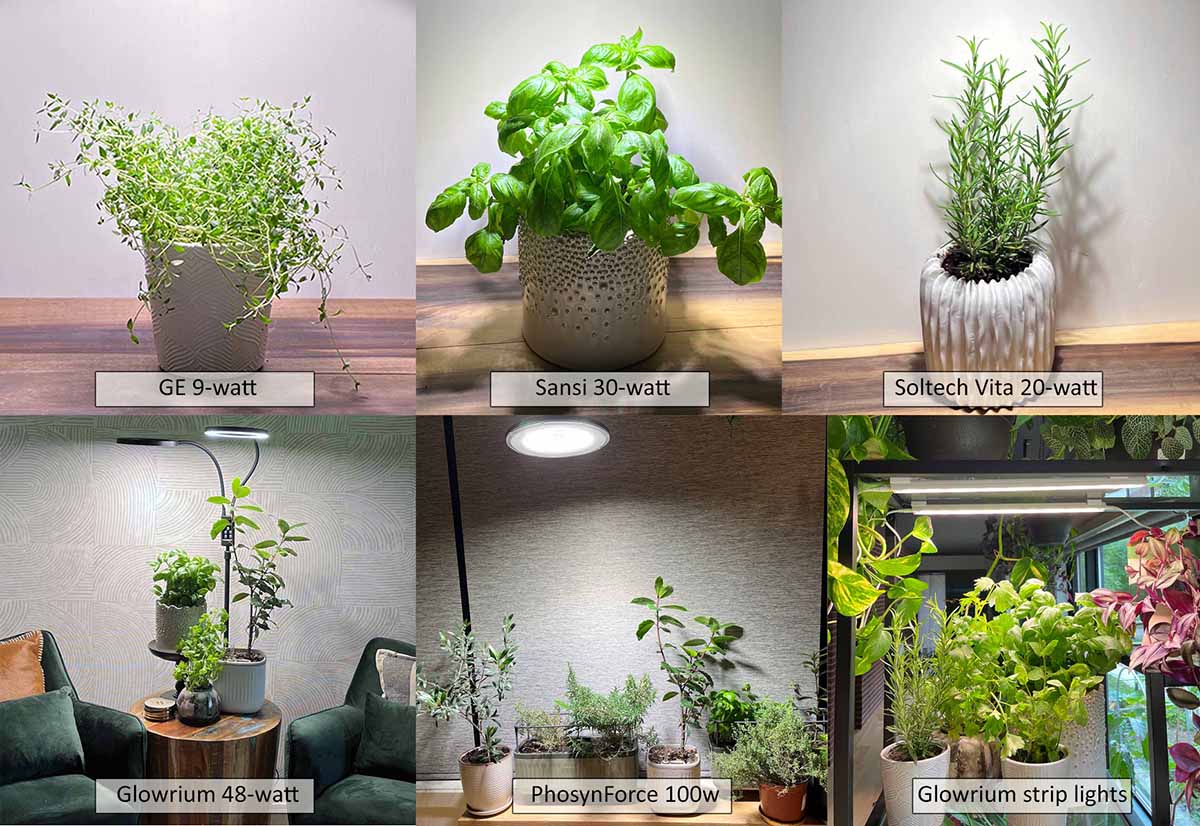
| Light | Why choose it |
|---|---|
| GE 9-watt | Cheapest way to light a single herb |
| Sansi 30-watt | High output bulb for several herbs |
| Soltech Vita 20-watt | For a room you spend time in |
| Glowrium G5 Lamp | A convenient all-in-one option with no accessories needed |
| PhosynForce 100-watt hanging fixture | For a large herb collection or you grow a lot of seedlings |
| Glowrium strip lights | To turn a shelf into an indoor herb garden |
For each of these grow lights, I'll tell you:
- How high to position it above the herbs (and why that matters more than you might think)
- How many herbs it can realistically cover
- Where to place basil and other high-light herbs
- How long to run each light
- What it costs to operate
- My own personal commentary
- Supporting equipment (when necessary) with specific requirements
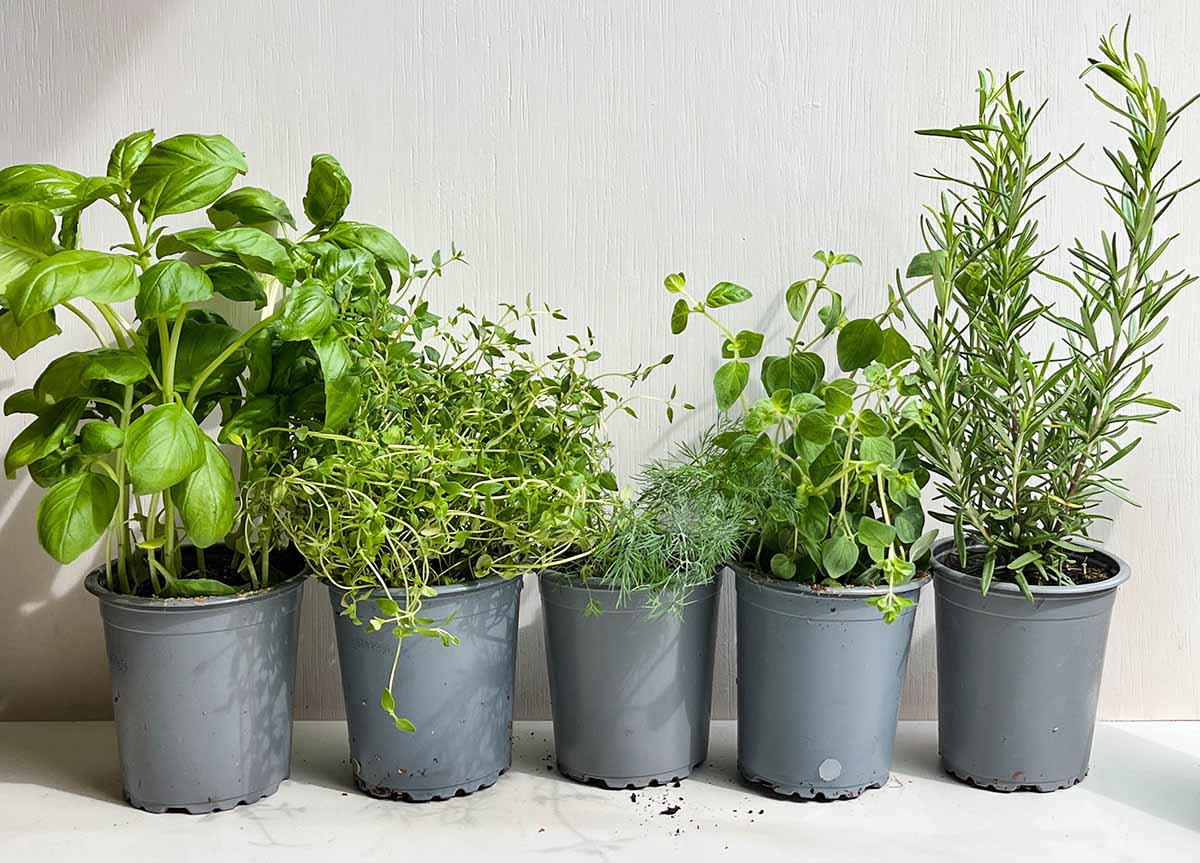
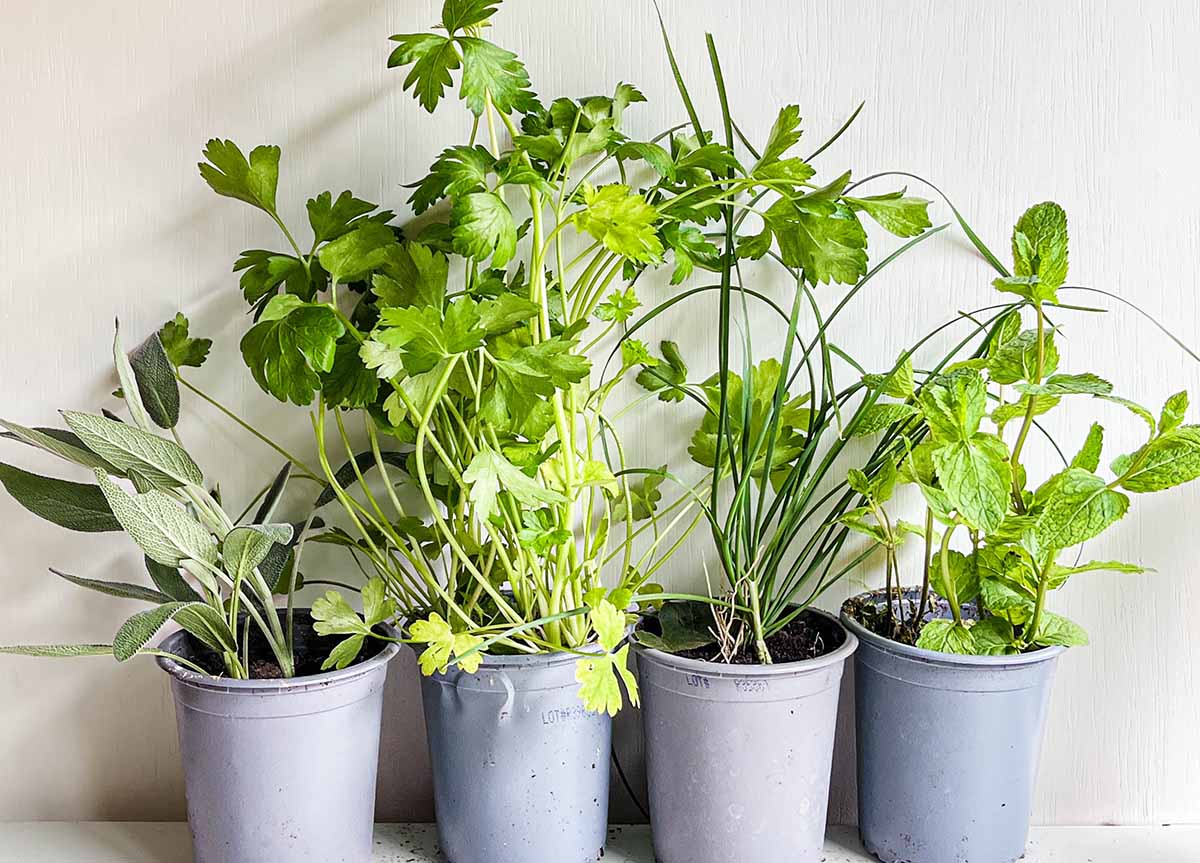
How much light do herbs need?
Most herbs need about 6-8 hours of direct sunlight a day. So what does that mean indoors?
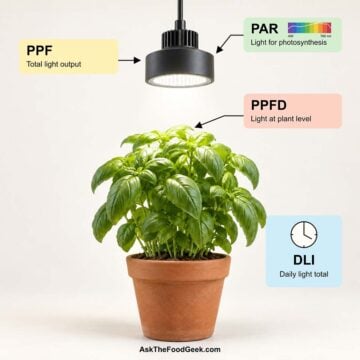
There's a measurement to help us with this: DLI. It stands for Daily Light Integral, which is just the total amount of light a plant receives in a day. 6-8 hours of direct sunlight translates into roughly a DLI of about 14-20.
That's the recommendation for them to thrive. That's what greenhouse growers target for maximum production. But in my own house, my herbs still do pretty well with about half of the ideal amount (7-10 DLI).
You can think of DLI like calories. For peak performance, let's say I need 2,000 calories a day. I can still function on 1,600, but I will be a little tired, slower, and probably have a little brain fog. But I won't feel too terrible unless I cut daily calories down to 1,000, let's say (I've never done that).
Plants are the same. Your indoor herbs will absolutely thrive if you give them 14-20 DLI, still do well around 7-10, but really struggle below that.
These targets are all based on experiments for greenhouse growers.
To illustrate the difference a grow light can make, one experiment grew basil with different amounts of light, spanning from 5 DLI up to 18. The amount of mint (by weight) tripled when given the most light.
When it comes to grow lights, you can increase the DLI several ways:
- Buy a higher quality light (that's better tuned to wavelengths the plant prefers)
- Buy a stronger light (more watts equals more light, assuming all other things equal)
- Leave the light on longer (but not more than 16 hours, as herbs need darkness to regulate)
What does this mean for herbs under my grow lights?
If you're wondering what this means for growing herbs under grow lights, don't worry, I've got you covered.
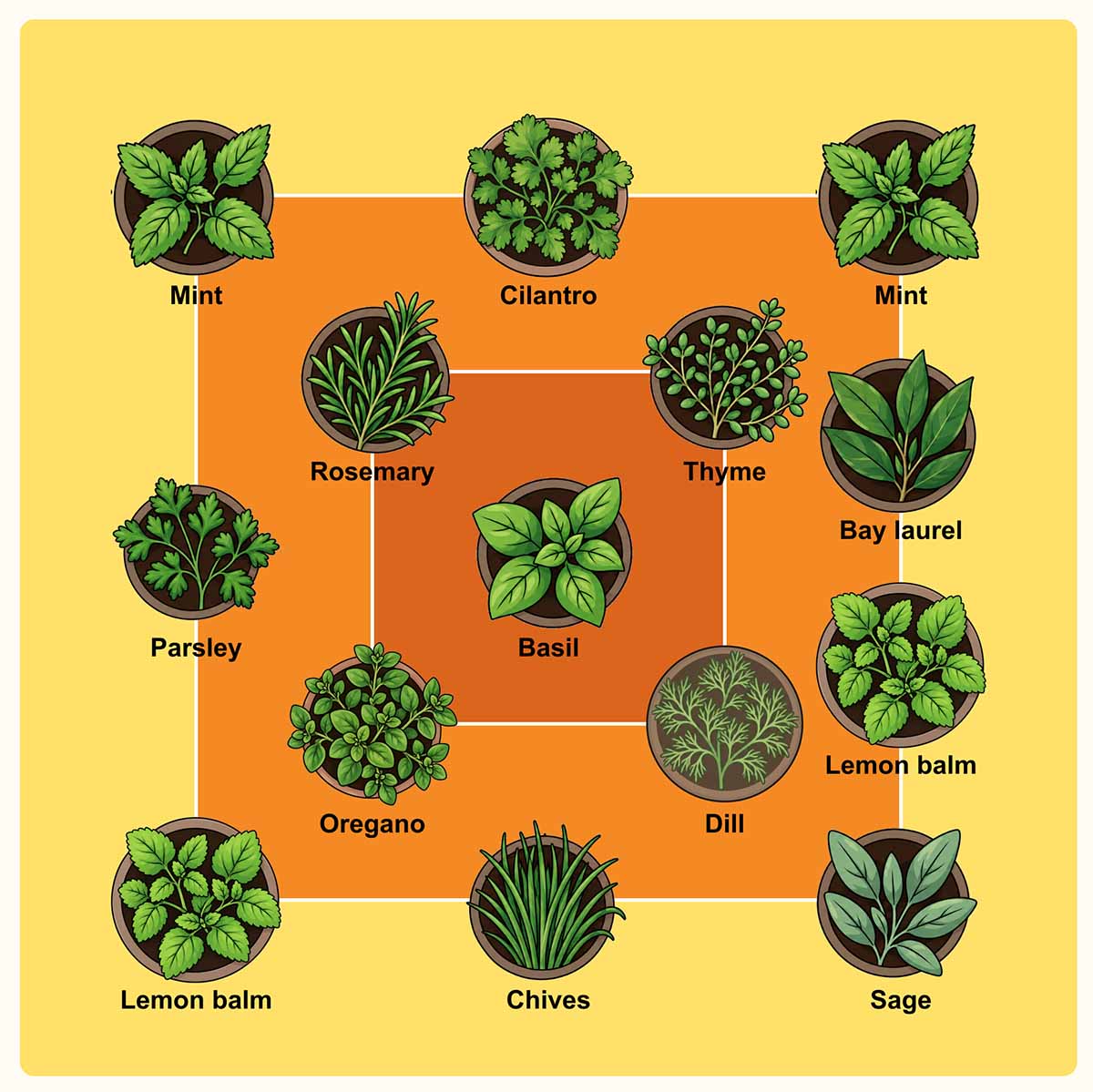
I put together a chart that tells you which herbs should get top priority and placement under the grow lights. The light is significantly more intense directly under the center, and noticeably faded toward the edges.
| Herb | Light priority indoors | Placement under light |
|---|---|---|
| Basil | Highest | Directly beneath center |
| Rosemary | Highest | Center or near-center |
| Thyme | Highest | Center or near-center |
| Oregano | Very high | Center or near-center |
| Dill | Very high | Center or near-center |
| Sage | Moderate-high | Center and outer positions okay |
| Cilantro | Moderate-high | Center and outer positions okay |
| Parsley | Moderate-high | Center and outer positions okay |
| Chives | Moderate-high | Center and outer positions okay |
| Bay Laurel | Moderate-high | Center and outer positions okay |
| Mint | Lower priority | Center and outer positions okay |
| Lemon Balm | Lower priority | Center and outer positions okay |
Specific light requirements for herbs isn't well studied in a way that translates to in-home growing conditions. However this study by Christopher Currey and Alexander Litvin from Iowa State and Grow With Hydroponics are pretty helpful.
They explain how some herbs, like parsley, mint, and sage, are more tolerant of lower light conditions than basil, thyme and oregano (for example). Mint and lemon balm are routinely cited as very low-light-tolerant.
What matters when buying a grow light for herbs
There are a handful of things to consider when evaluating grow lights:
- Bulb design
- Brightness
- Area of coverage (and distance from the plant)
This is a very simple overview, but you can read my full guide on how grow lights work if you're interested.
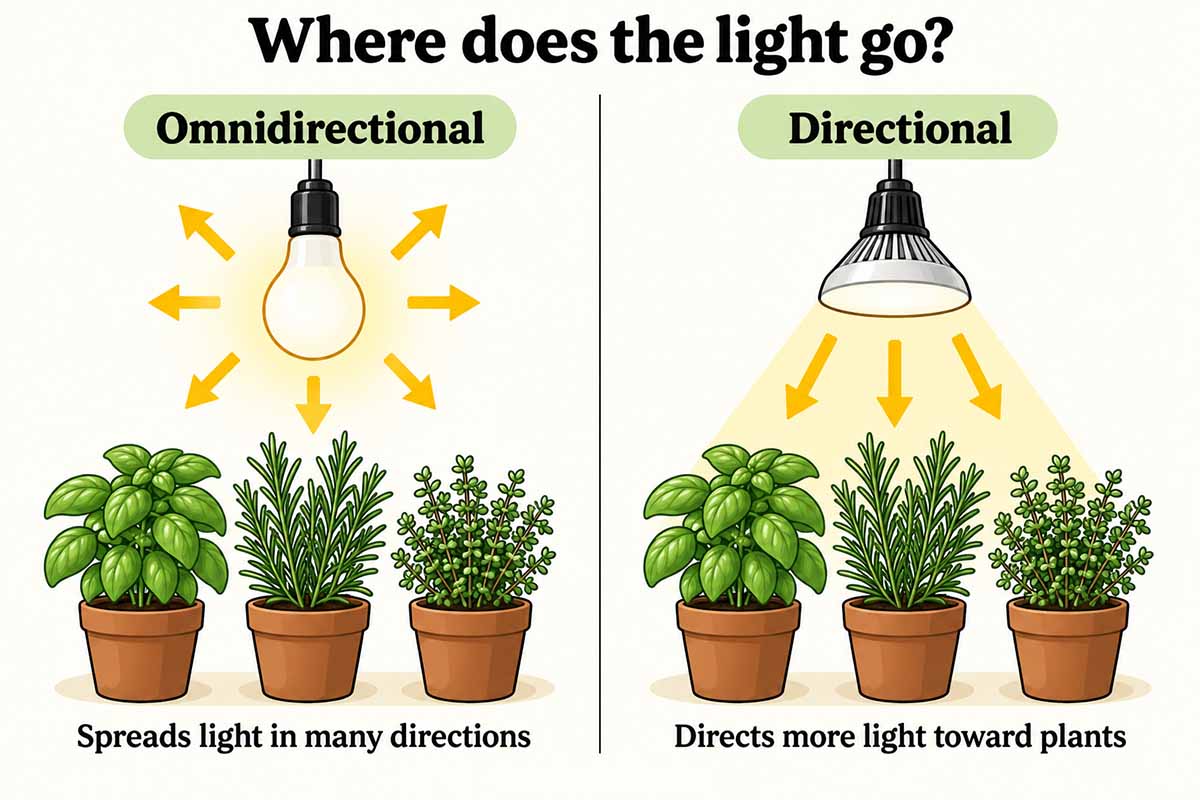
Bulb design
Grow lights are made differently than regular bulbs we put in a house lamp.
- Grow light bulbs shine light in a single direction, which sends more light at your herbs for the same energy use
- Grow lights are tuned to emit more wavelengths that plants prefer for photosynthesis (which cost more than the regular LED diodes)
When shopping for grow lights, top brands all use a good mix of wavelengths, so you can ignore that. But for bulbs, make sure they fit in your fixture (since some have a wider flood light shape).
There are some omnidirectional grow lights that are shaped exactly like a regular bulb and can work when placed in a small reflective lamp shade (like in a task lamp) that mostly redirects the light in a single direction.
Brightness
Grow lights have varying levels of max brightness (just like regular bulbs).
While this is tied to watts, it's also dependent on the quality of light plants use for photosynthesis (the wavelengths). So it's possible to have a 30-watt bulb outperform a 48-watt bulb, for example.
Grow lights are extremely bright, by design. If you're using it in a living space, they can be uncomfortable to look at. In that case, consider getting a dimmable bulb.
You can dim it when you're in the room (like watching TV), but not for the entire duration it's on (like in your office while working). You need max brightness to get the full benefit from the grow light.
I note which grow lights are dimmable in my recommendations below.
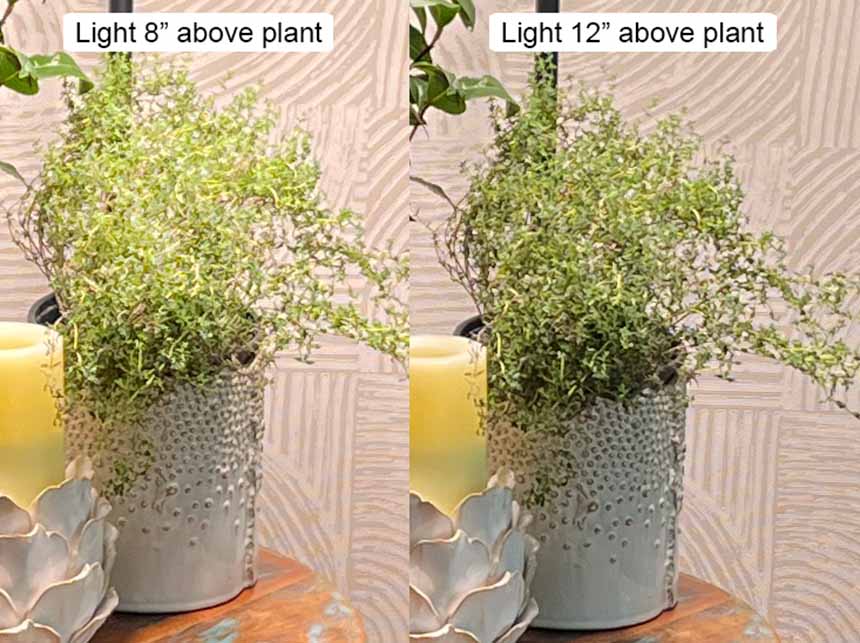
Why distance matters
The closer a grow light is to the plant, the more light the plant receives.
But you can't just pick any distance. Putting a grow light too close can do the following:
- Burn or dry out the leaves
- Limit the area of coverage (the center spot directly under a fixture gets the most intense light, which fades quicker toward the edges the closer the fixture is moved)
The trick is to find the sweet spot between placing the light as far above the herbs as possible for maximum coverage, and keeping it close enough to maximize the light intensity.
I've already done all of that work for you and suggest the best height and coverage area for each grow light recommendation.
Each light has a different setup, which ends up tracking closely with how powerful the light fixture is.
How to position herbs under grow lights
Most of us growing herbs indoors are growing several varieties. We can use this to our advantage when positioning them under a grow light.
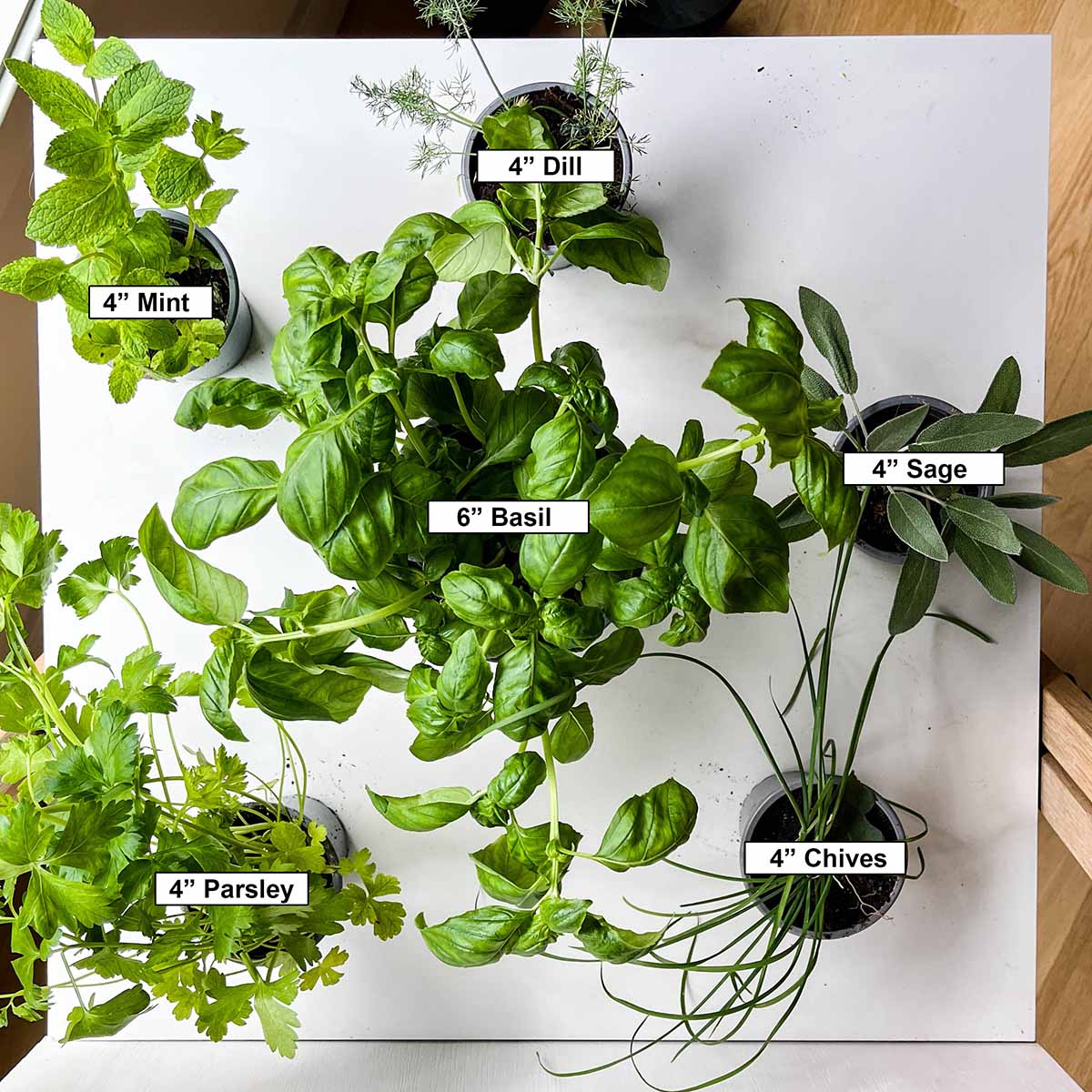
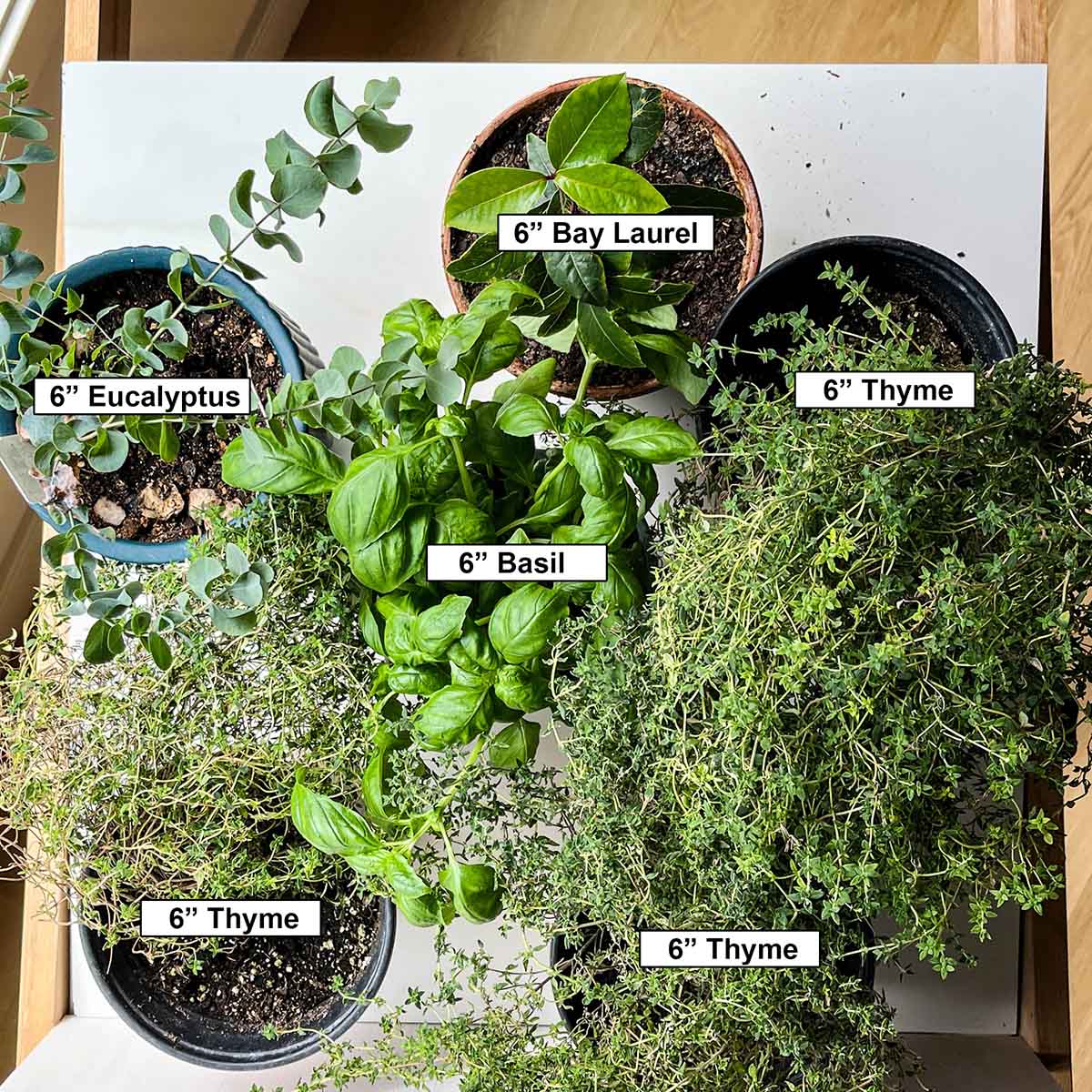
Recall that the center spot directly under a light is the brightest spot. You want to put your most sun-loving plants in the center (like basil), with the ones that can tolerate lower light arranged on the outside.
- 4 inch pots (slightly larger than a soup can): easily fit 1-3 in the center, and 5-6 on the outside
- 6 inch pots: can get crowded even in a 2-foot circle with bushy herbs like basil, thyme, parsley, and cilantro. Mix with herbs that are easier to control size and width, like rosemary, bay laurel, sage, and mint.
Some grow lights work well for a single herb plant, while others are able to support a larger group clustered together. I suggest the best arrangements for each grow light setup below.
About my grow light recommendations
I started this project at UCLA to measure grow lights. I recently dug up those numbers to write this grow light recommendation guide.
Soltech provided lights for that project at no cost as long as I returned them when finished. The rest of the lights I had purchased from Amazon on my own.
I also bought new lights, since LED technology is changing fast. Glowrium is an up-and-coming popular choice and they provided lights for me at no cost in exchange to be included in this guide.
I maintained full editorial independence and they did not get draft or final language approval.
The links I provide are affiliate links, so I do get small commission if you buy something.

Cheapest way to light a single herb plant
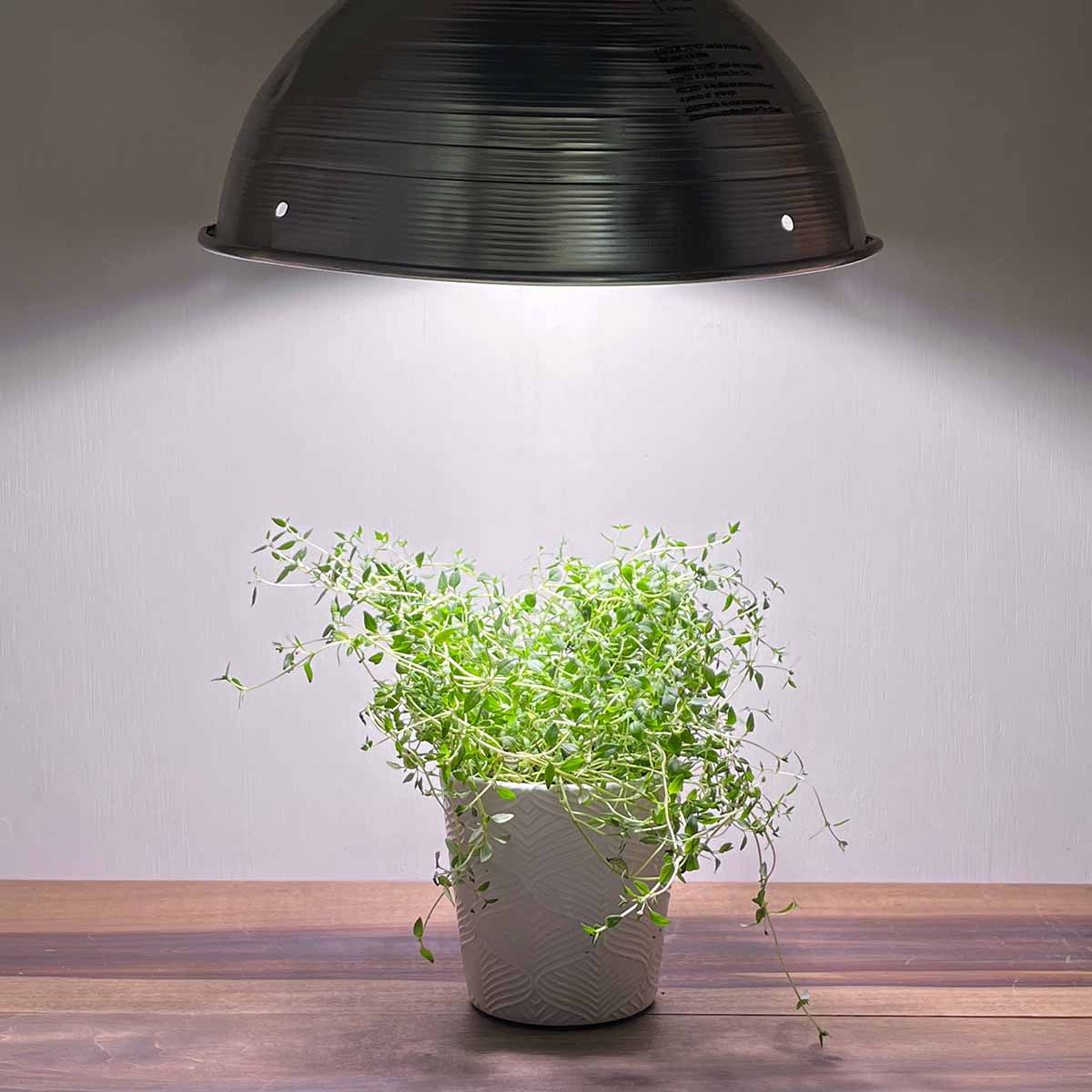
The GE 9-watt grow light bulb is a good quality for the price, but it's really only going to help a single herb plant on a desk or countertop. That said, it is bright enough for any type of herb, even sun-loving basil, thyme, and rosemary.
Suggested setup:
- Distance: 6" above the top of the herb plant
- Duration: 16 hours per day
- Measured performance: 18 DLI at center, 1.8 DLI in outer circle
- Arrangement: a single 6" herb pot, or three small 3" pots centered under the light. Mint and lemon balm can be on the edges.
- Energy cost: $0.80 per month and $10 per year (assuming $0.18 per KwH)
- Dimmable: no
- Color temperature: very cool, but with an odd blue and red tint
My hands-on opinion:
The price is pretty competitive while also coming from a trusted brand. It works well in a task lamp that you can raise up as the herb grows. It's also not so bright that it won't blind you when sitting in your office or cooking in the kitchen.
The major downside is that it's only good for a single herb. Once you move off center (even just by 6 inches), the light intensity drops to only 15%, which is similar to about 45 minutes of outdoor sun.
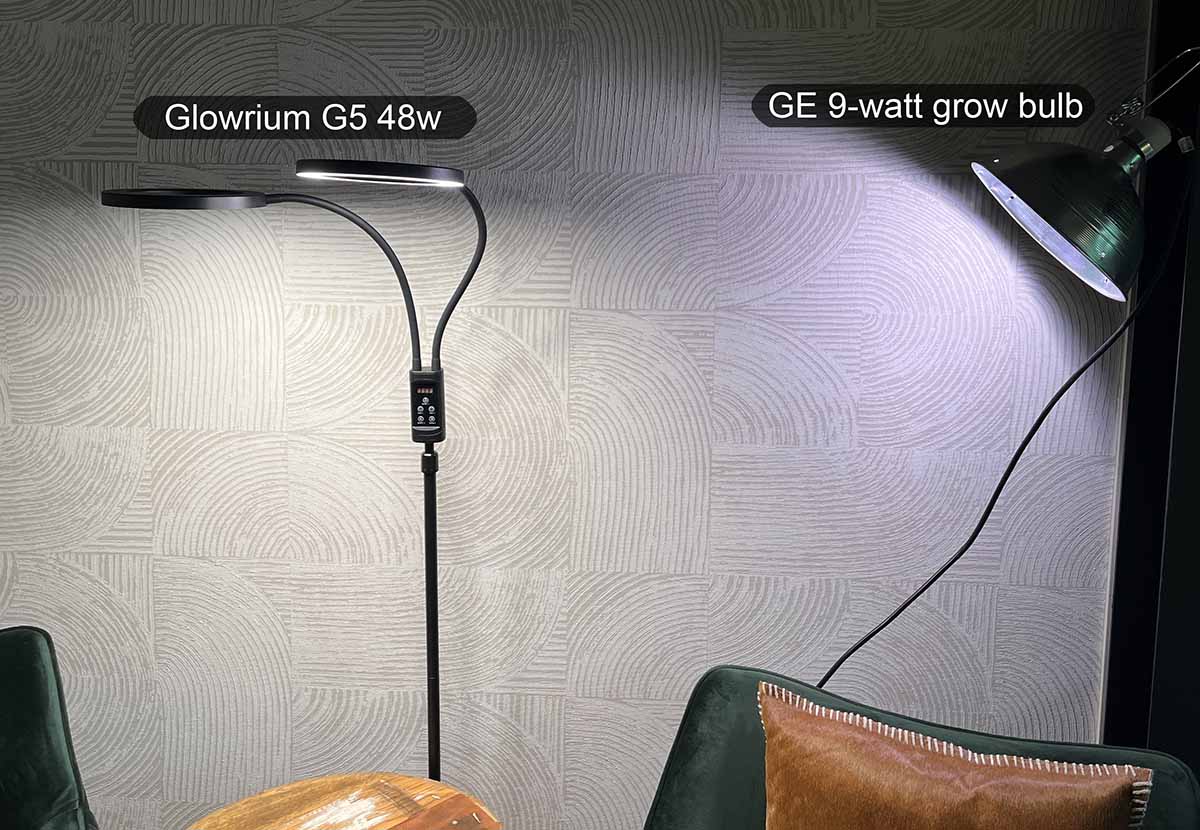
It also gives off a bit of an odd color so you probably wouldn't want it directly in your line of site. It's also not dimmable, but since this isn't overly bright to begin with, that's not a big deal.
Where to buy
This bulb should be easy to find at big box stores as well as amazon. Below are some links to the product, so you know what it looks like even if you go to buy it in person.
I tested the more flood-light BR30 shaped bulb. But it appears the regular-shaped one should perform similarly if put in a reflective lamp shade.
- Wide BR30 bulb: light is already focused down, good for an open decorative lamp shade. The bulbous end can be too big for smaller task lamps (but not all of them).
- Standard A19: omnidirectional, so best in a closed and reflective lamp shade like most task lamps.
- Both bulbs have a regular E26 screw in base that fits standard lamps


Supporting equipment: task lamp & timer
Task lamps are a great option for this grow light bulb since they can be easily raised or lowered depending on the current height of the herb.
If you buy a task lamp, make sure it can reach high enough to get 6 inches above your plant.
- My 6" potted herbs end up being about 12" high, so the lamp bulb would need to reach 18" above the table.
- My small 4" potted herbs are about 6-8 inches tall, so the bulb would need to reach 12-14" from the table (ideally more as the herbs grow).
- Be sure the bulb fits if you get the wider BR30 bulb. The task lamp recommendations below will fit either bulb.
I have not purchased any of these lamps myself - the links are for ideas and inspiration. I did verify they get at least 18 inches or higher above the table, have an e26 screw base, and are wide enough to fit the BR30-shaped bulb.


Timers are optional, but help with your grow light schedule. You can get a mechanical timer or a smart timer. I have not used the one linked below as my switches and outlets are smart compatible themselves.
Highest output bulb for a bunch of herbs: Sansi 30-watt
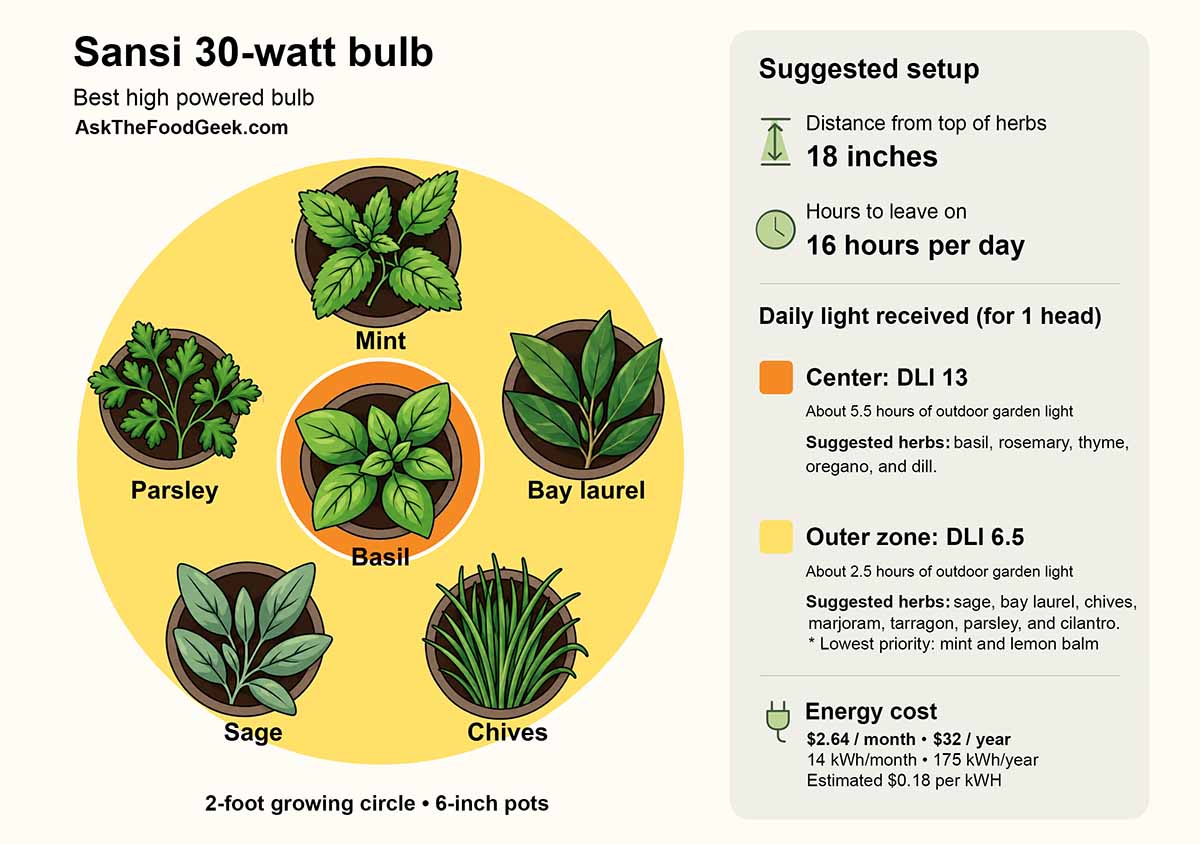
The Sansi 30-watt bulb is pretty high powered. It's strong good enough to light up a group of herbs while also being affordable.
- Distance: 18" above the top of the herb plant
- Duration: 16 hours per day
- Measured performance: 13 DLI at center, and 6.5 DLI for the outer circle
- Arrangement: a single 6" herb pot, or three small 3" pots centered under the light. The outer area can also support other herbs that still do well with dappled light.
- Energy cost: $2.64 per month and $32 per year (assuming $0.18 per KwH)
- Dimmable: no
- Color temperature: very cool with odd red/blue artifacts in the shadows
My hands-on opinion
To put the power of this bulb in perspective, most regular LED bulbs (not grow lights) you buy are 10-20 watts. So this Sansi 30-watt bulb is really bright and a great choice for the cost.
It's bright enough that it can support a larger cluster of herbs in about a 2-foot diameter circle.
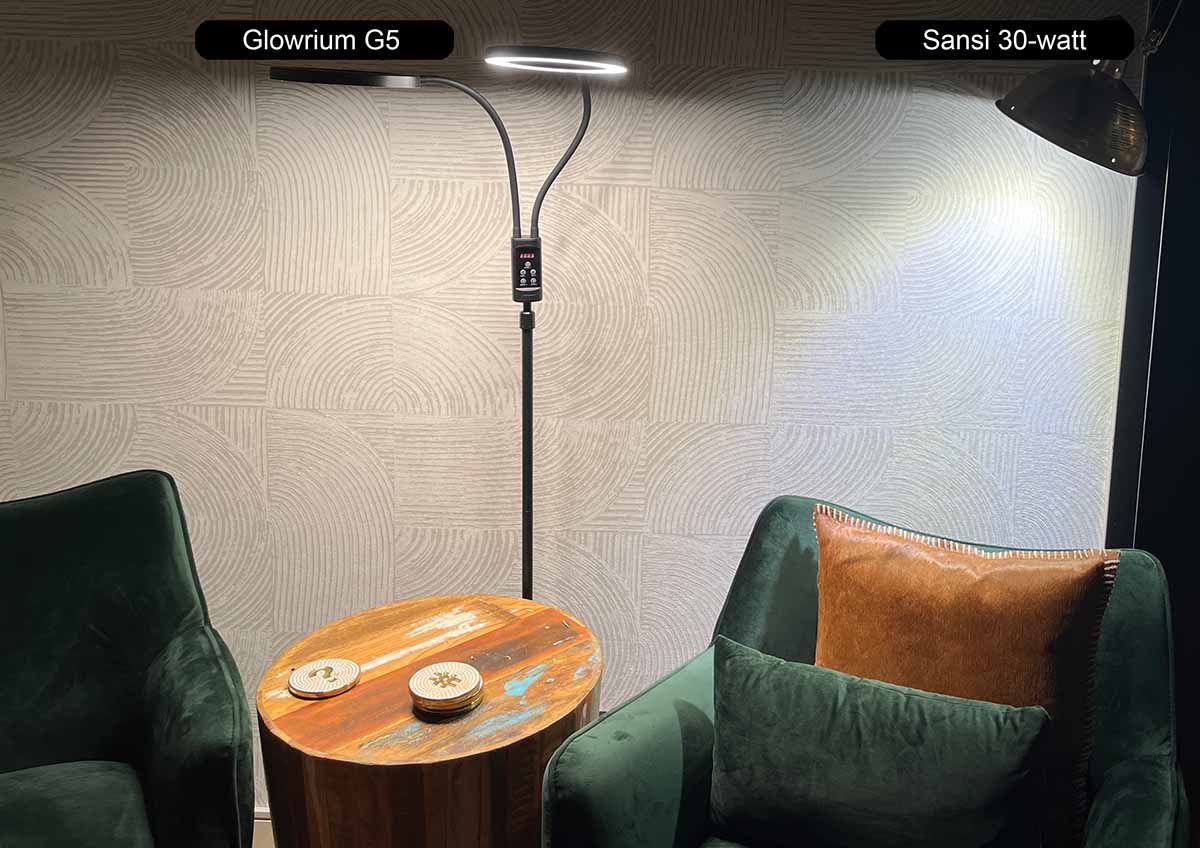
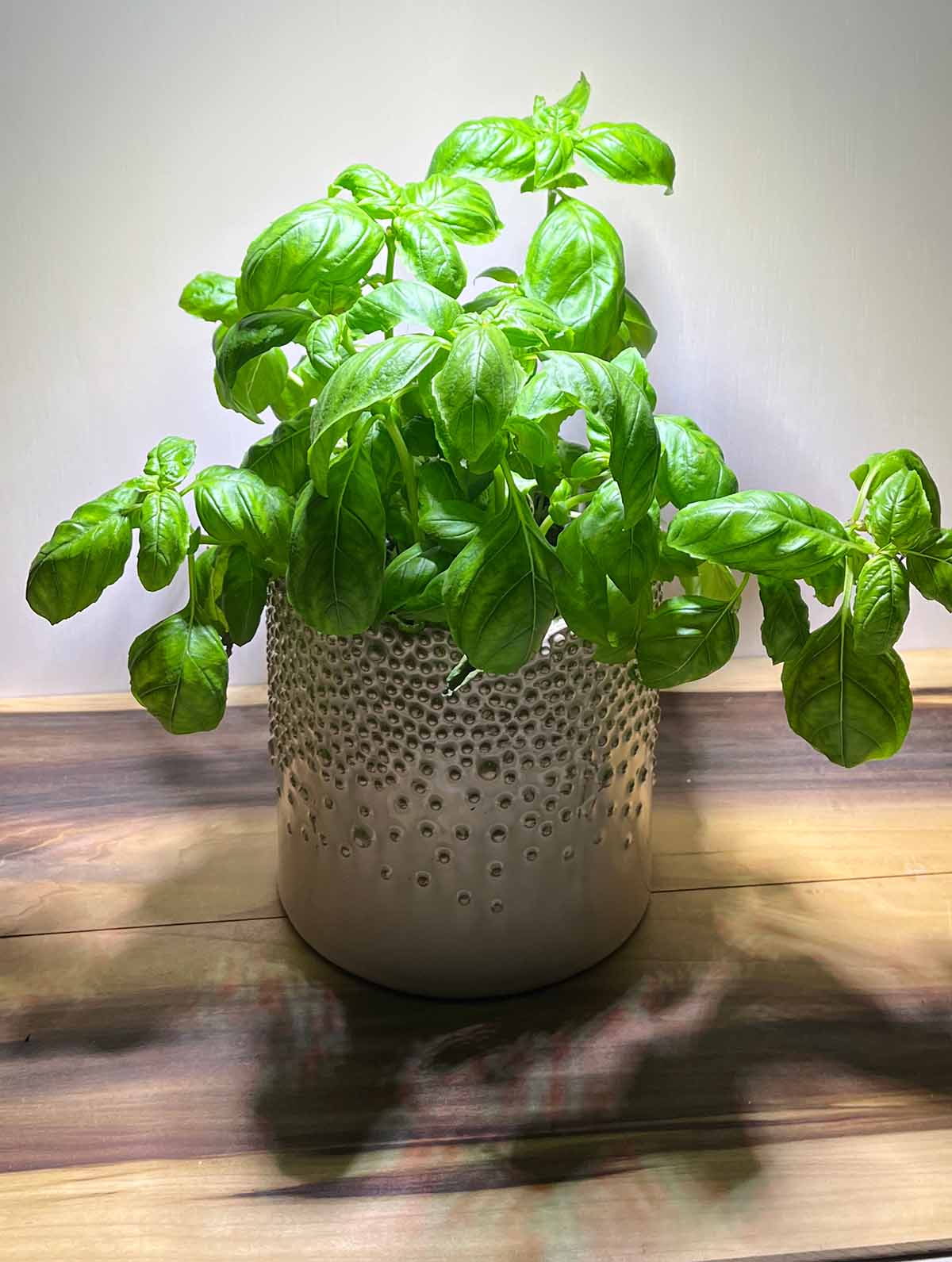
While the light itself is pretty cool on the spectrum, it does have an odd effect in the shadows that is hard to look at (as you can see in the basil photo above). It won't be great for a space where you spend a lot of time.
It's also not dimmable, which you would want if you're next to it duration.
Where to buy
The Sansi grow light bulb is easy to find on Amazon and is a respected grow light manufacturer.
The bulb I tested is not dimmable, but I did find another Sansi grow light that is.
The dimmable version has a slight difference in design but also comes with a remote and timer functions. The dimmable version should be placed 15" above the plant for the best light, instead of 18" (that's my estimation based on the manufacturer details, as I did not test that bulb).


Supporting equipment: a tall adjustable lamp & timer
Since this bulb is best 18" above the top of the plant, a taller desk task lamp is necessary to get the bulb high enough from the top of the plant. Most of my herb plants are about 12" tall, so the lamp would need to get the bulb up to a height of 30".
The bulb already does a great job of directing the light down, so you could get a standing lamp with a nice looking shade instead. The ones below both fit this bulb. (Or check out this dimmable lamp if you buy the Sansi bulb that dims).
Or keep it utilitarian with a hanging, plugin socket.
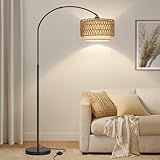
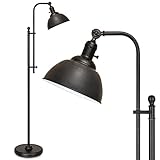

If you buy the dimmable Sansi bulb, it comes with a remote with timer functionality so you do not need to buy a separate timer like you would with the other Sansi bulb.
Best bulb for a room you spend time in: Soltech Vita
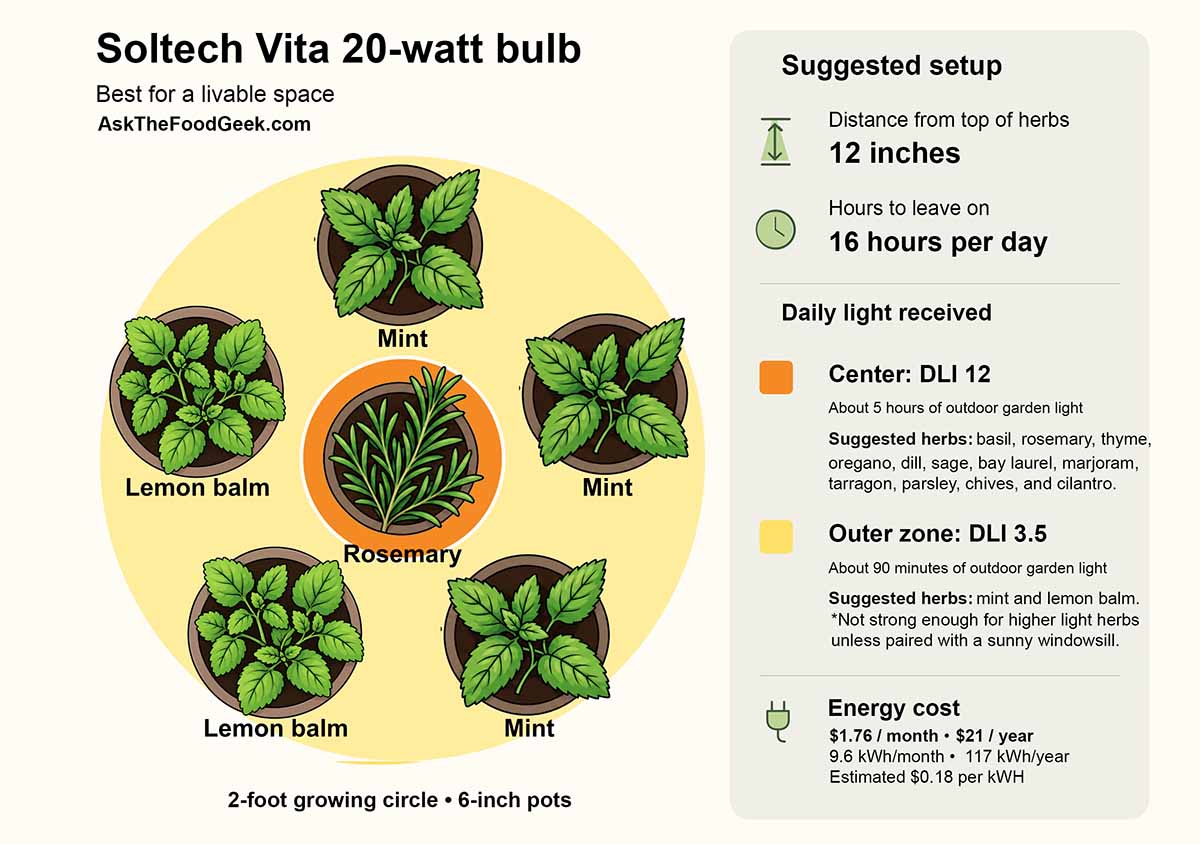
The Vita 20-watt bulb is definitely pricey, but it's designed to be look nice in your living space, even when it's on all day.
Suggested setup:
- Distance: 12" above the top of the herb plant
- Duration: 16 hours per day
- Arrangement: a single 6" herb pot, or three small 3" pots centered under the light. The outer area can only support low-light tolerant herbs (mint and lemon balm).
- Measured performance: 12 DLI in the center and 3.5 DLI toward the edges.
- Energy cost: $1.76 per month and $21 per year (assuming $0.18 per KwH)
- Dimmable: yes (with a dimmable lamp or outlet controller)
- Color temperature: warm-white (3000 kelvin)
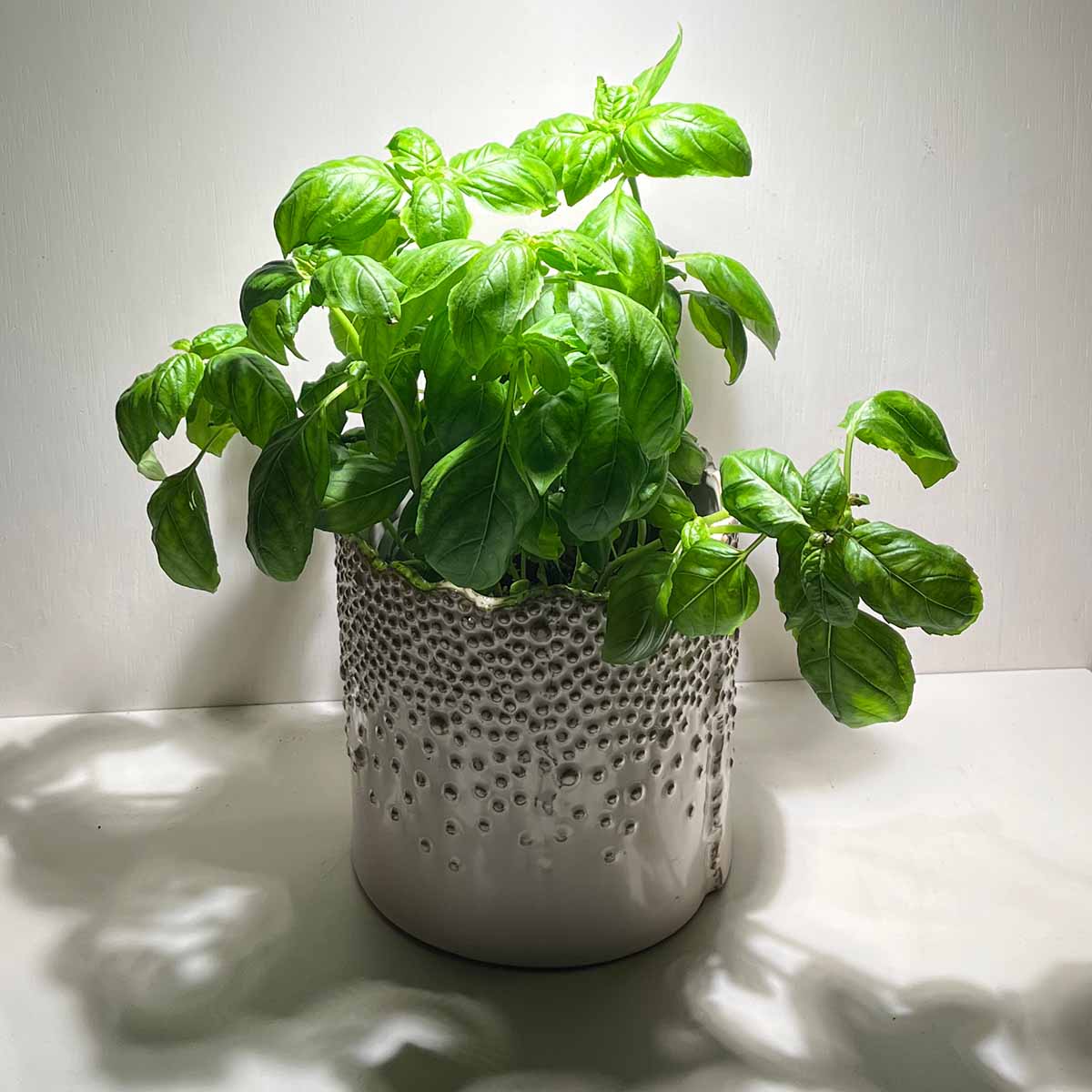
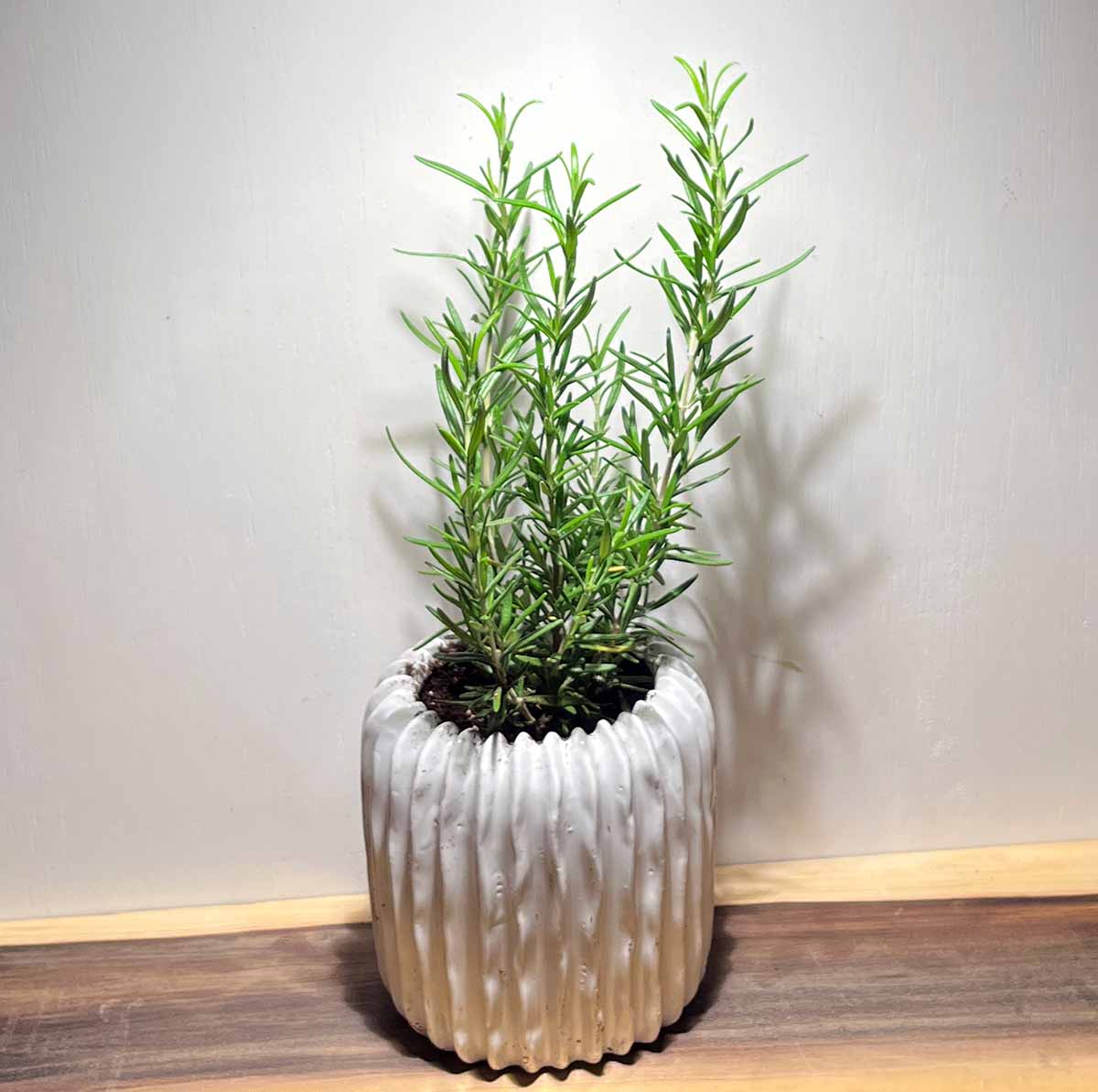
My hands-on opinion
This bulb lives up to the manufacturer's claim of looking beautiful in your living space. Soltech has really struck the balance between accurate color rendering and providing wavelengths that plants like.
At 20 watts, it is bright, but not too bright. It's a warmer 3000 Kelvin without being too yellow. There are no weird artifacts from colored diodes like in the Sansi bulb and it doesn't easily glare like other bulbs either.
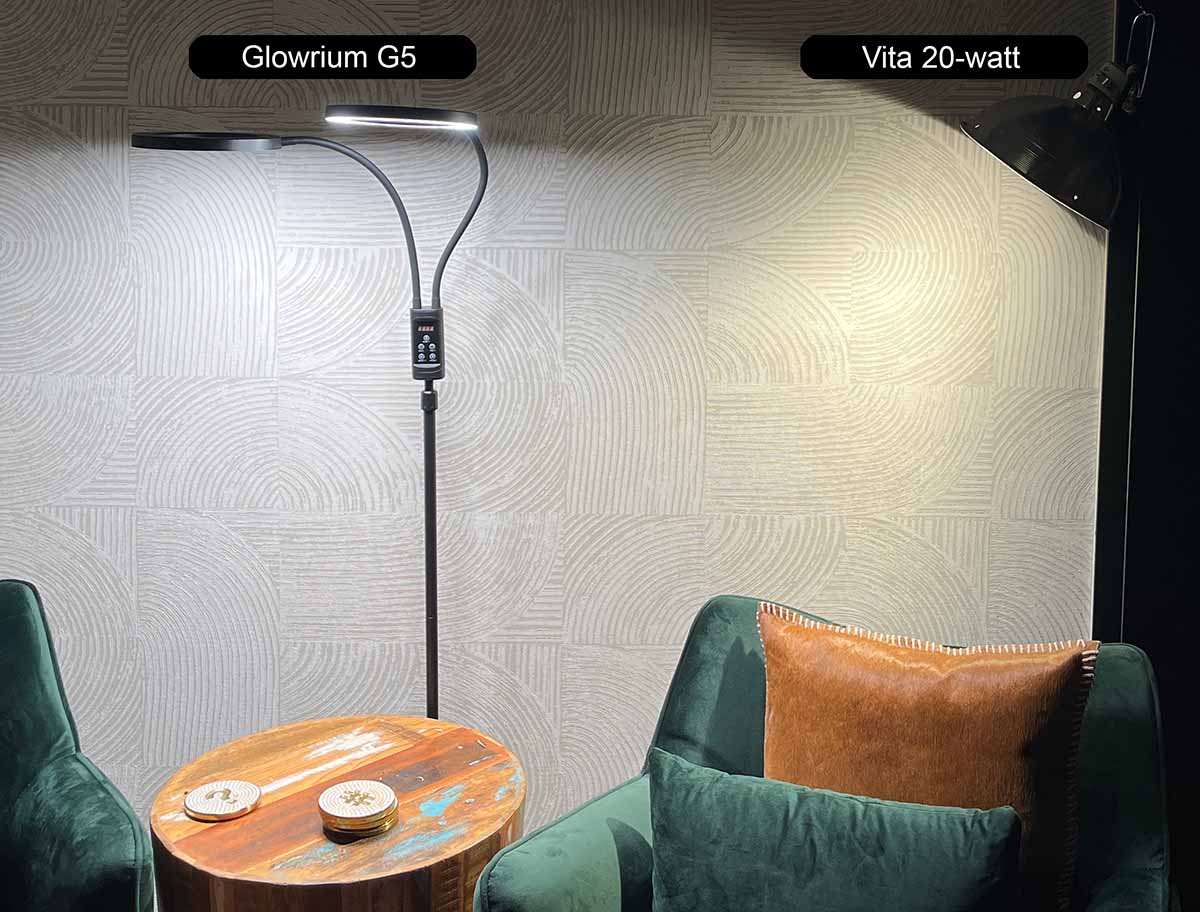
This grow light bulb also dimmable, which is nice for late evening, lower ambient lighting. (Of course, you still want to keep at full brightness as long as possible during the 16-hour window).
The Vita bulb can easily support a single herb plant, but anything outside of the center area will get very little light (about the equivalent to 90 minutes of outdoor sunlight). That area is still good for all sorts of house plants, just not more than one sunlight-demanding herb.
Where to buy
You can get this on Amazon (sold by Soltech) or directly from the Soltech website.

- THE ORIGINAL DECOR GROW LIGHT COMPANY: Soltech has been building grow lights in Bethlehem, PA...
Supporting equipment: a nice looking dimmable lamp
You can put this grow light bulb in any inexpensive task lamp. Or, since you're going all out with a good looking light, might I also suggest an attractive lamp?
Make sure the height can get the bulb to 12" above the plant or buy a display stand if it's too tall (I like using tall cake stands!) Here are a couple of ideas (including some plug-in wall sconces to go right above a console table, etc).


If you want a timer for your Vita grow bulb, I suggest the one by Leviton because it also has dimming capabilities.

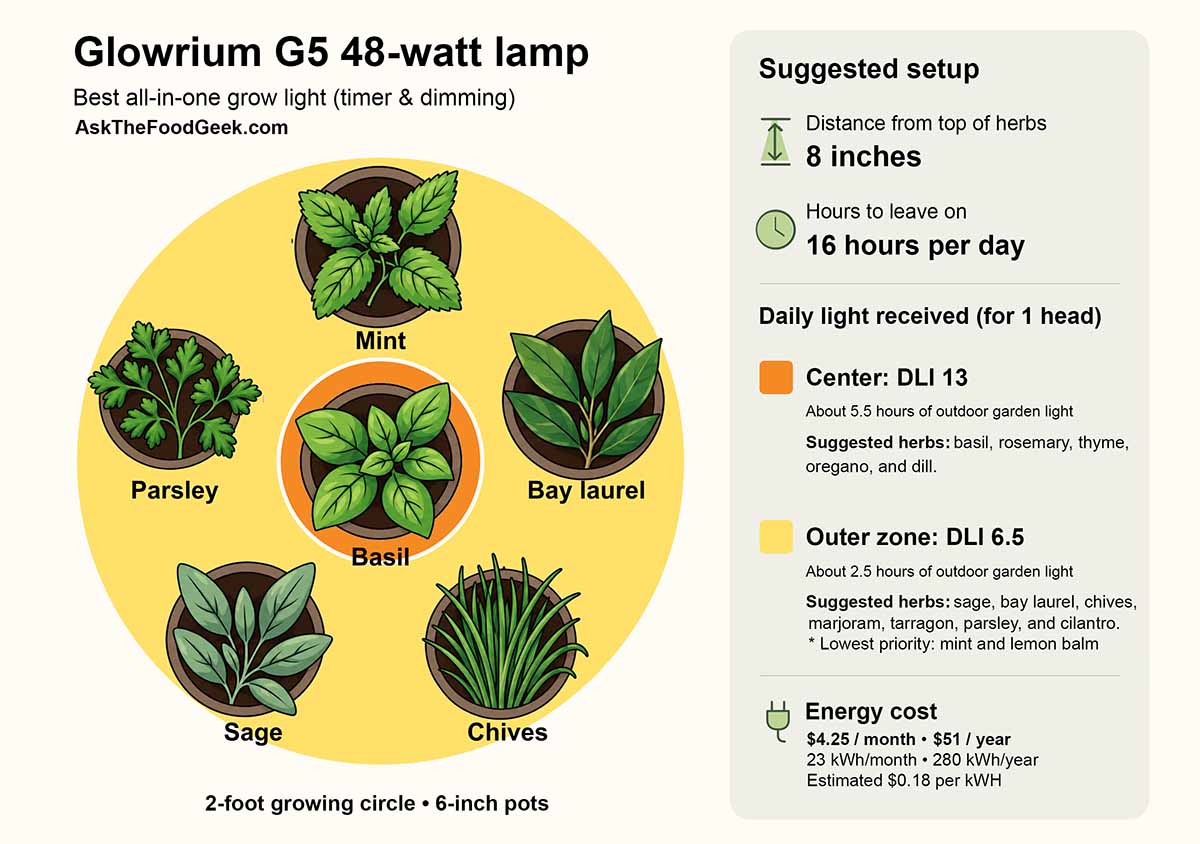
Best all-in-one grow light: Glowrium 48 watt lamp
This lamp checks a lot of boxes that I've had a hard time finding at an affordable price. It's powerful enough for a small group of herbs, the heads are adjustable, it's dimmable, and the lights can also be scheduled any number of ways, including automatic syncing to sunrise and sunset.
Suggested setup:
- Distance: 8" above the top of the herb plant
- Duration: 16 hours per day
- Arrangement: a single 6" herb pot, or three small 3" pots centered under the light. The outer area can also support other high light herbs that still do well with dappled light.
- Measured performance: 13 DLI in the center, and 6.5 toward the edges
- Energy cost: $4.25 per month and $51 per year (assuming $0.18 per KwH)
- Dimmable: yes, built in
- Color temperature: neutral white (3500k estimate)
The suggested setup is per head. So the dual-headed lamp can support either two groups of herbs or a single group of all high-light herbs (when the heads are pointed toward the same spot).
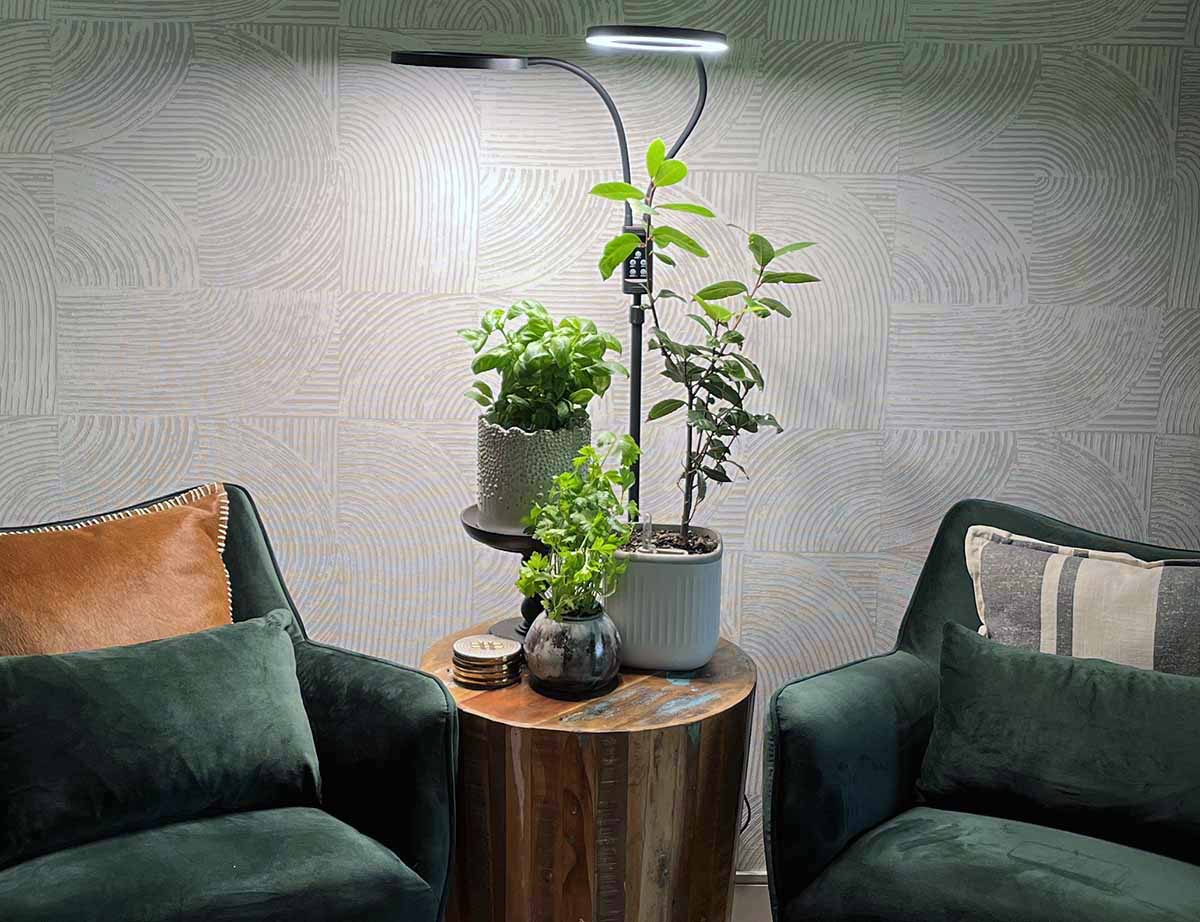
My hands-on opinion
Glowrium offers a bunch of different lamps. I chose the most powerful one they offered with dual heads to get the most light for my herbs.
I'm actually surprised at how affordable it is. For just a little more than the cost of two Sansi bulbs, you get a similar amount of growing capacity in a convenient plugin lamp (that also works nicely for taller house plants).
I also really like that the app lets you sync the light with sunrise and sunset. If you want the light on for 16 hours, you can still sync it to go on at sunrise, then stay on for 16 hours (or any number of permutations).
Also keep in mind that with an integrated LED lamp, if the lights burn out, the lamp is useless. Glowrium claims a 50,000 hour lifespan which would last 8.5 years if running 16 hours a day.
Supporting equipment: none
That's right! Everything is built in to this grow lamp. You just need to plug it in.
Where to buy
You can buy direct from Glowrium and the product should arrive in 1-2 weeks with either a $5 flat rate or free shipping. There are usually coupon codes you can use as well.
They also have a lot of other grow lamps at different heights, intensities, and prices. The G5 lamp I linked is one of their most expensive options.
Alternatively, you can get it shipped fast if you buy from Glowrium through Amazon (although there aren't usually coupon codes).

- Smart Bluetooth & Manual Control: Easily control your plants lights indoor with the Bluetooth...
- Adjustable Height - Up to 70.9": This grow lamp extends to 70.9 inches, perfect for tall...
- High-Performance LEDs - 48W Full Spectrum: Equipped with 128 LEDs, this 48W high-power grow...
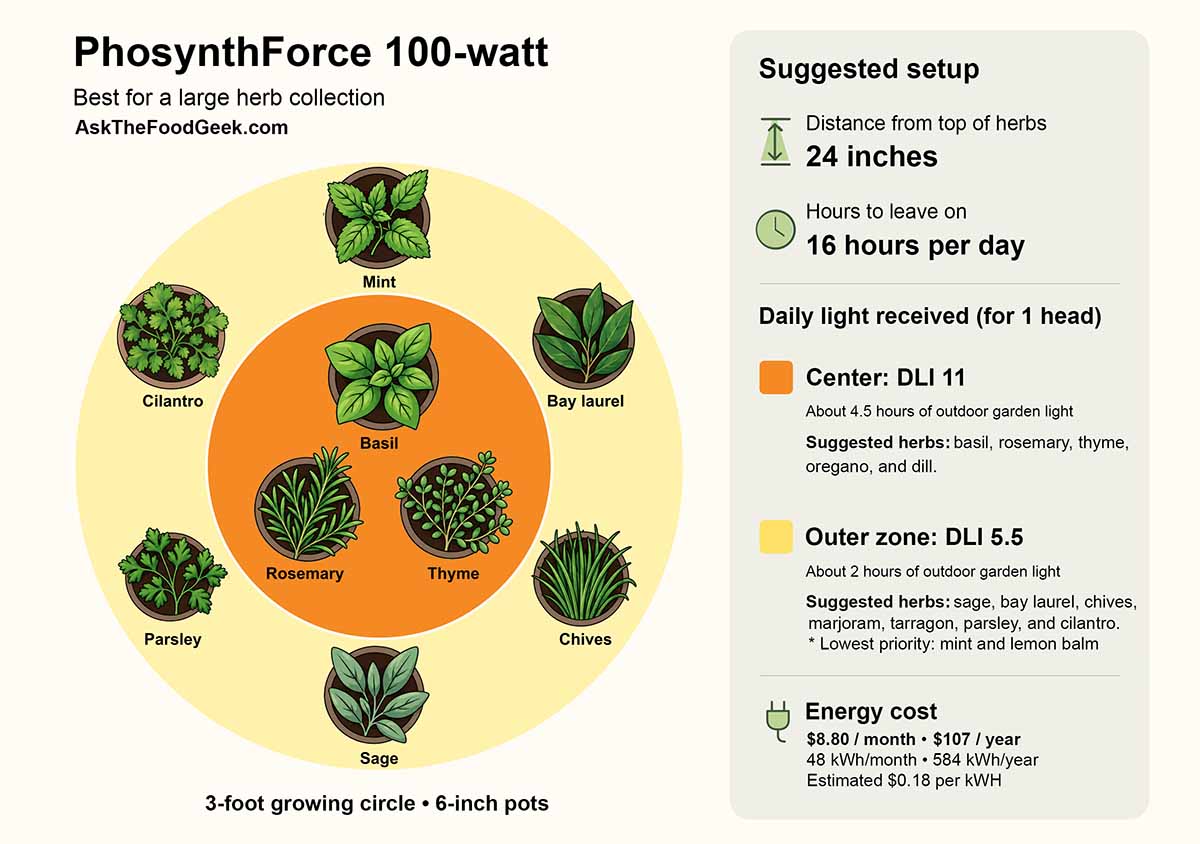
Best grow light for a large herb collection
The PhosynForce 100-watt grow light fixture lights up a larger area and can be made to look nice with a lampshade. It's just powerful enough to light up a larger central area that can support several high-light herbs.
Suggested setup:
- Distance: 24" above the top of the herb plant
- Duration: 16 hours per day
- Arrangement: Several high-light herbs in the center 18" zone and moderate-light herbs in the outer zone.
- Measured performance: 11 DLI in the center and 5.5 toward the edges.
- Energy cost: $8.80 per month and $107 per year (assuming $0.18 per KwH)
- Dimmable: yes, built in
- Color temperature: neutral cool-white (4000K estimate)
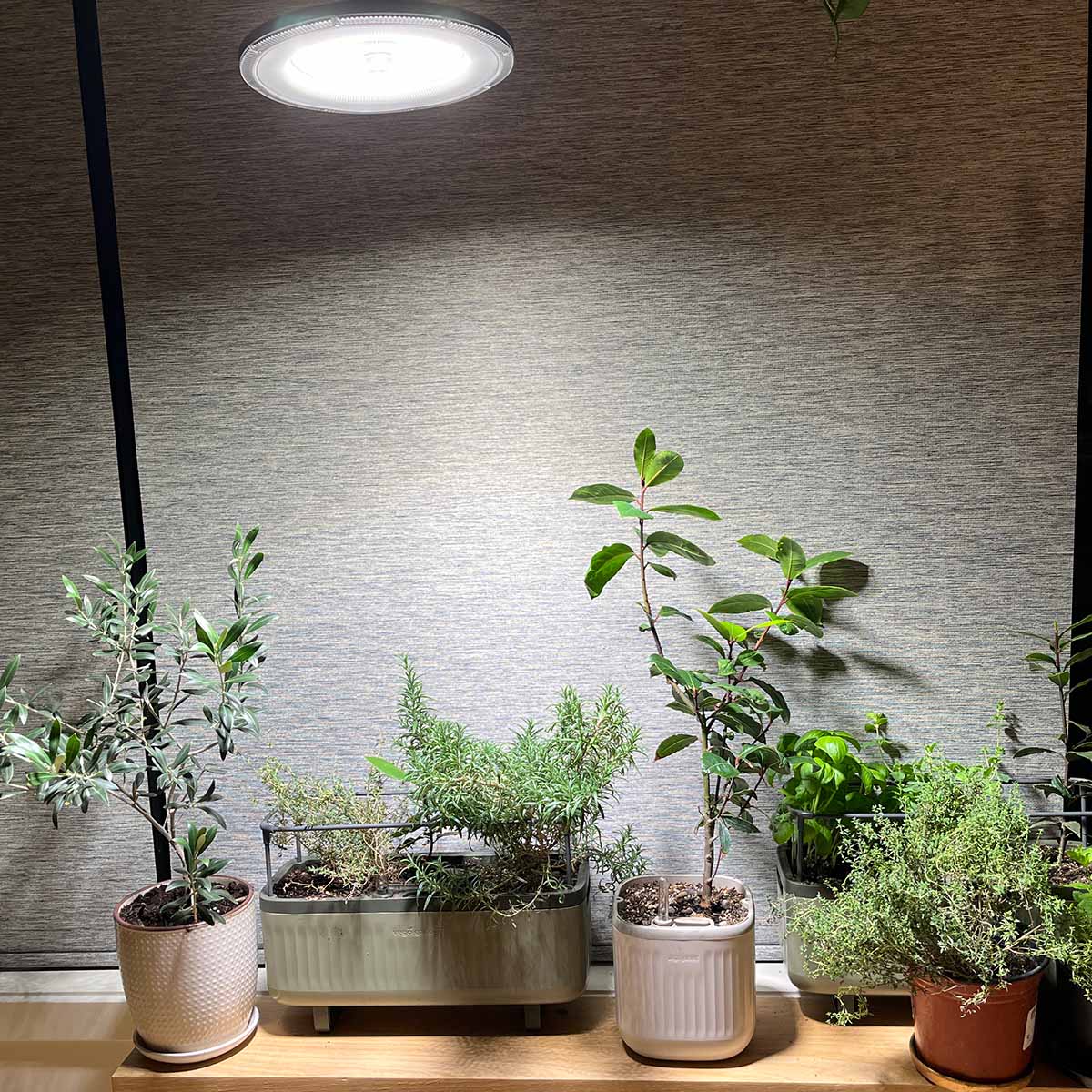
My hands-on opinion
I love a powerful hanging grow light since I grow a lot of herbs indoors.
They can actually be really cute in a living space if you're willing to buy a lamp shade and hang the fixture from the ceiling.
I had a hard time finding a 100-watt grow light that met my requirements: good enough quality for a living space, easy to spruce up with a lamp shade, and bright enough to support a large group of herbs.
The one I bought isn't a known name brand like the other lights I've listed. It's simply a find off Amazon that fit all of my parameters.
This light is also waterproof, so it can be hung outdoors in covered balconies that need a little more light. I like that the power cord is 13 feet long and the rope to hang it extends down to 6.5 feet.
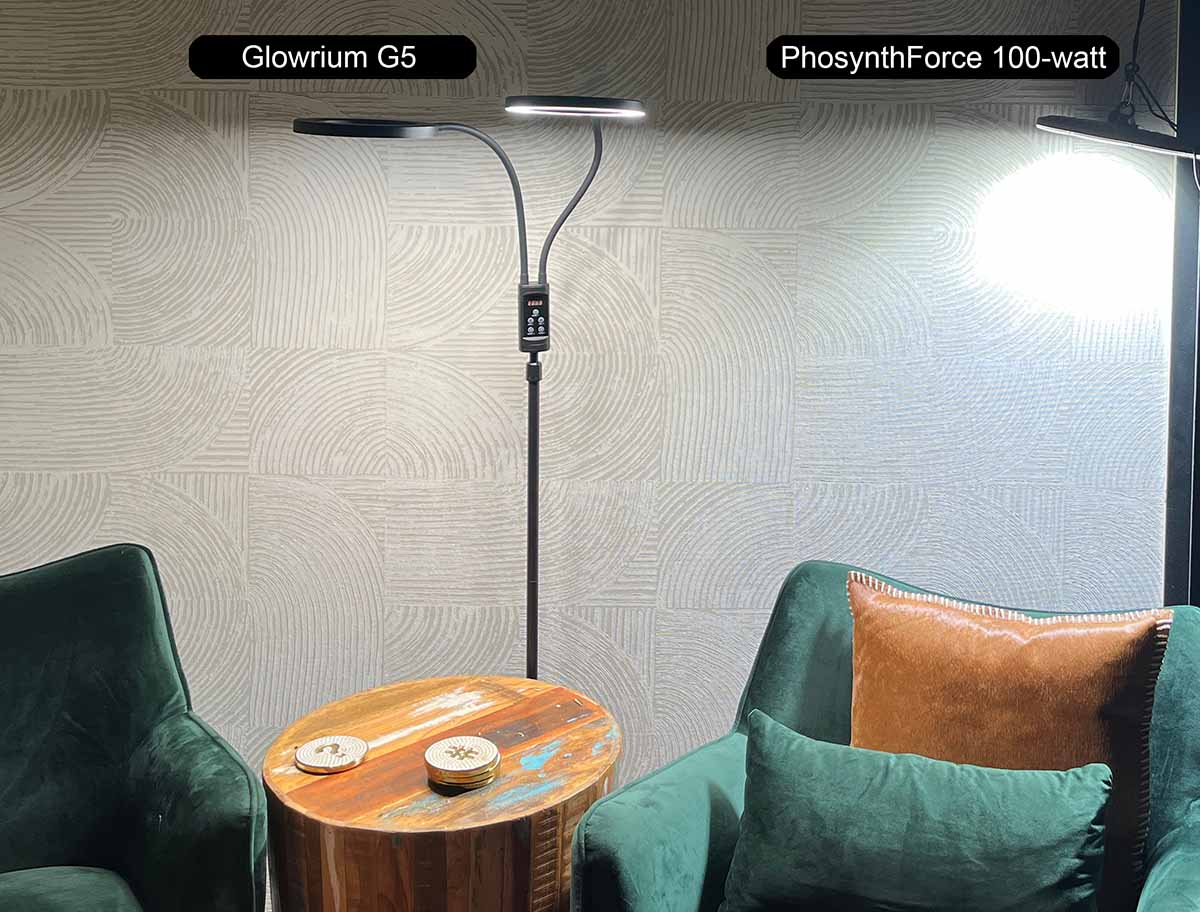
There are a of couple of downsides though.
First, the light output I measured is much lower than the manufacturer's claims. I double checked that I had it set to full brightness and measured three times to make sure. All of the other products I've linked in this post measure extremely closely to the product claims.
I measured the actual power usage and it draws 91 watts (close to the 100 watt claim).
Because of this, it's not as powerful as I was hoping. I was looking for a replacement for the CREE COB lights I have but are discontinued. You can sometimes find them on Ebay as well as on what some might call "medicinal herb" growing sites.
The PhosynForce grow light is still powerful, don't get me wrong, but not as strong as the original CFGrow version I have.
If you want a powerful grow light and don't care about appearance, get this one from a trusted brand, ViparSpectra 150 watt (with the focused lens).
Hang it 24" above your plants for 12-16 hours. The 2-foot growing area can support all of the high-light herbs, with moderate-light tolerant herbs up to 3 feet out.
Where to buy
I haven't found really strong grow lights in big box stores, but you can find them on Amazon. Here's the PhosynForce one I found.

- 🌞【High PPFD Full Spectrum】Featuring a 380-780nm full-spectrum LED, high PPFD output, and...
Supporting equipment: ceiling hooks and an (optional) lampshade
This isn't as plug and play, since it needs to hang from something. But let me help you make this a really nice light for your living space.
- A ceiling hook with a toggle bolt like these (to hang from drywall without hitting a stud, which is fine for this light that weighs 3.3 lbs).
- A lamp shade (optional): a standard 'spider' lamp shade fits over this fixture. Here's what to look for: that's at least 12" in diameter fits this light, but I'd get something around 16" to make sure the fixture has enough room to dissipate the heat. Get one with a small center hole (about 0.41").
- 16" drum lamp shade (a 12" fits the fixture, but I'd go wider for heat dissipation).
- A small center hole that's about 0.41" across
- Longer eye hook: you can unscrew the eye hook from the fixture and thread the lamp shade hole over it, then screw it back in. However, the screw shaft is too short, so you need a longer one. This one works (I tested it!)
- The links below all meet these specs!


Best grow light for shelves: Glowrium G6 strip lights
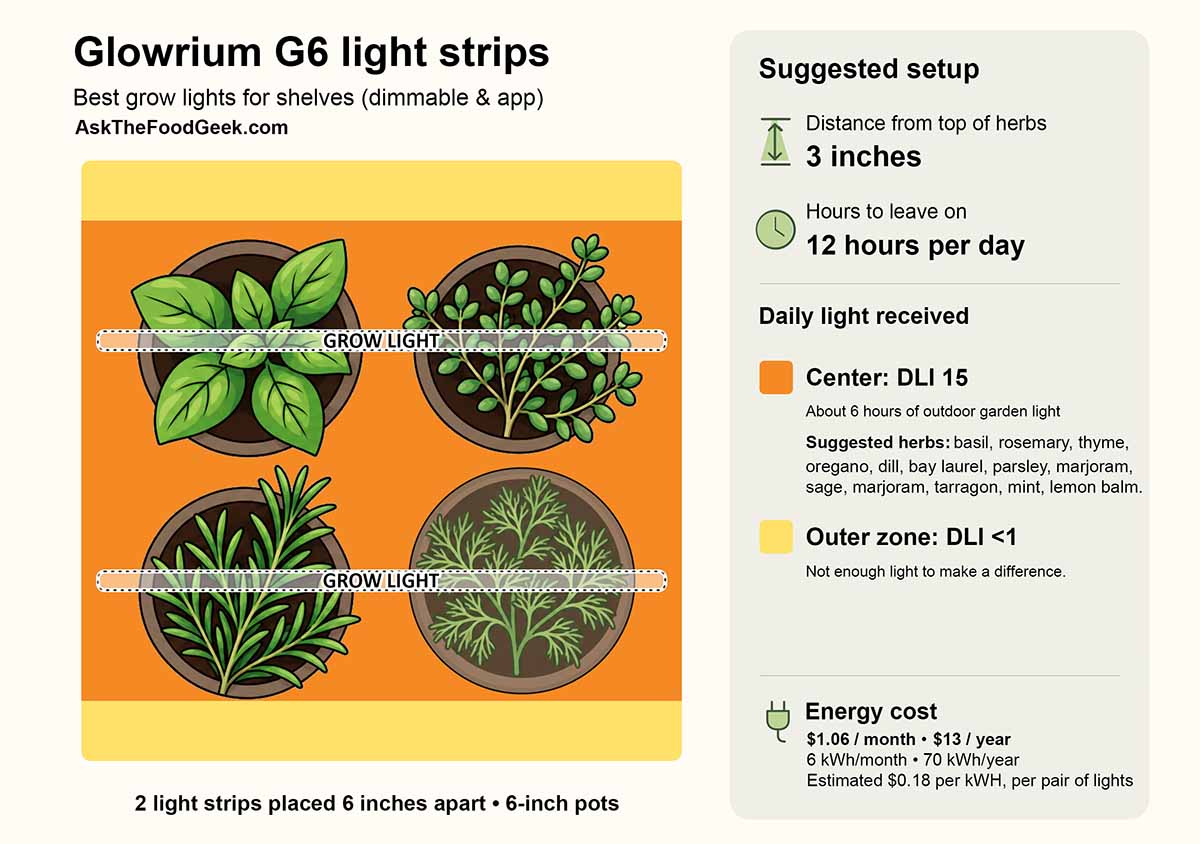
You can buy under-cabinet grow lights for your kitchen or to turn a set of shelves into a mini herb garden. The ones from Glowrium are 9 watts each, can be chained together, and are strong enough for bright-light herbs (as long as they are close to the plants).
Suggested setup:
- Distance: 3" above the top of the herb plant
- Duration: 12 hours per day
- Arrangement: a single row of herbs centered directly under the grow light. Hang two grow light strips side-by-side, 6-8 inches apart to create a double row system on a deep shelf or counter.
- Measured performance: 15 DLI directly under the grow lights, and less than 1 when moving more than 3 inches off center.
- Energy cost per pair: $1.06 per month and $13 per year (assuming $0.18 per KwH)
- Dimmable: yes, built in
- Color temperature: neutral white (3500K estimate)
Note: carefully measure 3 inches for the grow light distance. If you raise it up to 8 inches, for example, the intensity goes down to about 35%, which would put the center DLI down at 5.
My hands-on opinion
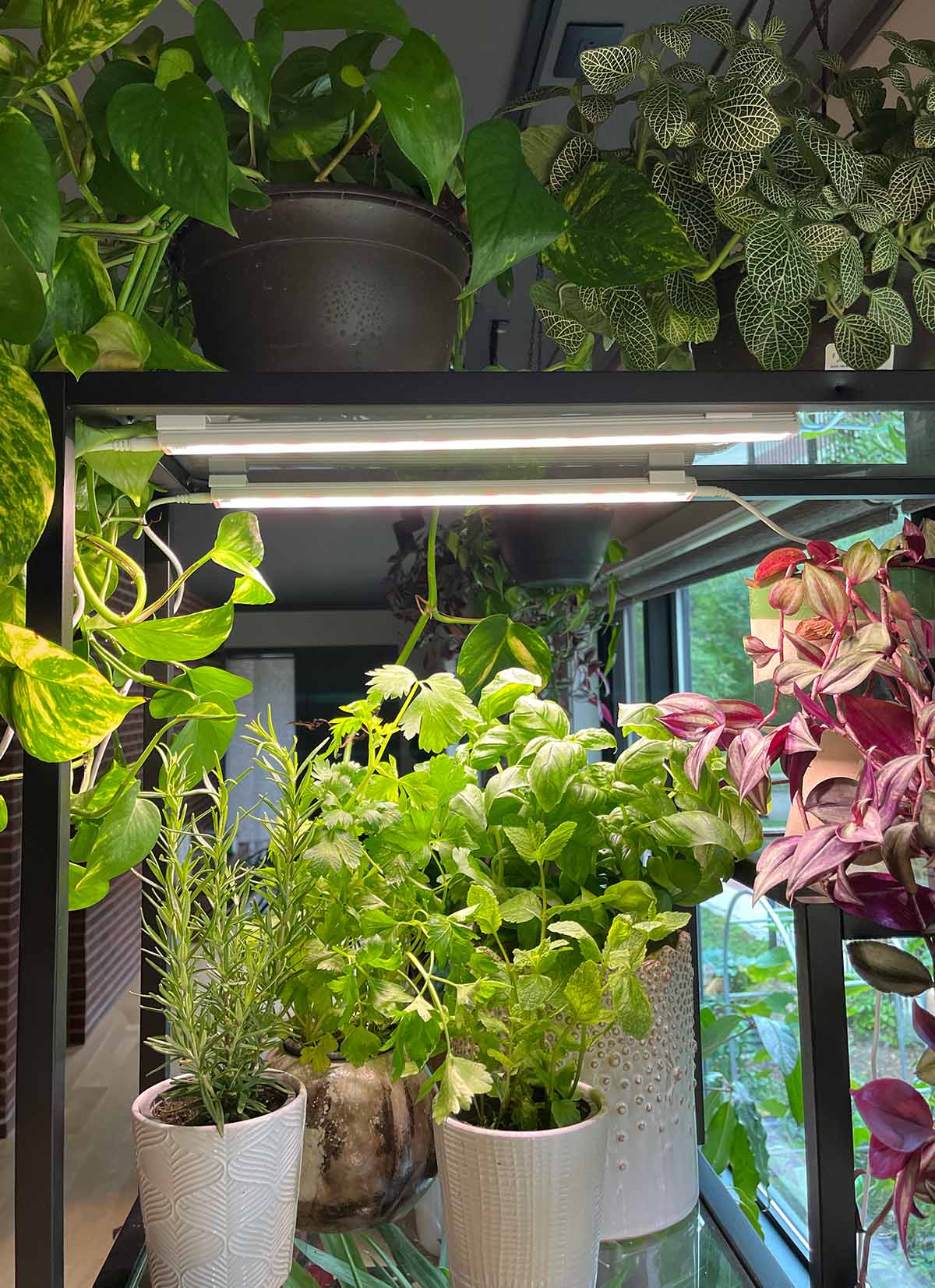
I have a set of black metal standing shelves that act as plant stands by my windows. They have glass shelves to let additional light shine through.
Like the Glowrium lamp that I tested, these are dimmable and controllable with the app. They look nice (and I should have gotten the black version to hide the cords, whoops!). The light is a pleasant neutral color too.
The design is well thought out. The grow lights clip into mounting brackets that can be attached with screws, zip ties, or double sided tape (all three options are included with the product).
But what's even more clever is that the lights can rotate within the mounting brackets to point more in (or out) toward the shelf. This lets you point the light more towards the wall to cut down on any glare you might see an eye level.
These are also delightfully affordable. If you get the 6-pack, each light is only $10 (which can support two full-sun herbs in 6-inch pots).
The only downside is that the plants have to be really close to the grow light to get enough for sun-loving herbs. So you might end up buying risers or display stands for your shelves or kitchen countertop.
Where to buy
You can buy the strip lights direct from Glowrium in a set of 2, 4, or 6 and in either black or white (so pay attention to your shelf colors, unlike me!)
Alternatively, you can get it shipped fast if you buy from Glowrium through Amazon (although there aren't usually coupon codes).

- Full Spectrum Grow Light:Our LED plant light features a scientifically balanced full-spectrum...
Supporting equipment: shelves or cabinets
These lights are perfect for sets of shelves. You can buy some nice looking ones for your living space, or cheaper storage ones for a basement or garage.
The dimensions for each light strip are 14.96" long, 1" wide, and 0.65" tall.
Below are some shelf recommendations that are each wide enough to fit the 15" long light strips with shelves that are at least 10-11 inches tall.


Do herbs in a window still need grow lights?
You might be trying to grow herbs in a windowsill. So let's take a moment to talk about how much light you get from that.
Most herbs need 6-8 hours of full sun a day. They thrive outside but when you grow them indoors, but they can struggle even when they are on a windowsill.
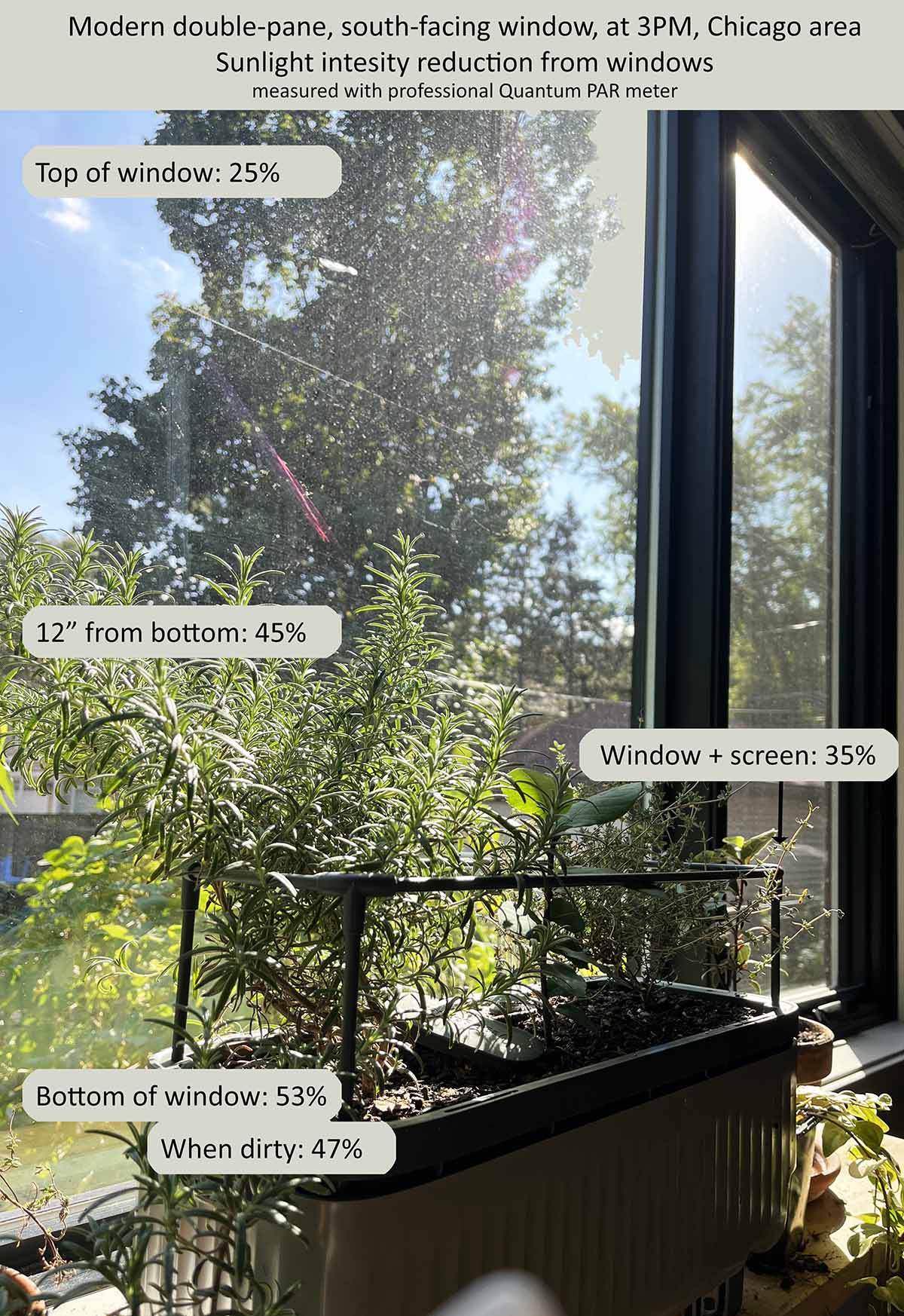
That's because the herbs might not be getting enough light, especially in the winter. Modern windows typically block about 50% of the light, and it drops from there depending on the sun angle, if you have a screen, if the window is dirty, or if your window is shaded from trees, neighbors, or eaves.
I used my professional grade quantum PAR meter to measure the sun's intensity outside, as well as inside near my window. Here are the findings for my own south-facing window in the Chicago area:
- Near the bottom of the window: 53% sunlight intensity (47% before I cleaned it)
- 12" above the bottom of the window: 45% of the sun's intensity
- At the top of the window: 25% of the sun's full intensity (shaded by eaves and the sun angle)
- Super-fine mesh screen: 35% of the sun's intensity at the bottom of the window
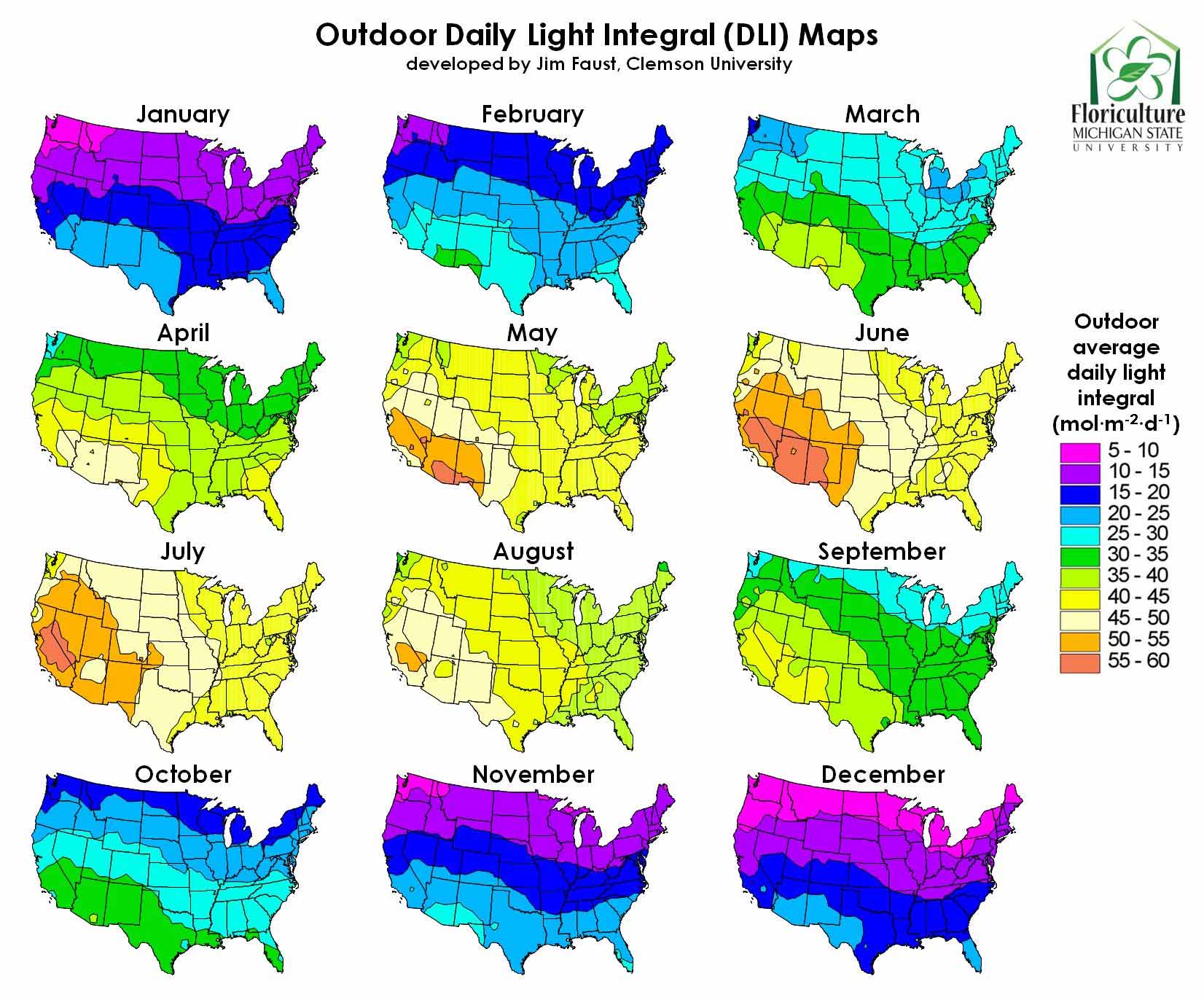
Now if you go from the sun intensity in summer to winter, northern regions only receive about 25% of total light each day due to lower sun intensity and shorter days. Southern regions of the US receive about 30-45% of the light.
That's why grow lights are so helpful when keeping herbs indoors.
If you want to try to calculate the light for your own windows, try this indoor plant sunlight calculator. It's a very thorough tool that asks for your location, size and type of window, distance of the plant form the window, and even the color of your walls (which does help reflect light back at the plant).
More growing guides
Now if you are wondering where to buy herbs online, I easily have a favorite source: Richter's. They have all sorts of fun and unique options, like caraway thyme, and over a dozen types of mint (which is great for growing on the edges of your grow light or any windowsill).
Otherwise, you can probably find them in Trader Joe's most of the year in little 3.5" and 5.5" pots.

Leave a Reply