After gardening outdoors for decades, I've started growing food indoors as well. I quickly discovered that choosing a grow light was confusing.
Product descriptions were filled with terms like PAR, PPF, PPFD, and DLI, but they rarely explained what those measurements meant.
To understand them better, I studied indoor plant biology with horticulturalist Leslie Halleck through her semester-long course at UCLA along with even more classes through the Chicago Botanical Garden.
I created this guide to help other people understand grow lights to give your plants the best light you can indoors:
- Terminology explained in a simple way (along with pictures)
- How to read a PPFD heatmap
- Grow light measurements for 9 different lights that I've personally tested
Understanding grow lights
You probably already understand more about grow lights than you might think:
- A warm-white bulb looks different from a daylight bulb because the spectrum is different
- A bedside lamp is dimmer than bright lighting in the kitchen because of bulb strength
- A light bulb looks brighter the closer your are to it
- A long summer day provides more light than a short winter one
All of these concepts apply to the quality of grow lights and how to use them with plants.
Plants use light for photosynthesis, a process that helps them grow and produce fruit or vegetables. They can use light from the sun and even light bulbs indoors - it all comes down to the amount of light they can use from a given source.
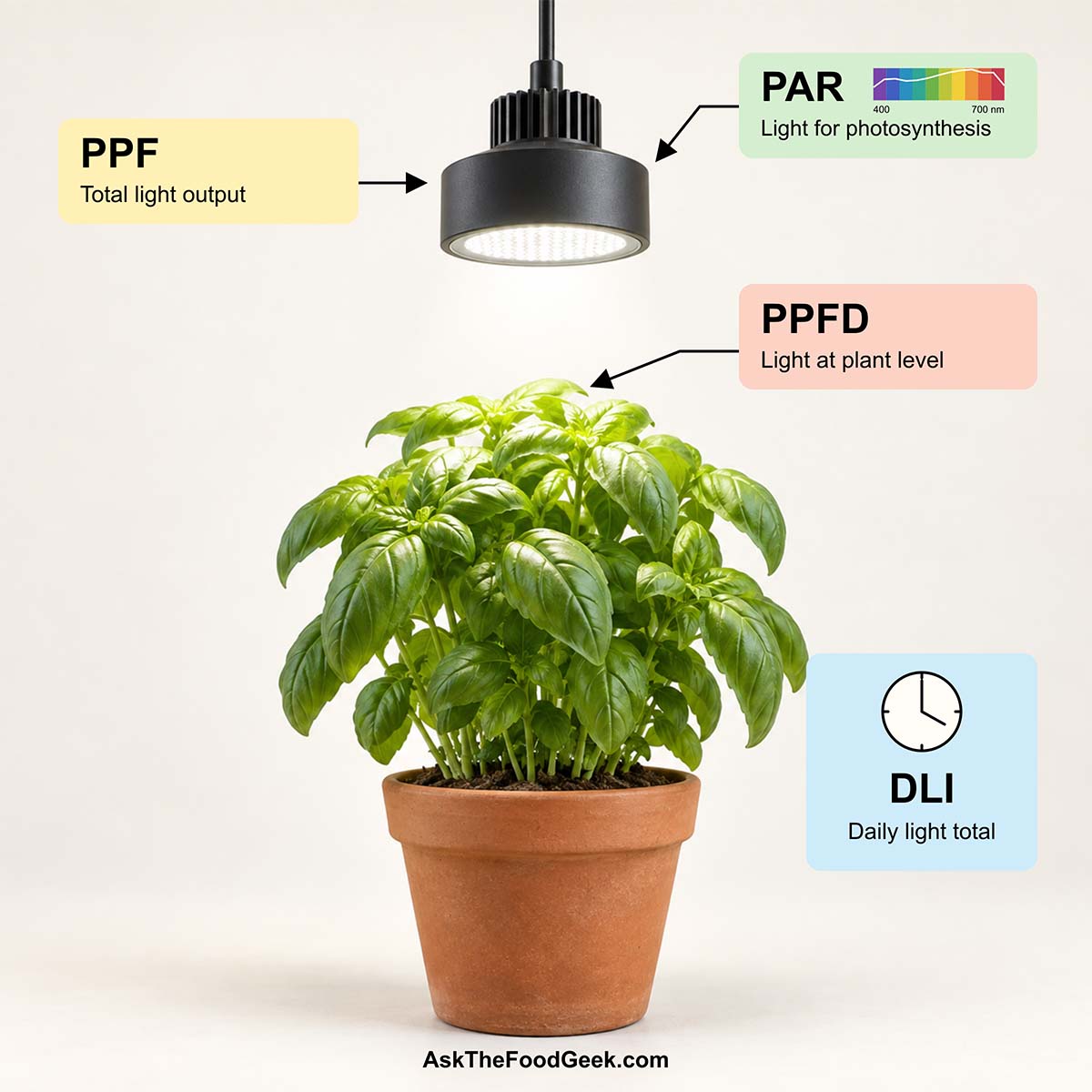
How do the things you already understand relate to grow lights?
These terms are really this simple in concept:
- PAR: relevant wavelengths of light for the plant
- PPF: how much usable light the bulb produces
- PPFD: how much of that light reaches the plant
- DLI: how much light the plant receives throughout the entire day
Now, if you want to go more in detail how each of these matters when evaluating grow lights, keep reading.
I'll try not to make your head spin, I promise.
PAR: which wavelengths do plants use for photosynthesis?
Not all light is created equally, and not all light has the same effect on plants or people.
We already know the difference between warm and daylight bulbs in our home. But let's take it a step further and talk about how the different colors actually affect us.
As an example, we've learned that the blue light from our phones at night can keep us from easily falling asleep or face masks with red light improves our skin.
Well each color of light affects plants differently too.
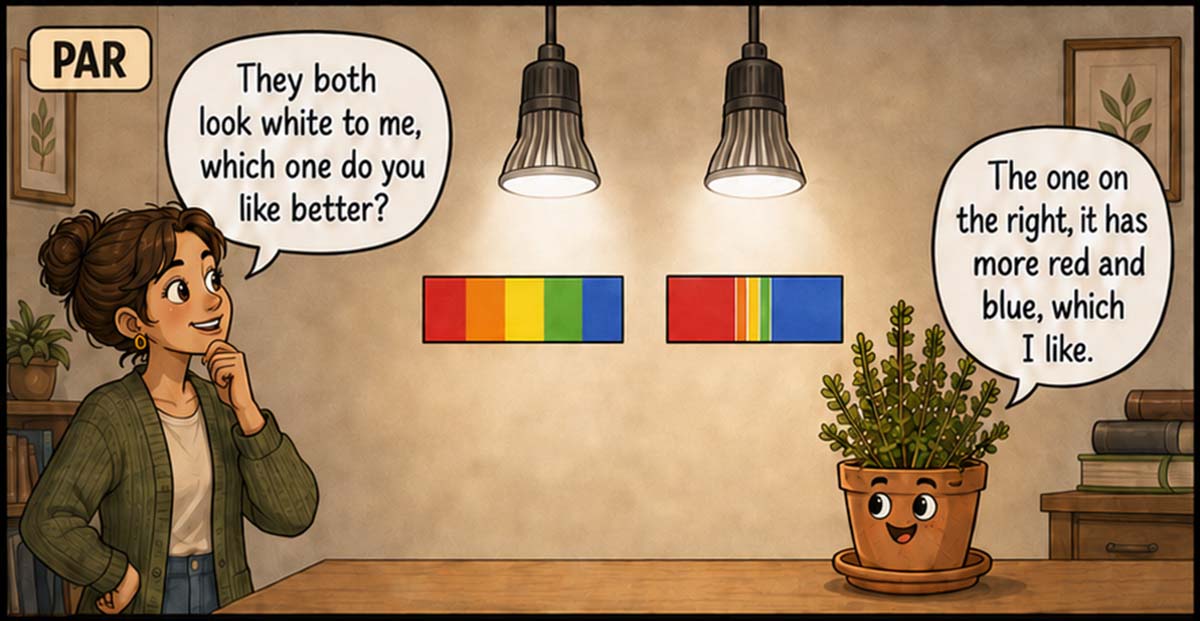
The light used for photosynthesis is measured as PAR (Photosynthetically Active Radiation). It refers to a range of 400-700 nm wavelength of light, which includes blue, green, yellow, orange, and red light.
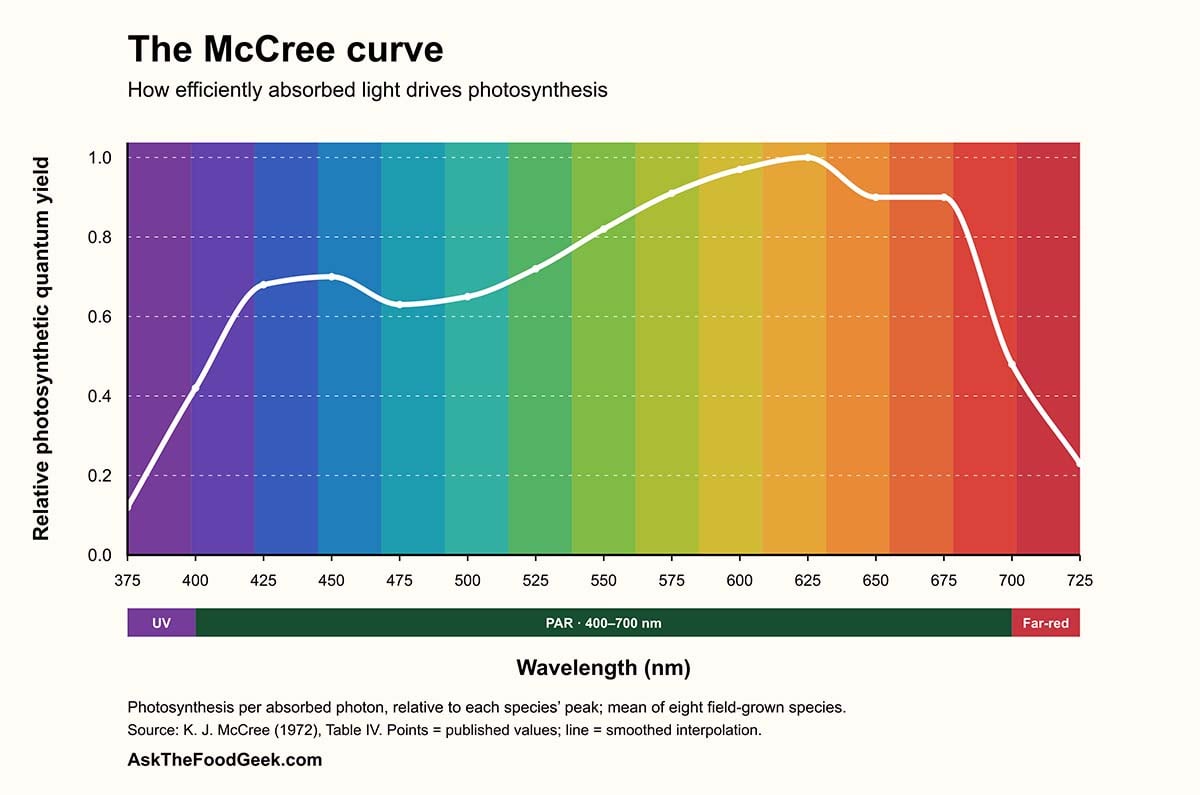
This is where the McCree curve comes in. K. J. McCree's research set the standard for measuring grow lights.
The chart above shows that red and blue light are absorbed more efficiently for photosynthesis. This is why the early LED grow lights were red and purple, along with being more energy efficient by not 'wasting' energy on other colors.
However, more recent research has demonstrated that plants perform better over the long haul when exposed to the full spectrum. One such example is how green light isn't absorbed for photosynthesis as readily, it does help improve water intake and total plant mass.
Other modern research suggests that far-red wavelengths (above 700) helps photosynthesis when combined with other light.
Now that LEDs have gotten even better, you can get grow lights tuned to have more red and blue wavelengths while still containing the full spectrum (and look white to our eyes). Even if we can't see the color difference, plants' can.
Key takeaways:
- PAR - plants use light from 400-700 nm for photosynthesis.
- Blue and red light are more readily absorbed by the plant, but green light still has benefits
- When shopping: grow lights typically show you a graph of the mix of wavelengths they are using and some list far-red (or wavelengths between 700-750)
Caution: light bulbs also use an unrelated PAR abbreviation that refers to the size of the bulb. You'll see PAR30 and PAR38 most commonly and this not related to measuring light for plants. It's confusing, I know!
White (full spectrum) grow lights vs regular bulbs
If white (full spectrum) LED lights work so well, you might be wondering if you can just use a regular light bulb instead of a dedicated grow light?
You can but it won't perform nearly as well. Regular bulbs and grow lights are built differently. It's not just a gimmick, I promise!
Regular LED bulbs focus on what our eyes can actually see. They are trying to keep efficiency high and costs down. Because of this those bulbs have large gaps in the light spectrum, missing the deep reds that plants love for photosynthesis.
Meanwhile, grow lights add in red diodes to get those colors back and amp up the desirable blue wavelengths too. Then they mix it all together so it looks white to use while being much better for plants.
PPF: how much usable light does the bulb produce?
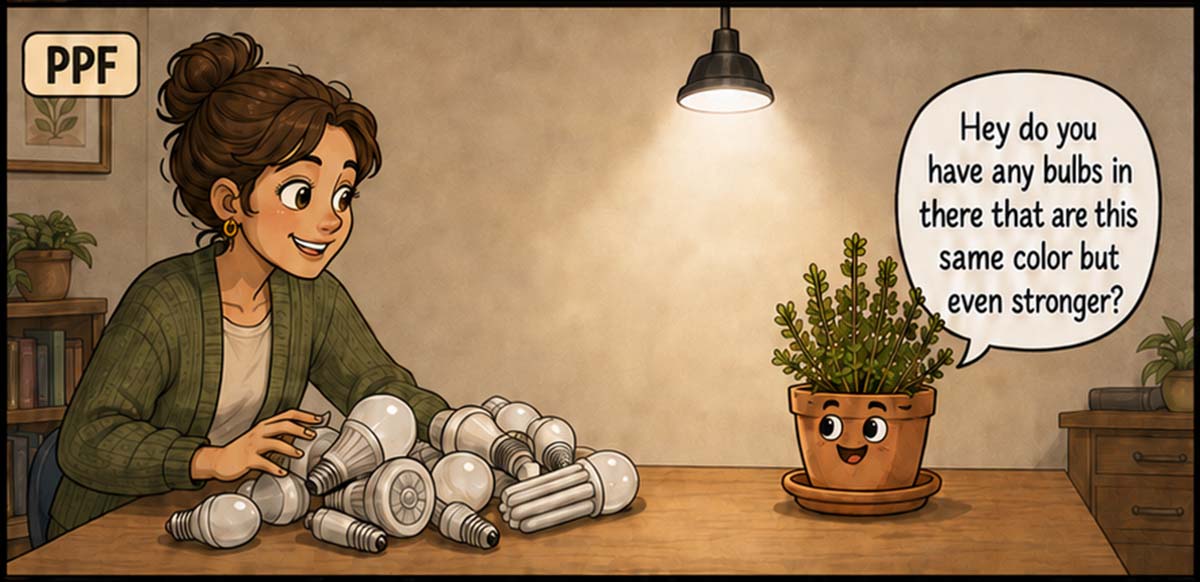
Two grow lights can produce a similar spectrum but emit very different quantities of plant-usable light.
PPF (Photosynthetic Photon Flux) counts the total number of photons within the desired spectrum that leave the bulb every second. It's measured in micromoles per second, abbreviated as µmol/s.
To simplify it, think of PPF as the total output of the grow light.
If two different grow lights have the same mix of usable wavelengths, then the one with a higher wattage will be a more powerful grow light.
When shopping for grow lights, you might see this value listed (for example, this GE grow bulb lists a 50 PPF.
Key takeaways:
- PPF tells you how much usable light the fixture produces
- A higher PPF means a brighter light
- When shopping: look for PPF numbers to compare the relative strength of different grow lights
PPFD: how much of that light reaches your plant?
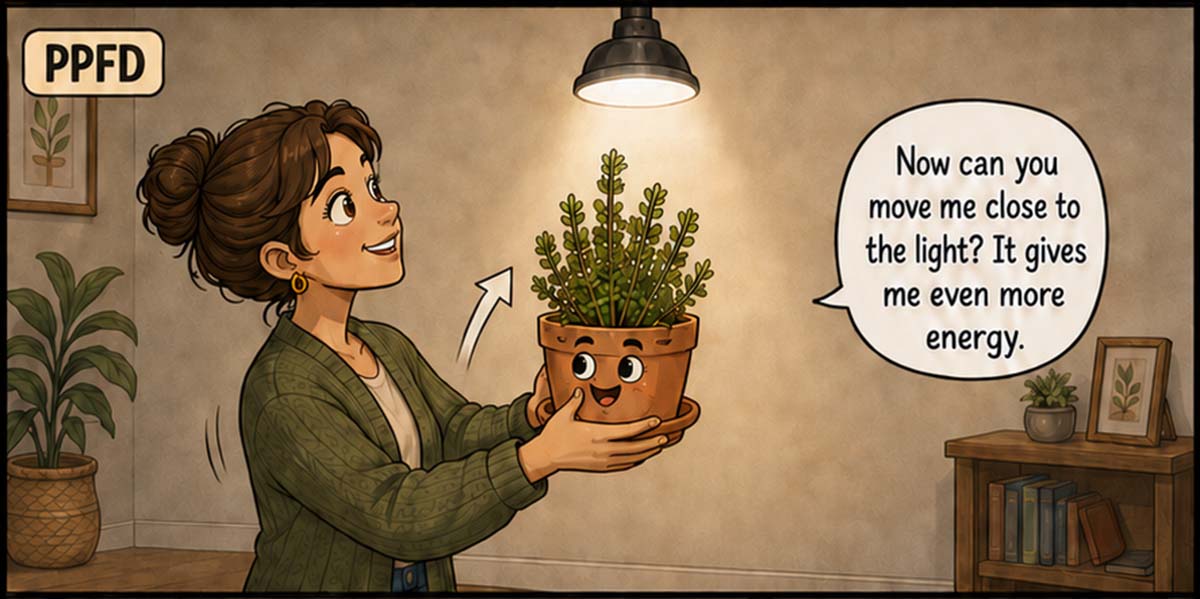
PPFD (photosynthetic photon flux density) is similar to PPF, except that it measures how many of the photons within the PAR range land on a specific location. For example, how much light reaches my little herb plant.
- PPF measures the amount of usable light from the bulb
- PPFD measures the light that actually reaches your plant from that source
PPFD depends on the bulb's output as well as the distance from the plant, beam angle, reflectors, and coverage area. Basically anything that directs more light at the plant.
- Fixture output (how much usable light the bulb produces)
- Distance from the plant
- Beam angle
- Reflective surroundings
- Position beneath the fixutre
- Size of the growing area (size of the plant(s))
Distance from the plant
Moving a plant closer to the light doesn't change the output of the bulb. But it does change how much light actually hits the plant.
Think about using a flashlight when you lose power in your house. The closer you move to a wall, the brighter the spot of the wall looks. That's because the light covers a smaller area up close, so more photons reach each part of that area.
Beam angle
What is a beam angle? Have you ever played with those flashlights where you can adjust how narrow or wide it shines?
When you make the beam narrow, the light is very bright where you point it. When you make it wide, it lights up a larger area but nothing is lit very brightly.
Another example are kitchen pendants that face down and usually light up the work area pretty brightly (narrow beam angle) and a flood light outside (wide beam angle).
Reflective surroundings
We all know that light bounces around from reflective surfaces. This same concept affects the amount of light plants receive from grow lights as well.
A grow bulb in a reflective lamp shade bounces more of the usable light toward the plant. That's why those clamp-on desk lamps have white interior shades instead of black.
Some people also put plants in a reflective box so that light bounces off each of the walls back onto the plant. I'm just growing plants at home for fun, not for sale, so I don't worry about the extra optimization with this type of setup.
Position beneath the fixture
We talked about the distance to the fixture, but the position also matters. A plant under the very center of the fixture gets more light than one on the edge.
Think of the flashlight example again. When you shine it at the wall, you can see how the center is lit up much brighter than the edges. This same principle applies to grow lights shining of plants.
Size of the growing area
A small plant will be happy sitting under the center of a narrow beam grow light bulb.
You might also have a bunch of small herb plants in a small cluster under the center of the grow light.
Meanwhile, a larger plant, like an indoor lemon tree, will easily have a 3-foot canopy. A plant like this benefits from a wider angle grow light so the entire tree receives light, not just the very center.
Key takeaways:
- PPFD tells you the light intensity at the level of your plant
- The light intensity increases the closer it is to the plant
- When shopping: look for PPFD numbers at various distances. For example, some are meant to be 6 inches above the plant and others are meant to be 3 feet away. Look at the PPFD for each height given.
PPFD example in the real world
To illustrate how this affects plants, let's look at a PPFD 'heat map' of a grow light that I measured. The specific numbers don't matter for this example, rather the difference between them.
I taped a 1-meter section out on the floor (about 3 feet by 3 feet). I then used more tape to create a grid of squares. I put the light meter inside the center of each square and took a PPFD reading.
The heat maps below represent those measurements with the warmer red and orange colors representing higher PPFD readings and the greens representing lower PPFD readings, with light green being the lowest.
A note on the grid layout vs cones of light
When grow lights were first developed, they were square and rectangle, which is how the industry standard of measuring PPFD in a grid came to be.
However, modern home grow bulbs are now mostly circular and produce light that's concentrated in the center and fades out toward the edges of the circle.
As far as I know, there still isn't a new standard to measure a cone of light (rather than the square grids). But you will see marketing material for some grow lights show a cone and related PPFD numbers at different heights.
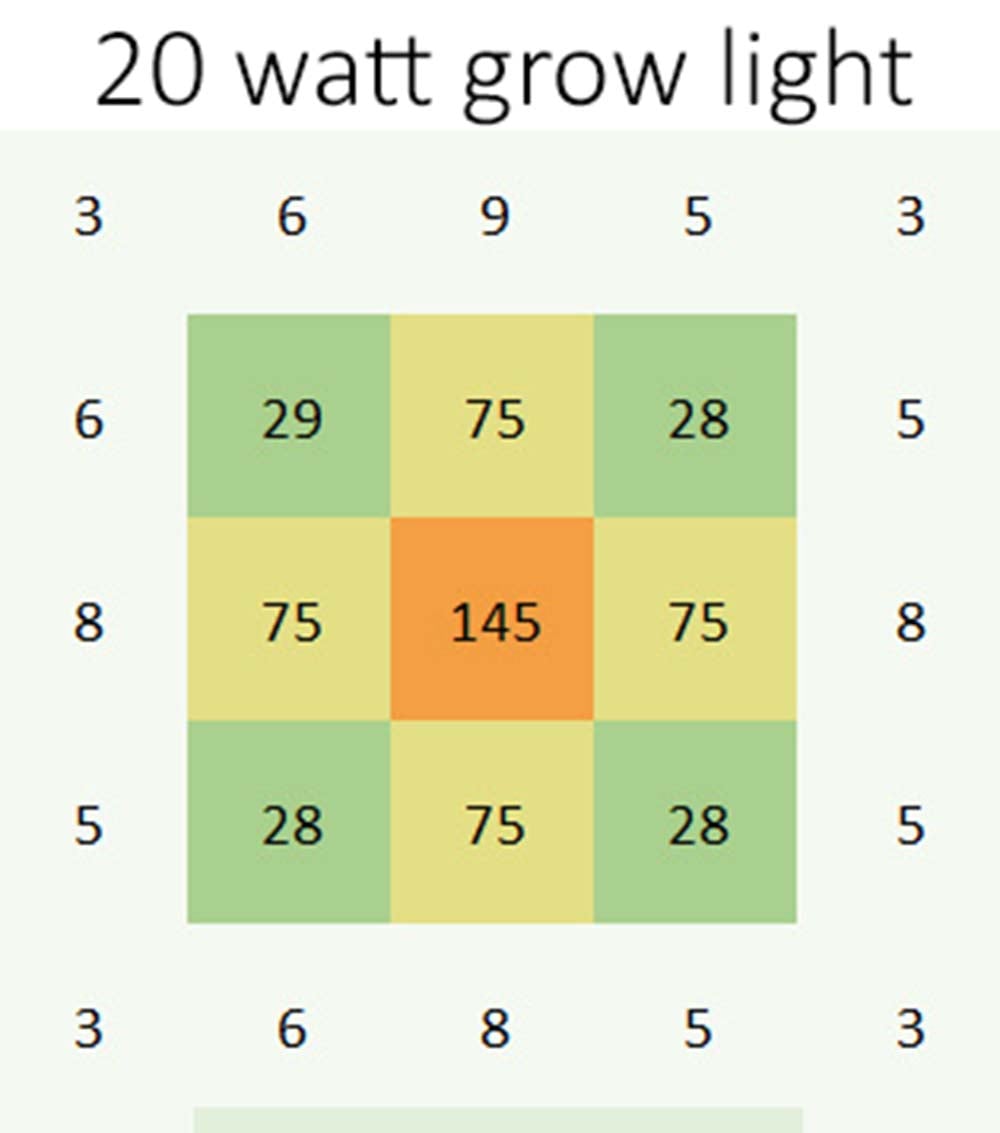
First, let's look at the heat map in general. Each square represents part of the grid I taped on the floor. The number inside is the PPFD measurement I took inside that particular square.
- The center receives the most intense light
- The edges receive less light
Use this to picture how your light will affect your plant setup:
- A single little herb plant in the center would get a ton of light (145 PPFD in this example)
- 9 herb plants: the center plant would get a ton of light, the squares closest to the center would get about half as much light, and the katty corner squares would get about a quarter of the light because this bulb lights up a circle (not a square).
- A lemon tree with a 3-foot canopy: The center would get a lot of light and the outer leaves, not much at all.
What happens when I change the distance?
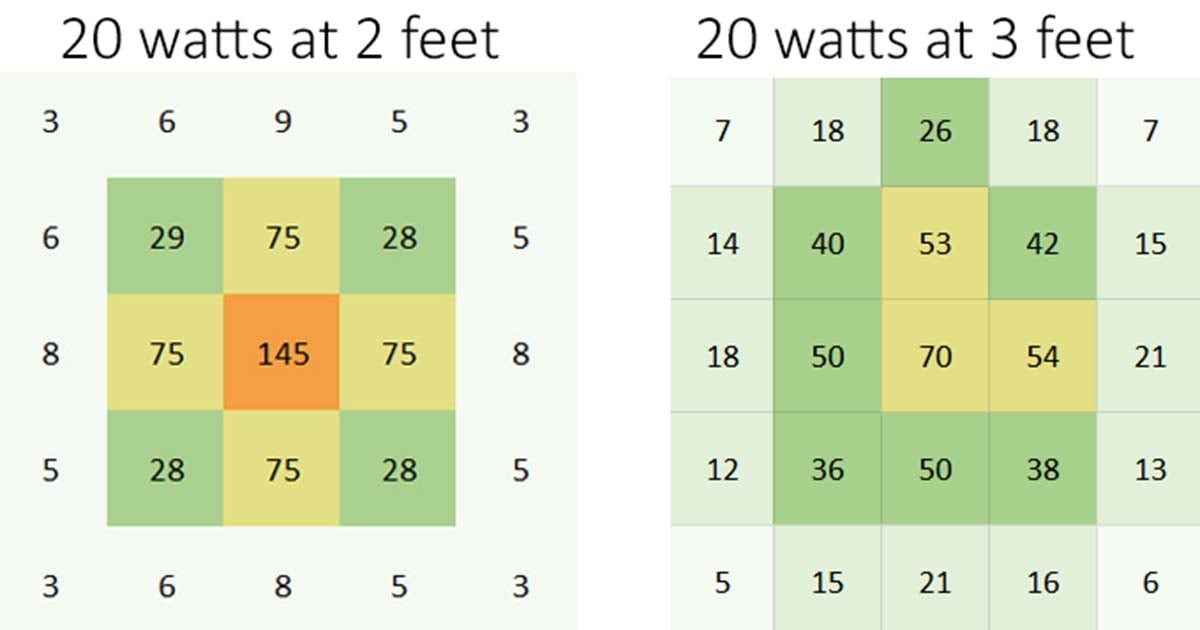
Let's take that same 20-watt grow light and instead of hanging it 2 feet above the plant, let's hang it higher at 3-feet. In this case the average PPFD over a square meter is nearly identical at both heights, which isn't always the case by the way. Each light is different.
From the graph above, you can see that once it's raised, the center numbers are reduced, but the edges are getting more light now.
How would this affect our plant scenarios?
- A single herb plant would be better off with the grow light closer
- 9 herb plants would be better with the closer grow light as well, but rotated on occasion to give each plant a fair share in the better light positions.
- A citrus tree would be better off with the higher light position as well, to cover more of the canopy since the average PPFD is the same for both lights over the growing area of 1 square meter.
Does higher wattage mean more light reaches the plant?
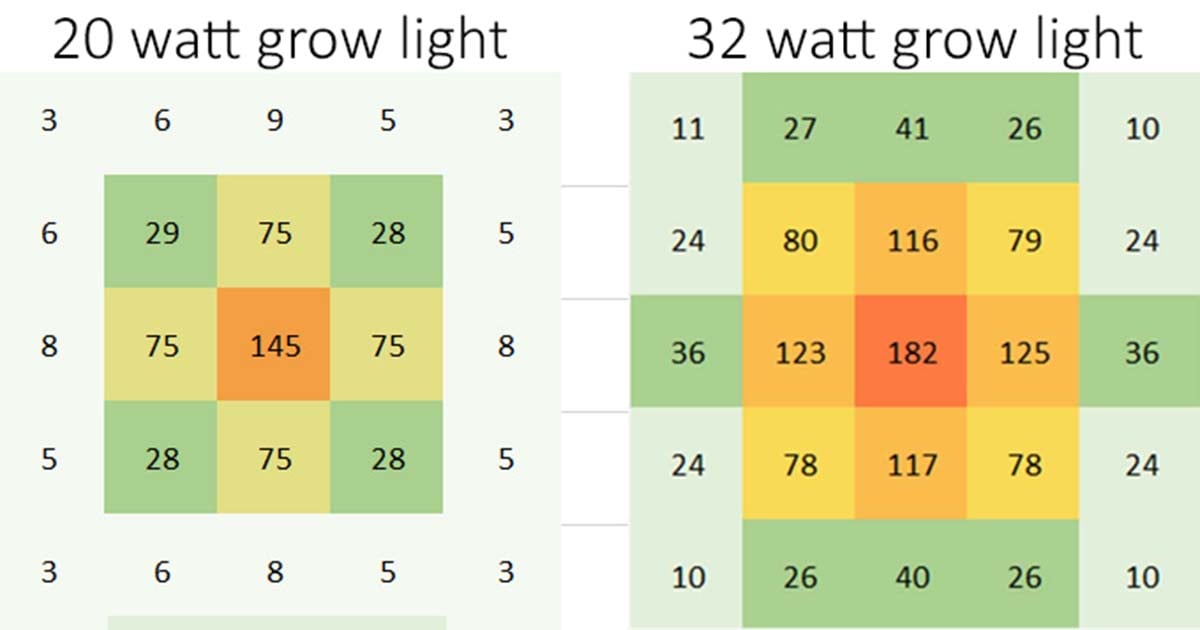
Now let's compare that 20-watt grow bulb with a 32-watt bulb with very similar PAR (usable wavelengths).
What do you notice?
- The 32-watt bulb is much stronger with higher PPFDs
- The center of the weaker bulb is still stronger than any squares outside the center of the stronger bulb.
A higher watt grow light doesn't always mean more light will reach the plant. But it usually does within the same brand. One light can be manufactured better than another and put out more light at a lower wattage than a competitor.
How does beam angle change coverage?
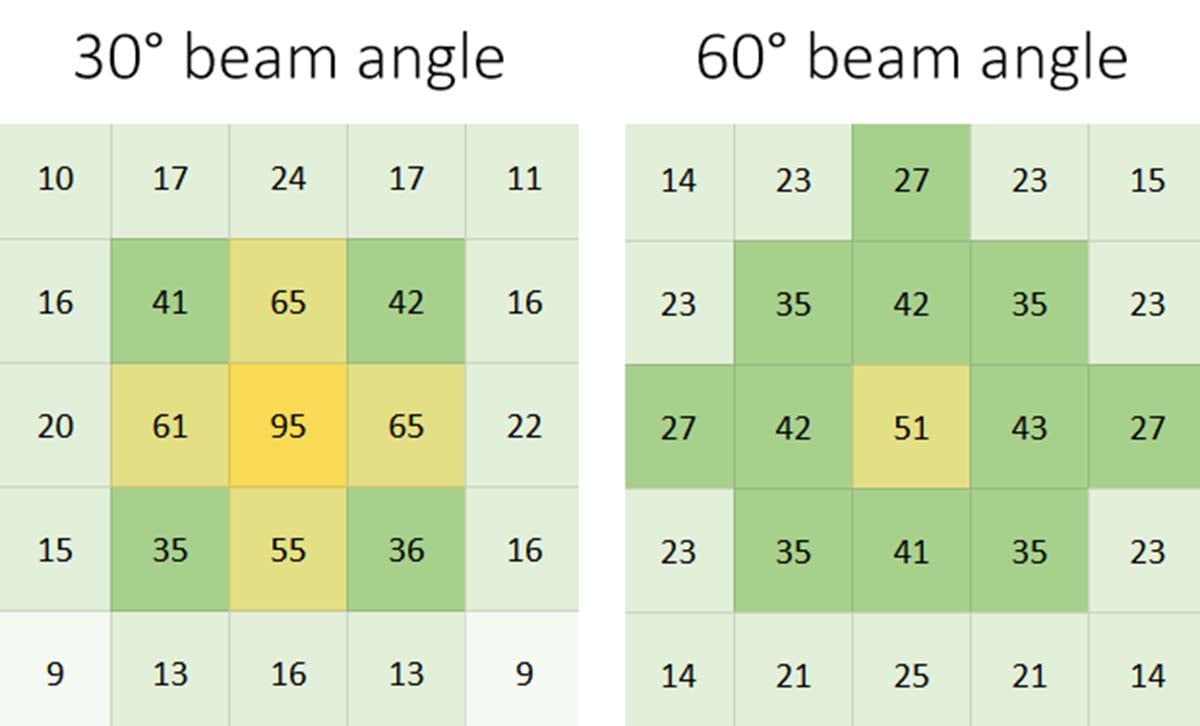
Let's also take a look at how the beam angle impacts your choice in grow lights. In the example above, these are both Soltech Highland track lights at 30 watts. The only difference is that one has a narrow 30° beam angle and the other a wider 60° beam angle.
When measured over a square meter under the light, they have nearly identical PPFD measurements:
- 30° beam angle: 30 PPFD at 3 feet above the area
- 60° beam angle: 28 PPFD at 3 feet above the area
Why is this important? Again, it depends on what you are growing.
The grow light with the narrow 30° beam angle is perfect for a small herb or lettuce plant. You can see from the example above that a plant in the very center would get a 95 PPFD!
Meanwhile, a citrus would benefit more from the 60° beam angle because the light is more evenly spread out over the lemon tree's canopy.
What if you are grouping a lot of herbs under the light, or trying to grow a ton of tomato or pepper seedlings? That setup will benefit from the wider beam angle too, so that each plant gets a more fair share of light. With a narrow beam angle, the center plants get significantly more light than the ones at the edges.
PPFD takes all of this into account and measures the light that actually reaches your plant. It is the most useful measurement for evaluating grow lights.
DLI: How much light does the plant receive all day?
Okay, so now you know how much usable light reaches the plant at different positions under the light. These numbers are much more useful when put into context: how much light does a plant need over the entire day?
You can compare this to calories. If a cup of graps has 100 calories, that doesn't mean a whole lot unless you know how many calories you need in a day. That's where DLI comes in.
The amount of light plants need each day is referred to as the Daily Light Integral (DLI). There are two factors that affect how much light your plants get from grow lights each day:
- The wavelengths (PAR) & strength of the grow light (PPF and PPFD) - everything we've discussed up to this point.
- How many hours you leave the grow light on
Another way to think of this is like summer and winter. In summer, not only is the sun more intense than in winter, but we also get more daylight hours. We know this affects humans, especially since a lot of people get a little depressed from lack of sunlight in winter.
Not surprisingly, it also matters for plants. You can increase DLI several ways:
- Use a brighter light (higher PPF)
- Move the light closer (PPFD)
- Keeping the light on longer
Key takeaways:
- DLI combines light intensity and how long the lights are on
- Different plants have different DLI needs
- When shopping: rarely mentioned on product boxes, but some might say what plants are best with the light, suggested distance above the plant, and how long to leave the light on.
Ideal DLI for plants
The ideal daily light requirements come from studies on commercially grown greenhouse crops. These requirements (suggestions) are for maximum production & profit under these commercial settings.
Because of this, I have two caveats to share:
- Not all plants we grow in our homes have well-researched DLI (total daily light) suggestions. For example, while lemon trees are an increasingly popular indoor plant, there is lacking DLI information for them. That's because there is no need to grow them commercially in greenhouses so studies are lacking.
- The DLI suggestions are intended for fast growth and maximum yield. Plants will perform fine with less light in our homes, but might be slightly slower to grow or have a smaller yield. (Too little light and they won't thrive at all and might even die).
My plants get about half of the minimum suggested commercial DLI's. I've been very happy with how those plants perform at the lower DLIs. They definitely don't grow or produce as quickly as my outdoor garden plants, but I don't expect them to.
But you can see how a commercial grower would want full production indoors. So it's easy to see why they want to blast the plants with a ton of light!
| Plant | DLI for commercial growth | My own in-home setup |
|---|---|---|
| Microgreens | 6 | 3* |
| Small herbs | 10 | 6* |
| Large herbs | 14 | 8* |
| Lettuce, arugula, spinach | 12 | 6* |
| Tomato or peppers seedlings | 14 | 7* |
| Tomatoes / peppers to harvest indoors | 20 | 10 |
| Citrus (lemon, etc) | 20 | 10* |
Plants also need darkness
Now some of you may have wondered if you could leave the light on 24/7 to get the most out of the grow lights. Unfortunately, that doesn't work.
The plants we're growing at home, indoors, do need some darkness in order to properly grow. Just like people - we don't function well if we don't have at least some darkness for sleeping.
The general recommendation is to give plants at least 8 hours without light.
Sunlight
As a reference, it's worth knowing how much light plants get outdoors from the sun, as well as indoors through the window.
We can use that information to offset some of the light provided by grow lights if your plants are sitting in front of a window.
Start with these maps below, which show the DLI (total daily light) across the US by month.
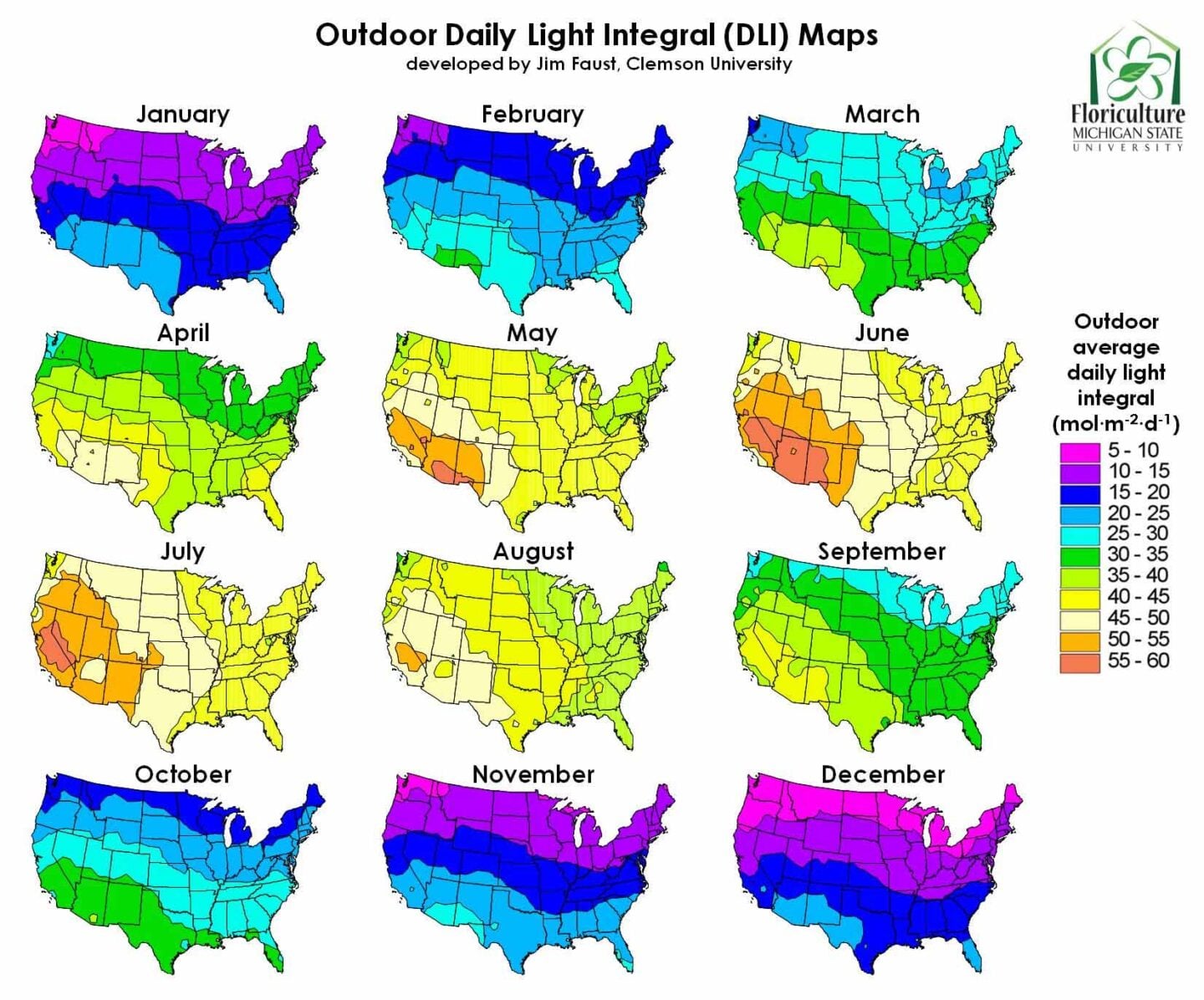
If we look at Chicago in winter, we can see that the DLI in January is 10-15, outdoors. Modern windows typically block about 50% of that light, so the best we can get inside in Chicago is 5-7 DLI.
But even that much is unlikely, unless you have south-facing windows and a skylight. So start reducing the DLI from there. For Chicago in January, here's what I'd estimate for Chicago in the winter:
- A south facing window that isn't shaded by a nearby tree or house, can probably get 3-5 DLI as a rough estimate
- East and west windows: 2-3 DLI
- North facing windows: 1 DLI
And if we look at Chicago in July, the DLI is 40-45 outside. The windows would block 50%, letting in enough light to get a DLI of 20-22 indoors (Less depending on your window situation and the sun angle).
This assumes your plant is right next to the window. As it moves further away, it will get less light (it's surprising how quickly the light intensity drops as you move further away).
I've started seedlings in front of my south-facing windows and they still get leggy without a grow light. So they do still benefit from some supplemental light in spring.
Calculating total daily light: DLI
It's important to be able to calculate this, because it determines how much light you'll need from grow lights, which ones to buy, and where to place them (close or further away).
Thankfully, there's a DLI calculator for that. You need to know two things for the calculation
- PPFD
- Number of hours you plan to leave the light on for
Measuring the PPFD requires the actual light source and an expensive light meter tool. Although some manufacturers do list it!
Since this isn't something anyone is going to do when shopping for grow lights, I've done it for you. You can use the values from my study to calculate your own DLI.
Grow light measurements & results
I tested white (full spectrum) lights because I wanted to grow plants in my living spaces and not see this purple-pink light everywhere.
To do this, I purchased a scientific grade PAR meter listed below, which allows me to get PPFD readings for each grow light.

- Scientific grade PAR meter with genuine quantum sensor. Measures PPFD, Daily Light Integral as...
I personally measured each of the lights in this test following industry guidelines. I also ran my methodology and results past several experts including a UCLA biology instructor for growing plants indoors as well as the Co-founder of Soltech (not sponsored).
I also compared my results to published studies and got similar values. Because of this, I'm confident in the accuracy of my tools and setup.
Here's how I set up some standardized tests:
- Used a basement room with no windows so it is completely dark. The room also had dark gray and concrete walls to reduce reflective surfaces (so get the lowest reading possible so you should get this performance or better).
- Hung the light at a specific height, in this case, 3 feet above where the plant would sit.
- Taped 1 square meter out on the ground and divide it into a 5x5 grid.
- Turned the light on and put the meter in each grid to take a measurement. Stand alone bulbs were put into a reflective fixture.
- Filled in a 5x5 grid with my numbers
- Turned those numbers into a heat map
- Repeated with a light only 2 feet above the plant to simulate another at-home option and to show you how more light reaches the plant when it's closer.
I share the results of each grow light test below in the heat maps. I also included a chart to give you an idea of how much light your plants will receive under 3 scenarios:
- Center spot: a small plant placed right in the center of the grow light
- 2 foot cluster: assuming you have a medium sized plant that takes up about 2 feet, or a cluster of small plants that take up the same space
- 3 foot canopy: assuming you have a large plant (like a citrus tree) that takes up the entire measured area (which is actually 1 square meter / 3.3 square feet).
First I'll share measurements for grow light fixtures, followed by stand alone bulbs you can put in your own lamps at home.
CFGROW CREE COB 100 watt grow light
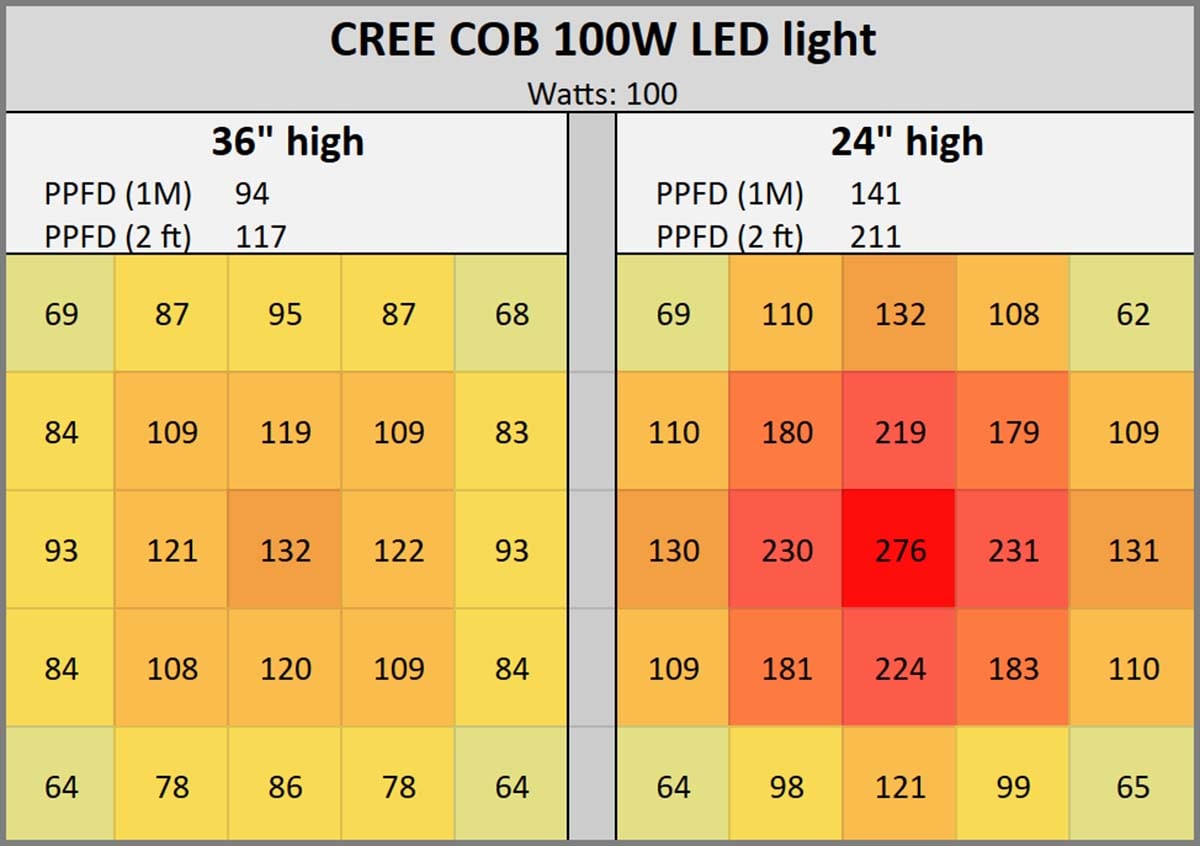
This is a super powerful grow light. I actually measured the old model, which the brand has replaced with a new one. Their listed PPFDs look the same so I hope the measurements I've taken are still representative.

- New COB LED Grow Light with New Technology, ensure the light power intensity better than 300W...
| Measurement | Center spot | 2 foot cluster | 3 foot canopy |
|---|---|---|---|
| PPFD at 2 feet above the plant | 276 | 211 | 141 |
| DLI for 8 hours | 8 | 6 | 4 |
| DLI for 12 hours | 11.9 | 9.1 | 6.1 |
| DLI for 16 hours | 15.9 | 12.2 | 8.1 |
This grow light is great for indoor fruiting plants, like lemon trees or tomatoes. I have one of these for each citrus tree and leave it on for 16 hours. That plus light from the south-facing window is enough to keep them healthy enough to flower and produce fruit.
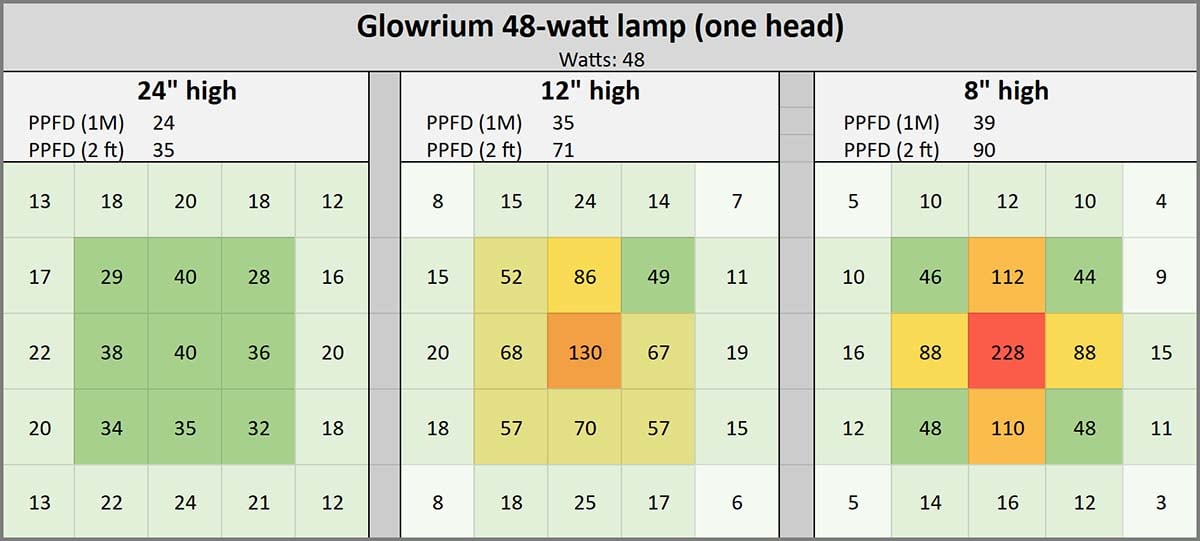
Glowrium 48-watt lamp
Glowrium was kind enough to send me some products to test. All of the other lights you see in this article I either purchased myself, or was provided at no cost but returned after testing. Glowrium let me keep the products.
After I took the measurements, I looked at what Glowrium was reporting on their own site. I was very happy to see our measurements were extremely close. If you shop through them, I'd feel confident in the PPFD numbers they report.
| Measurement | Center spot | 2 foot cluster | 3 foot canopy |
|---|---|---|---|
| PPFD at 2 feet above the plant | 40 | 35 | 24 |
| DLI for 8 hours | 1 | 1 | 0.7 |
| DLI for 12 hours | 1.7 | 1.5 | 1 |
| DLI for 16 hours | 2.3 | 2 | 1.4 |
I tried to not let the free products affect my judgement. I did, however, take some additional measurements at closer distances because their lights allow it without harming the plant. However other lights that are more intense (like the CFGrow and Soltech Aspect) should not be placed closer than 2 feet or you risk burning the plant.
Here's the same chart, but at just 12" above the top of the plant, which I think would be an average use case for a lamp like this.
| Measurement | Center spot | 2 foot cluster | 3 foot canopy |
|---|---|---|---|
| PPFD at 1 foot above the plant | 130 | 71 | 35 |
| DLI for 8 hours | 3.7 | 2.0 | 1 |
| DLI for 12 hours | 5.6 | 3.1 | 1.5 |
| DLI for 16 hours | 7.5 | 4.1 | 2 |
You can go even closer, which would make sense for a smaller desk lamp. You can use the PPFD's listed on the Glowrium site to calculate the DLI on waveformlighting.com.
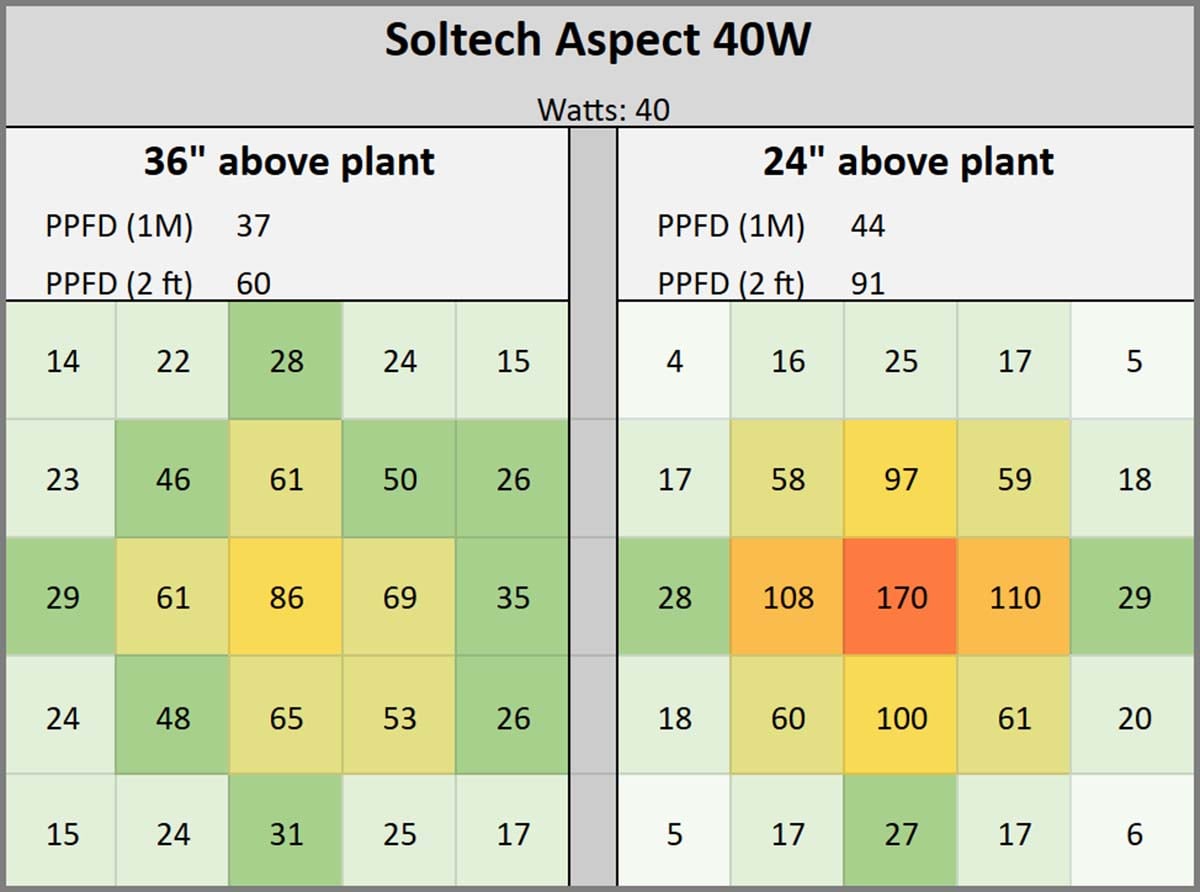
Soltech Aspect pendant grow light (40 watt)
Soltech makes a couple of lights that look nice. They are meant to integrate into your living space while looking attractive.

I actually measured the previous version of this light which was 40 watts. The Gen 2 version has 20% more usable light than the version I measured, and is only 36 watts (because it doesn't need as much power).
My guess is the PPFD of the Gen 2 will be maybe 10%-30% higher than my own measurements. I'll try to get one to measure it.
This pendant light has a very focused beam. It's great for hanging over a single plant. Since the beam is so focused, measuring it over a square meter is a bit detrimental (it's like a focused flashlight beam).
| Measurement | Center spot | 2 foot cluster | 3 foot canopy |
|---|---|---|---|
| PPFD at 2 feet above the plant | 170 | 91 | 44 |
| DLI for 8 hours | 4.9 | 2.6 | 1.3 |
| DLI for 12 hours | 7.3 | 3.9 | 1.9 |
| DLI for 16 hours | 9.8 | 5.2 | 2.5 |
Use this table to decide where your plant will be and how long you are willing to leave the light on. Then you can decide if 1 fixture is enough or if you need to point more than a single light at it.
For example, this light is more than strong enough for a small plant placed in the center, with the light left on for 16 hours. But it's not strong enough for a citrus tree with a 3-foot canopy because it only gets 2.5 DLI over 16 hours, when it needs closer to 10.
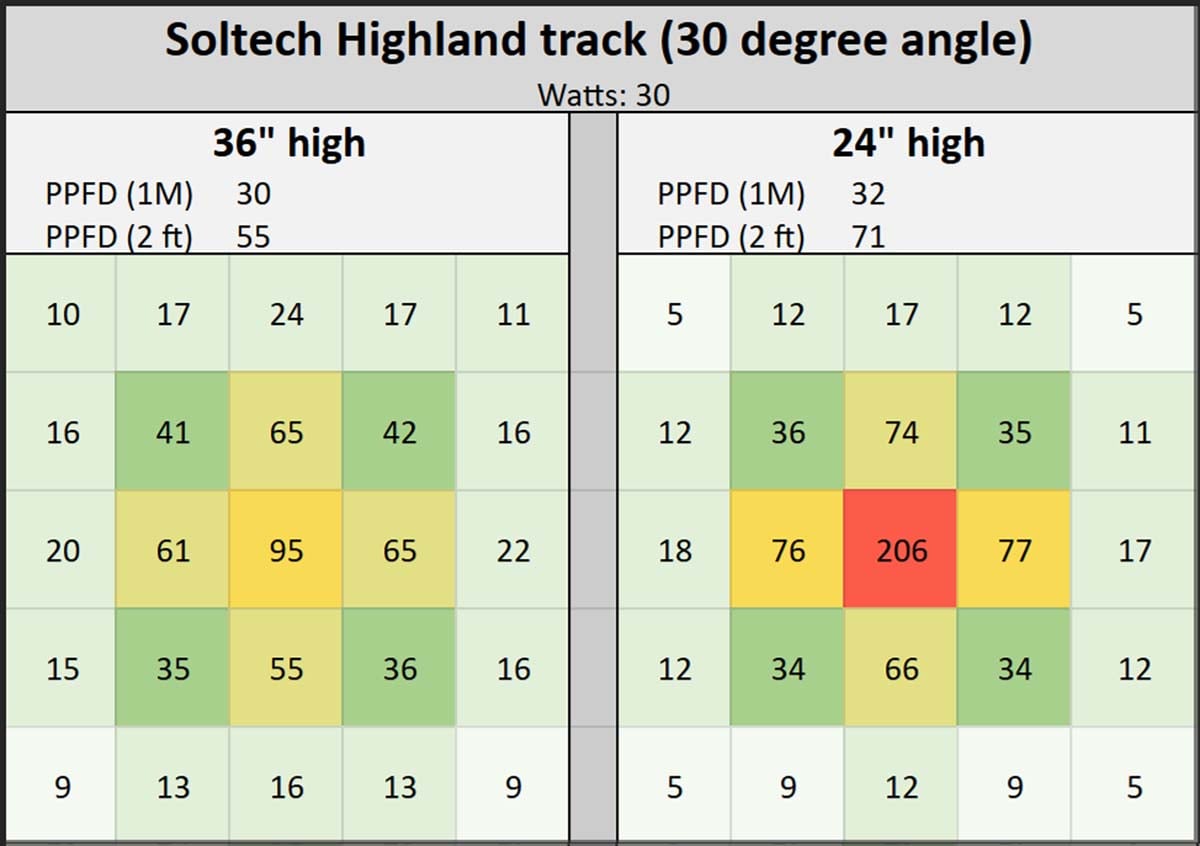
Soltech Highland track light (30 degree angle)
There are two track heads, one with a 36° beam angle, and one with a wider 60° beam angle. If your track is on the ceiling and that's far away from your plants, get the 36° angle. If it's close to your plants (like within 2-3 feet), get the 60° angle.

I actually had the older model of the narrow beam, which was 30° instead of the now 36°. So the heat map would be slightly more evenly distributed for the newer model.
| Measurement | Center spot | 2 foot cluster | 3 foot canopy |
|---|---|---|---|
| PPFD at 2 feet above the plant | 206 | 71 | 32 |
| DLI for 8 hours | 5.9 | 2 | 0.9 |
| DLI for 12 hours | 8.9 | 3.1 | 1.4 |
| DLI for 16 hours | 11.9 | 4.1 | 1.8 |
These track grow lights fit on any H track and you can fit 1 per foot in case you need to aim multiple at a larger plant, like a citrus tree.
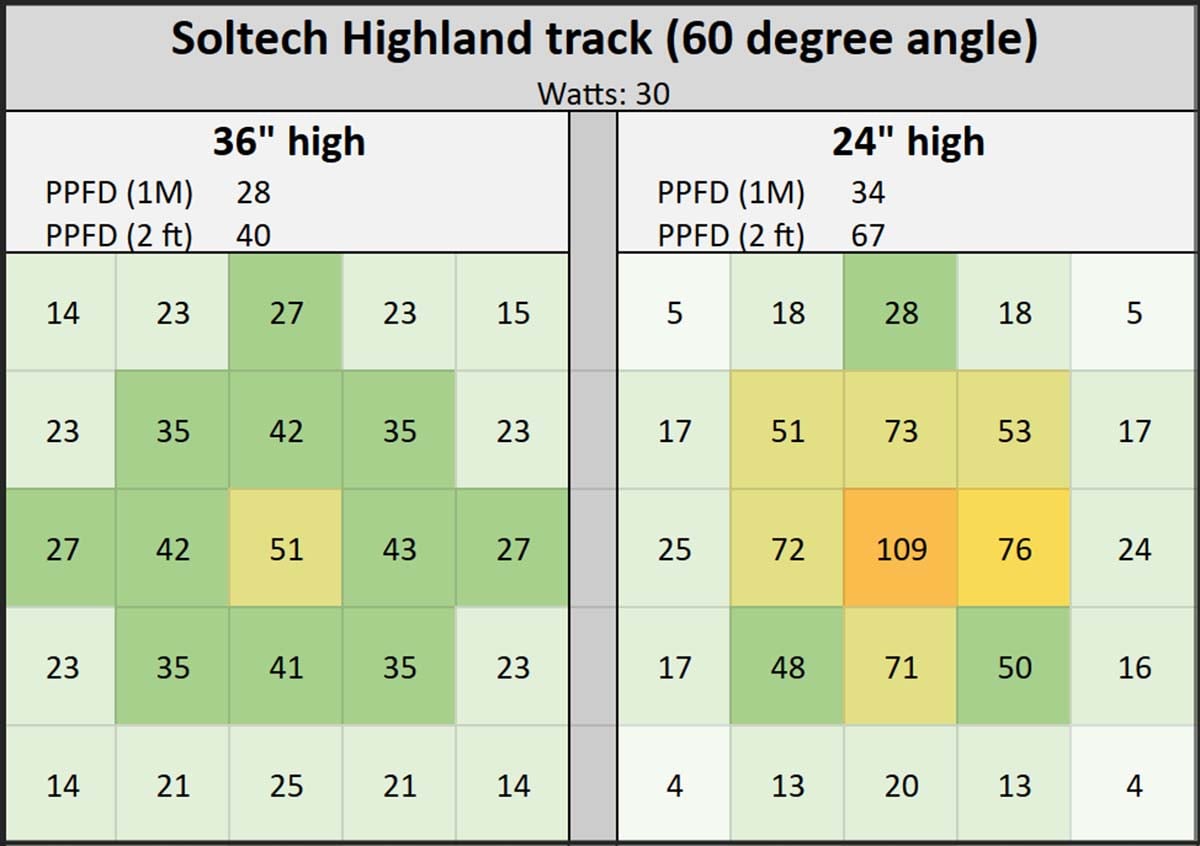
Soltech Highland track light (60 degree angle)
I also measured the wide angle version of the Soltech track light, wondering which would be better for my indoor lemon, lime, and clementine trees.
| Measurement | Center spot | 2 foot cluster | 3 foot canopy |
|---|---|---|---|
| PPFD at 2 feet above the plant | 109 | 67 | 34 |
| DLI for 8 hours | 3.1 | 1.9 | 1 |
| DLI for 12 hours | 4.7 | 2.9 | 1.5 |
| DLI for 16 hours | 6.3 | 3.9 | 2 |
The overall PPFD is very similar, however the light is more evenly spread out with the 60° version, as you can see from the heat map. That means the canopy of the citrus trees will get more even light, which is better for the plant.
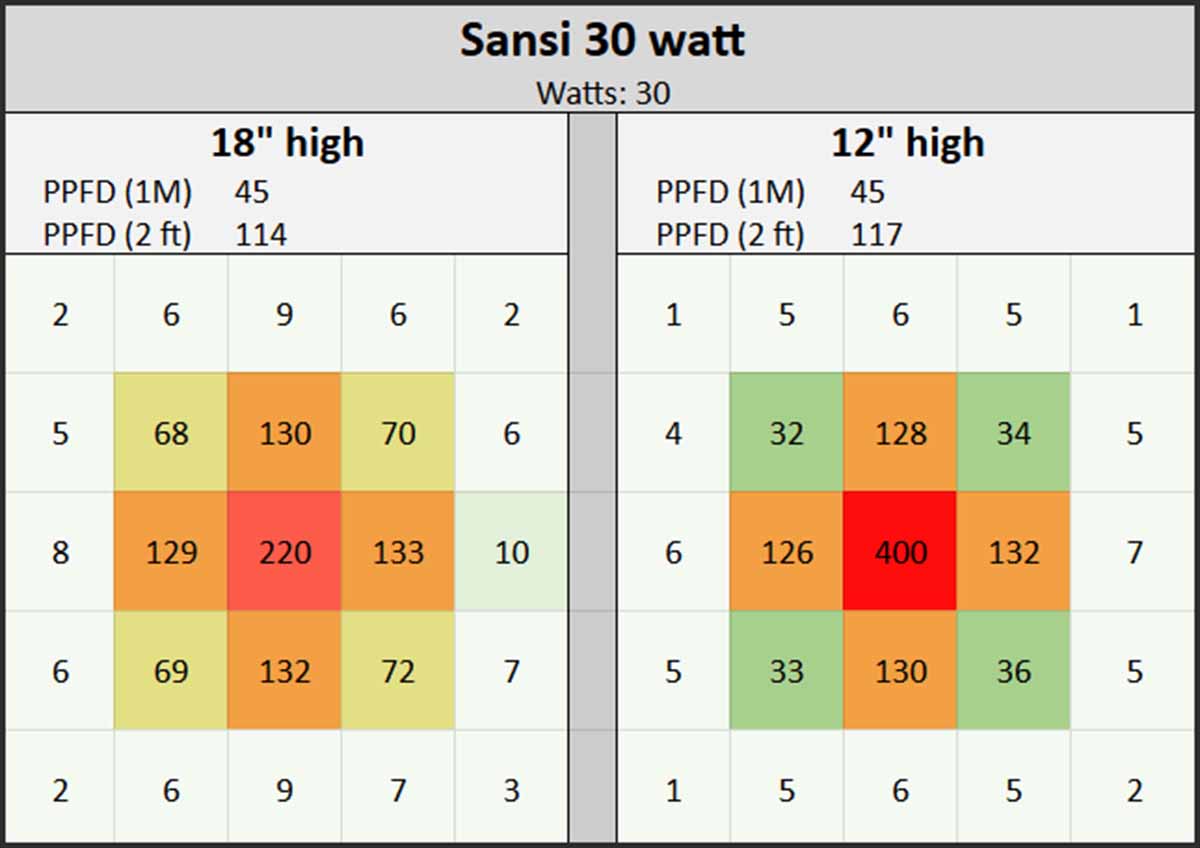
Sansi 30 watt grow light bulb
This bulb has good output but also has some red and blue artifacting in the shadows that can be hard to look at if used in a living space.

- [Full Spectrum + 660NM Supplementary Light] Customized red and white full spectrum, realizes a...

| Measurement | Center spot | 2 foot cluster | 3 foot canopy |
|---|---|---|---|
| PPFD at 18 inches above the plant | 220 | 114 | 45 |
| DLI for 8 hours | 6.3 | 3.3 | 1.3 |
| DLI for 12 hours | 9.5 | 4.9 | 1.9 |
| DLI for 16 hours | 12.7 | 6.5 | 2.6 |
Compared to similar wattage bulbs, the SANSI has pretty efficient output. If you want a dimmable version that also comes with a remote (and timer function), you can get this one on Amazon.
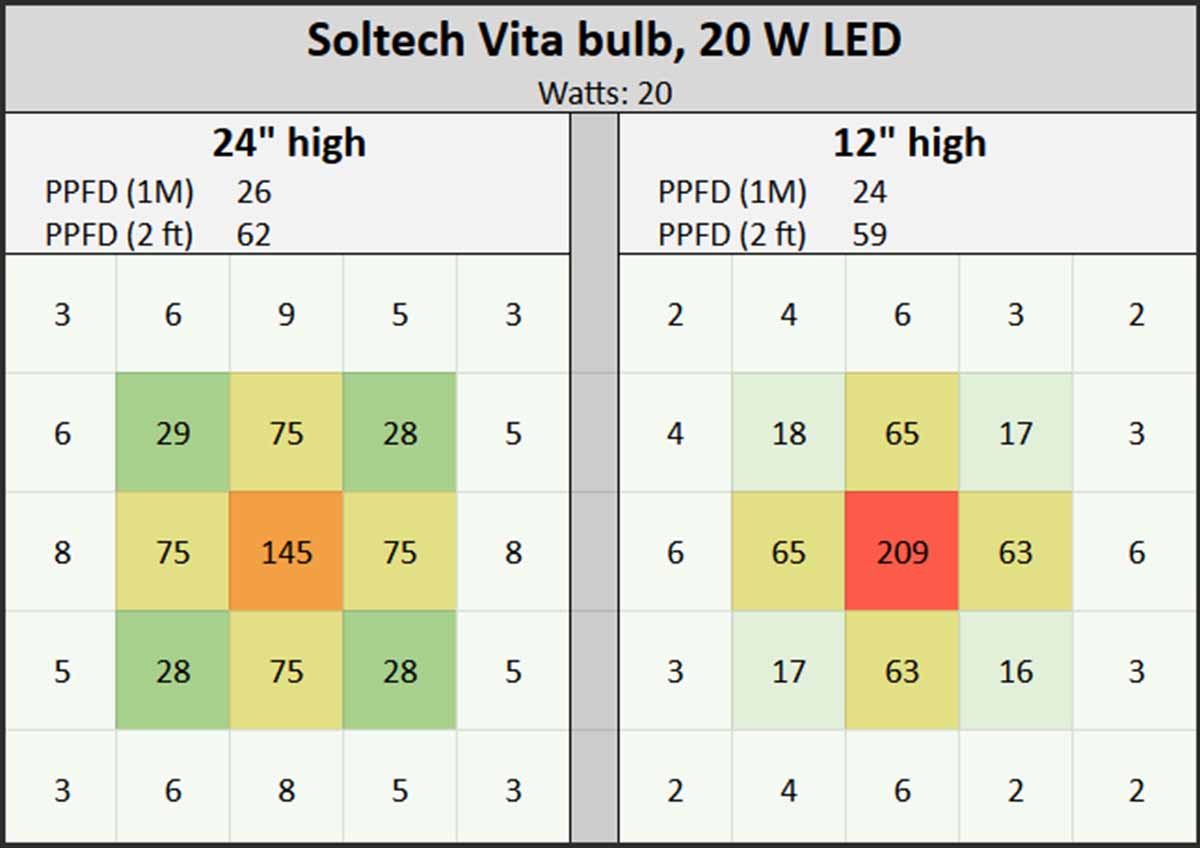
Soltech Vita 20 watt bulb (60° beam angle)
This bulb does well for its energy consumption. It's great for decorative indoor plants, but only supports 1 small sun-hungry food plant (like basil). It fits in a regular (E26) socket but the top end is larger, like a flood light.
They also sell a 36° beam angle, but I only tested the 60° version.
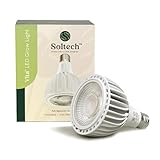
- THE ORIGINAL DECOR GROW LIGHT COMPANY: Soltech has been building grow lights in Bethlehem, PA...
| Measurement | Center spot | 2 foot cluster | 3 foot canopy |
|---|---|---|---|
| PPFD at 12 inches above the plant | 209 | 59 | 24 |
| DLI for 8 hours | 6.0 | 1.7 | 0.7 |
| DLI for 12 hours | 9.0 | 2.6 | 1.0 |
| DLI for 16 hours | 12.0 | 3.4 | 1.4 |
This is a fairly pricey bulb, but they have built it to try to reduce glare and be generally easy on the eyes in your main living space. It's also dimmable (the other bulbs I listed are not dimmable).
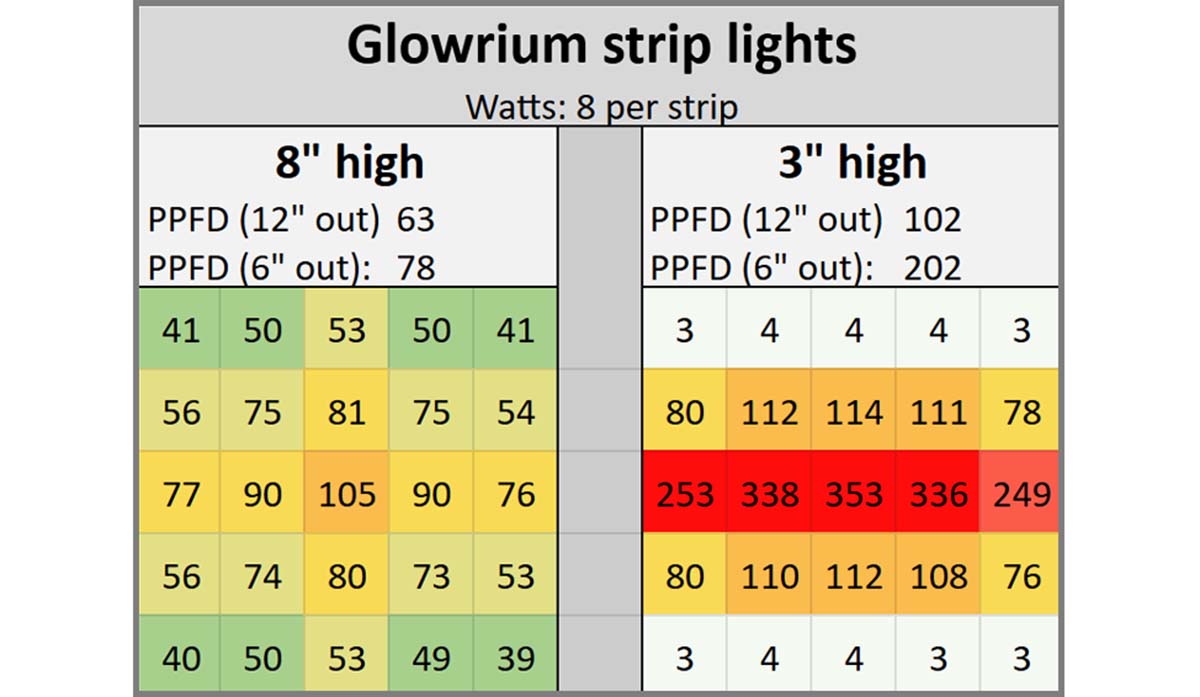
Glowrium light strips
These were also provided to me for free and the measurements seemed pretty close. My PPFD at 3 inches above the plant, measuring the center and 3" out in both directions gave me a PPFD of 202. The Glowrium site lists a PPFD at the same height at 256, which might have measured something more like 1.5 inches in both directions.
A height of 3 inches above the plant is a great option for growing seedlings.
| Measurement | Center strip | 3" out on both sides | 6" out on both sides |
|---|---|---|---|
| PPFD at 3" above the plant | 306 | 202 | 102 |
| DLI for 8 hours | 8.8 | 5.8 | 2.9 |
| DLI for 12 hours | 13.2 | 8.7 | 4.4 |
| DLI for 16 hours | 17.6 | 11.6 | 5.9 |
I haven't tested other grow light strips like this. If you compare their PPF (or PPFD) to see how powerful each one is. I do really like that these integrate with their app to control on/off times.
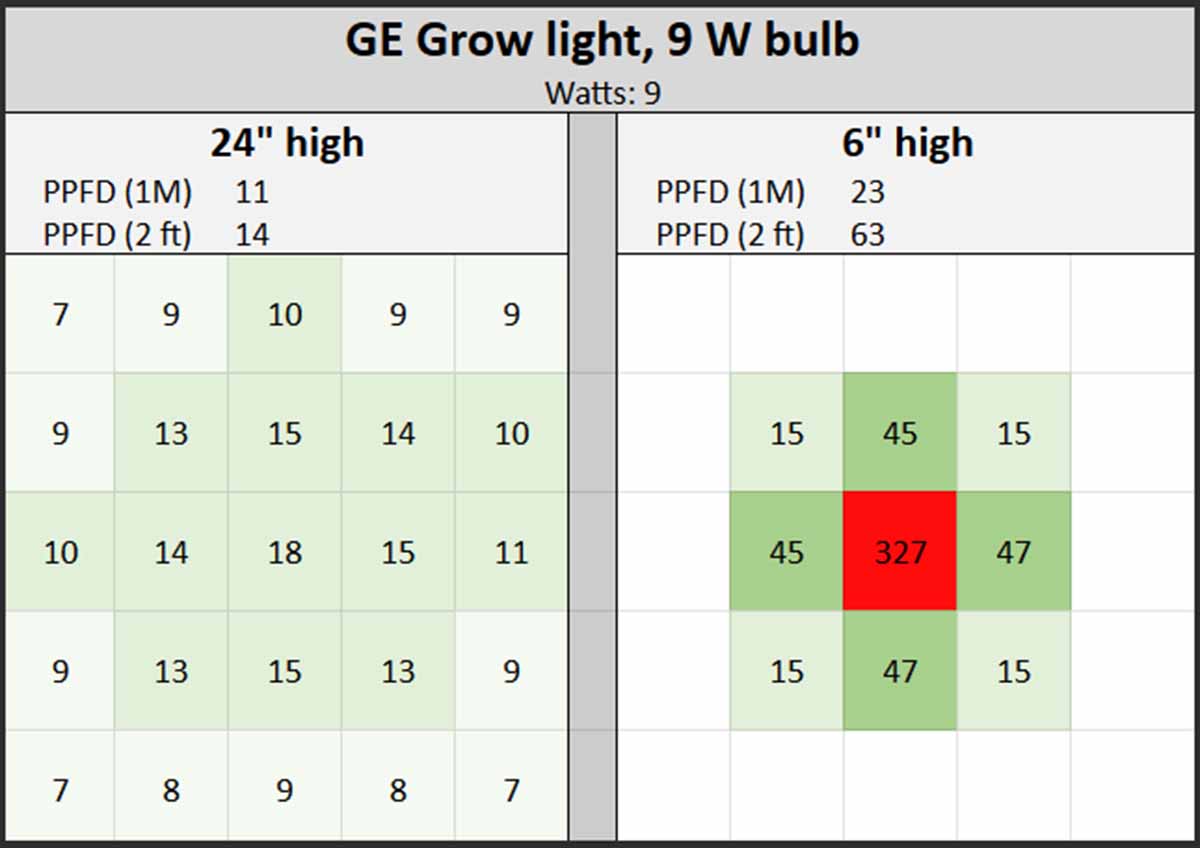
GE 9 watt grow light
This little grow light bulb isn't very strong but it works when placed really close to a single, small plant.

- Plant Grow Light: This plant light for indoor plants provides the perfect high-quality...
The listed price is for two bulbs (all of the others I listed are for a single bulb). But that still doesn't make this light worth it.
Leave a Reply