I'm an organic gardener and avoid pesticides at all costs. However, when it comes to squash vine borers, I seem to battle them every year and need all the help I can get, which is why I turn to two organic biopesticides: Bt and spinosad.
For squash vine borers, specifically, I prefer Bt because it targets caterpillars with very little risk to bees and other beneficial insects. I use spinosad when I need something that lasts longer between applications.
So I'm here to help you learn when, how, and why to use Bt and spinosad on your squash plants this year.
- How do Bt and spinosad kill squash vine borers?
- When do I spray? And how often?
- What about injecting Bt?
- What if it doesn't work?
- What do I do if I want to minimize pesticide use?
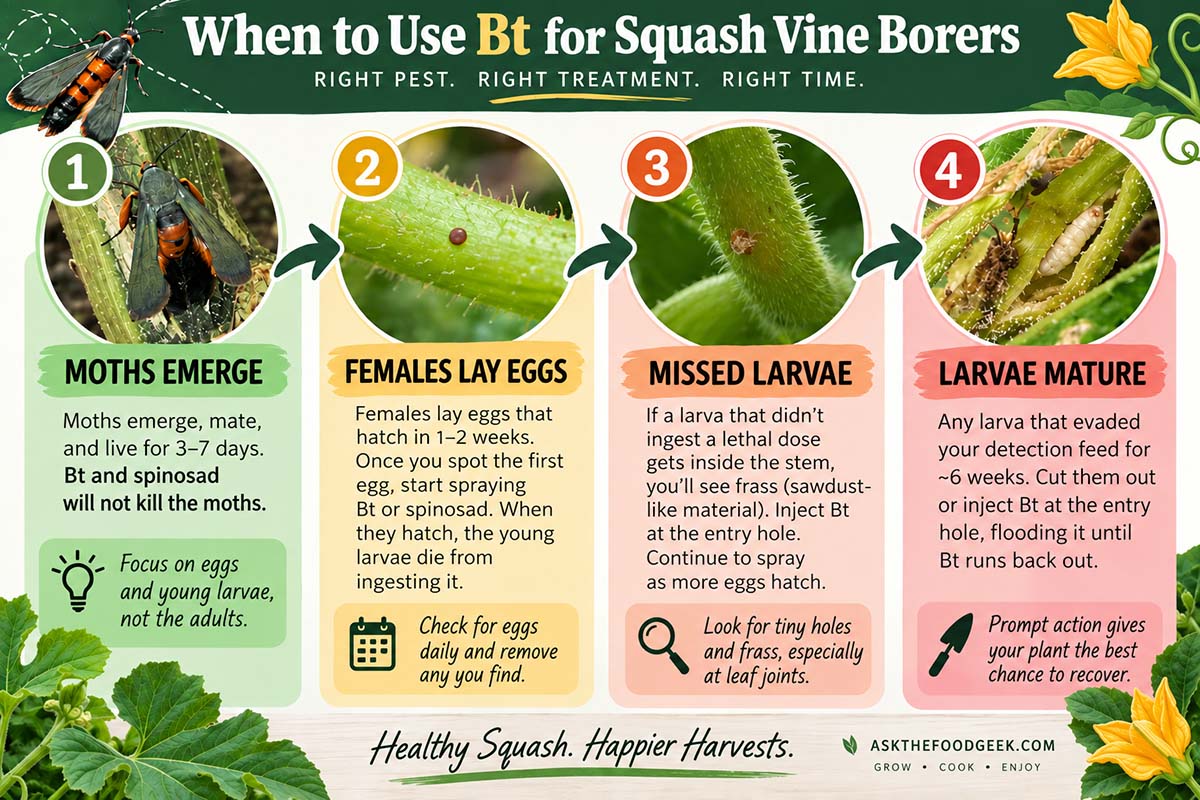
Neither one is a magical solution. But if you know how they work and when to apply them, you'll give your plants the best chance at surviving against squash vine borers (svb).
Jump to:
- How Bt and spinosad stop squash vine borers
- Bt vs Spinosad
- What is Bt (Bacillus thuringiensis)?
- What is spinosad
- When & how to spray Bt or spinosad
- How to inject Bt for a current infestation
- Does preventative Bt injection work?
- Do the insecticides get into my squash?
- Which method is right for you?
- Summary & more squash guides
If you're already seeing frass or wilting and think you already have borers in your stems, skip to the section on injecting Bt or check out my full guide on saving squash plants from squash vine borer damage.
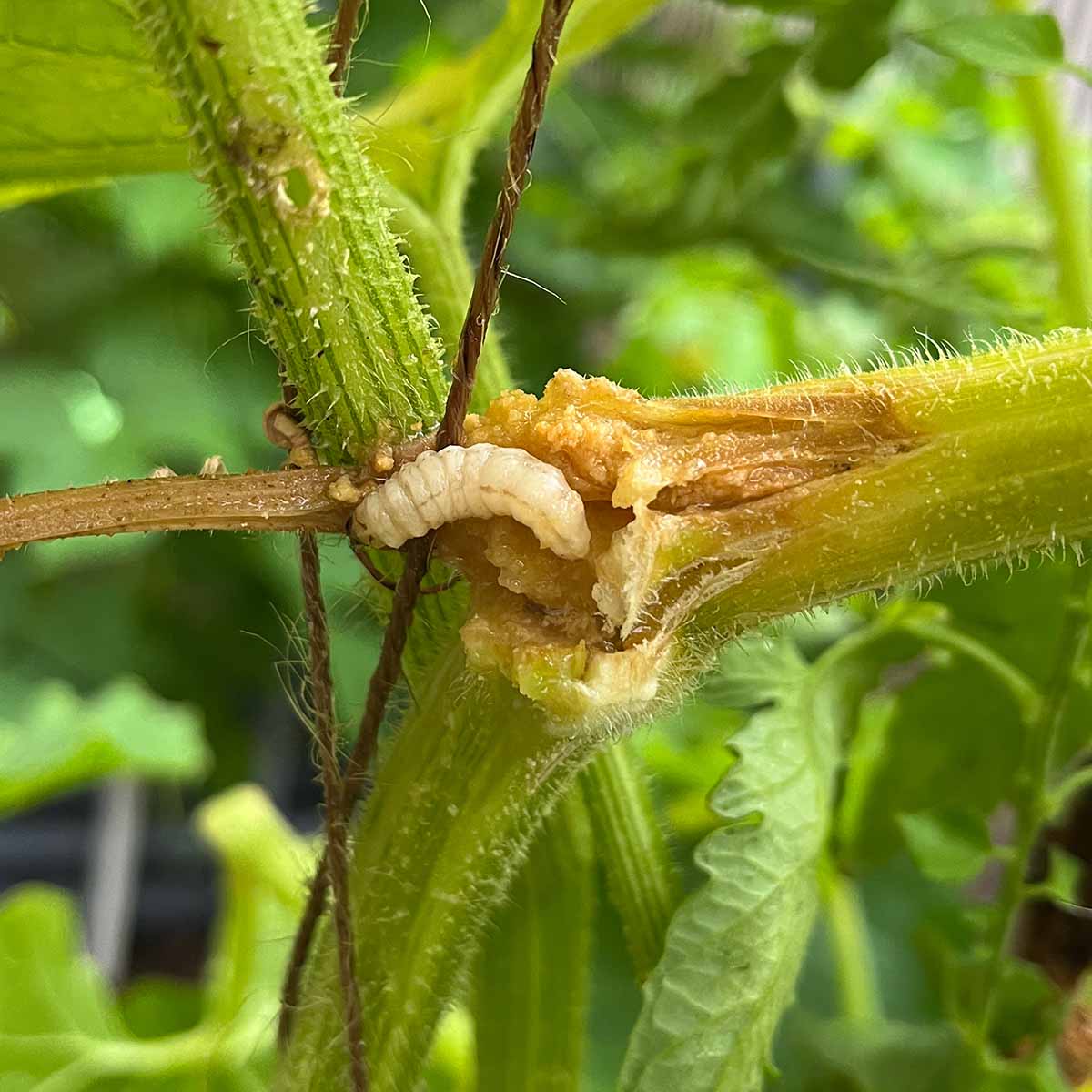
How Bt and spinosad stop squash vine borers
Neither Bt nor spinosad kills the squash vine borer eggs, unfortunately. I'm not aware of any spray (organic or conventional) that will kill the eggs.
Instead, you're using these insecticides to kill the larvae after they hatch.
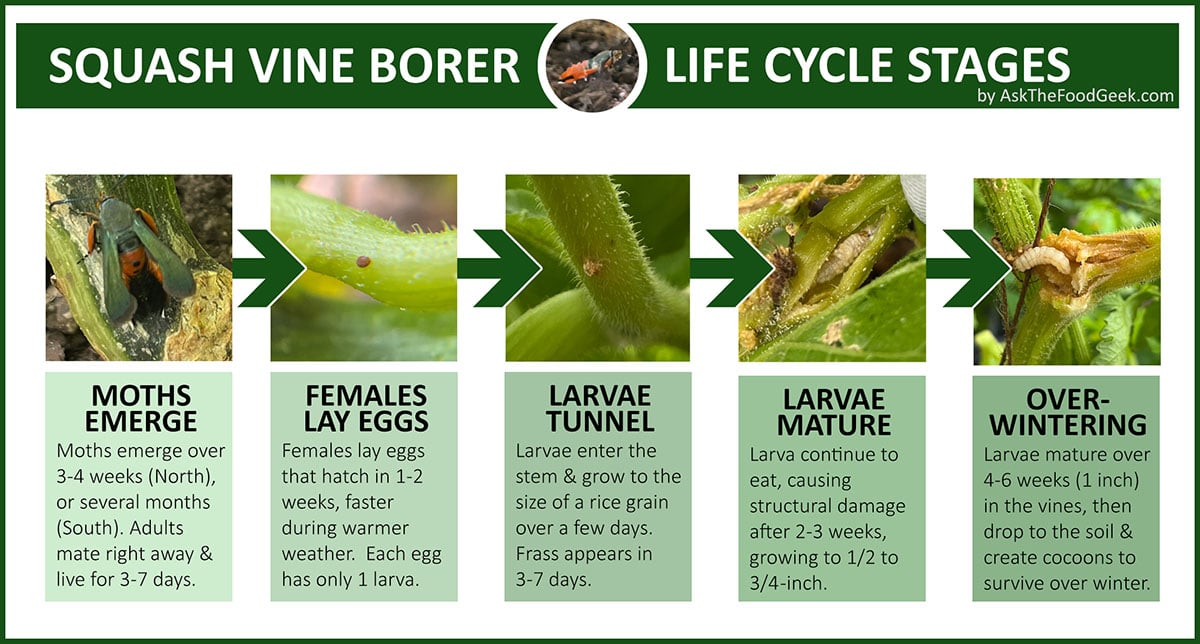
Surface spraying and injection target two different stages of the squash vine borer lifecycle.
- A surface spray targets newly hatched larvae as they feed on their way into the stem
- Injection targets larvae that are already feeding inside the stem
The catch for these to work is that there needs to be Bt or spinosad on the plant where they are eating for them to be exposed to a lethal dose. This is true whether you're spraying it or injecting it.
Bt vs Spinosad
I wanted to provide a quick overview of these two organic insecticides and then go into detail about each one.
| Characteristic | Bt (Btk) | Spinosad |
|---|---|---|
| Target | Caterpillar larvae | Caterpillars, thrips, leafminers, beetles, fruit flies |
| Kills SVB larvae | Yes | Yes |
| Kills SVB eggs | No | No |
| How larvae are exposed | Ingestion | Ingestion and some contact |
| How long it lasts | 1-4 days (possibly up to a week) | 1-2 weeks |
| Bee risk | Extremely low | Toxic when wet (little to no effect after it dries) |
| Bird risk | Very low | Low |
While the active ingredients are organic, not every formulation is, so be sure to check the label before purchasing.
These are also both biopesticides because they come from a natural source, which generally have less risks than human-made pesticides. But that doesn't mean they have zero risk to the other living things in our yards.
Which one should you choose?
If you only need to deal with squash vine borers, I'd recommend using Bt because it's highly targeted with extremely low chances of harming birds, bees, and other insects.
However, spinosad is useful as a foliar spray when you don't have time to reapply Bt every few days or will be on vacation. Spinosad is also effective against many other garden pests, including tomato hornworm and asparagus beetles.
What is Bt (Bacillus thuringiensis)?
Bt is shorthand for Bacillus thuringiensis, a naturally occurring soil bacterium that has proteins toxic to certain insects.
There are different Bt strains depending on which insect you are targeting. For squash vine borers, you'll want to buy Btk (Bt var. kurstaki). This targets caterpillar larvae (which includes the squash vine borers).
The main advantage of Bt is how narrow it's target is: caterpillar larvae. I appreciate that when I'm only trying to kill squash vine borer as I don't have heavy pressure from other pests. The tradeoff is that it breaks down relatively quickly from sunlight.
Toxicity to other insects & animals
Bt is so highly recommended because of its low toxicity to non-target species. Here are some stats from the National Pesticide Information Center:
- Practically nontoxic and doesn't cause disease in birds and fish
- Does not cause disease in mammals
- Little to no toxicity to non-target insects, lacewings, predatory beetles, parasitic wasps, or earthworms
- Toxic to other caterpillars that feed on this plant
This is assuming it's properly diluted and applied as instructed.
Where to buy Bt
You can probably find it at your local nursery, hardware store, and big box chain. I use the Captain Jack's because it's ready to spray and pre-diluted.
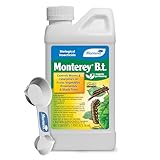
The other organic brands are Southern AG, Safer, and Monterey. (Note not all formulations are organic, depending on whether they add other things to the formula).
Here's what those brand labels will look like, so you can find them locally. If you want to buy them from Amazon, the links below are affiliate so I get a small commission if you buy something.



How much to buy
I buy my Captain Jacks from Amazon and go through about 4 bottles each summer across 10 squash plants as a preventative spray and injection.
I spray 2-3 times a week, depending on weather and only have one squash vine borer cycle a year here in the Chicago area (warmer climates have two).
Always follow the manufacturer instructions for mixing and using (like how often you should reapply when spraying).
What is spinosad
Spinosad is an insecticide made from the soil bacterium, Saccharopolyspora spinosa, and is commonly used in organic gardening to control a number of pests besides the squash vine borer (thrips, leafminers, spider mites, and more).
It won't kill the adult moths, but it will kill the larvae if they ingest it, or with sufficient contact exposure. This can happen when they hatch and start chewing their way into the main vine.
It also won't kill squash bugs (a different pest). Sorry for the bad news on that one!
Toxicity to other insects & birds
Spinosad is broader-spectrum than Bt, targeting a much wider range of insects. Fresh spray is highly toxic to bees, but dried residues have little to no effect on honeybees and other beneficial insects.
"Spinosad is practically non-toxic to slightly toxic to birds, based on studies with bobwhite quail and mallard ducks. It is moderately toxic to earthworms. Spinosad is very highly toxic to bees. However, evidence suggests that spinosad has little or no effect on honey bees and other beneficial insects after sprays have dried." - National Pesticide Information Center
This is why guides advise you to only spray spinosad in the evening. As this article from Texas A&M says, "Spray your plant stems weekly with spinosad for control of SVB, but do it in the evening when bee activity has ceased. Spinosad is toxic to bees when wet."
Where to buy spinosad
You should be able to find spinosad at some nurseries and big box hardware stores, but you'll have to read the labels for the active ingredient.
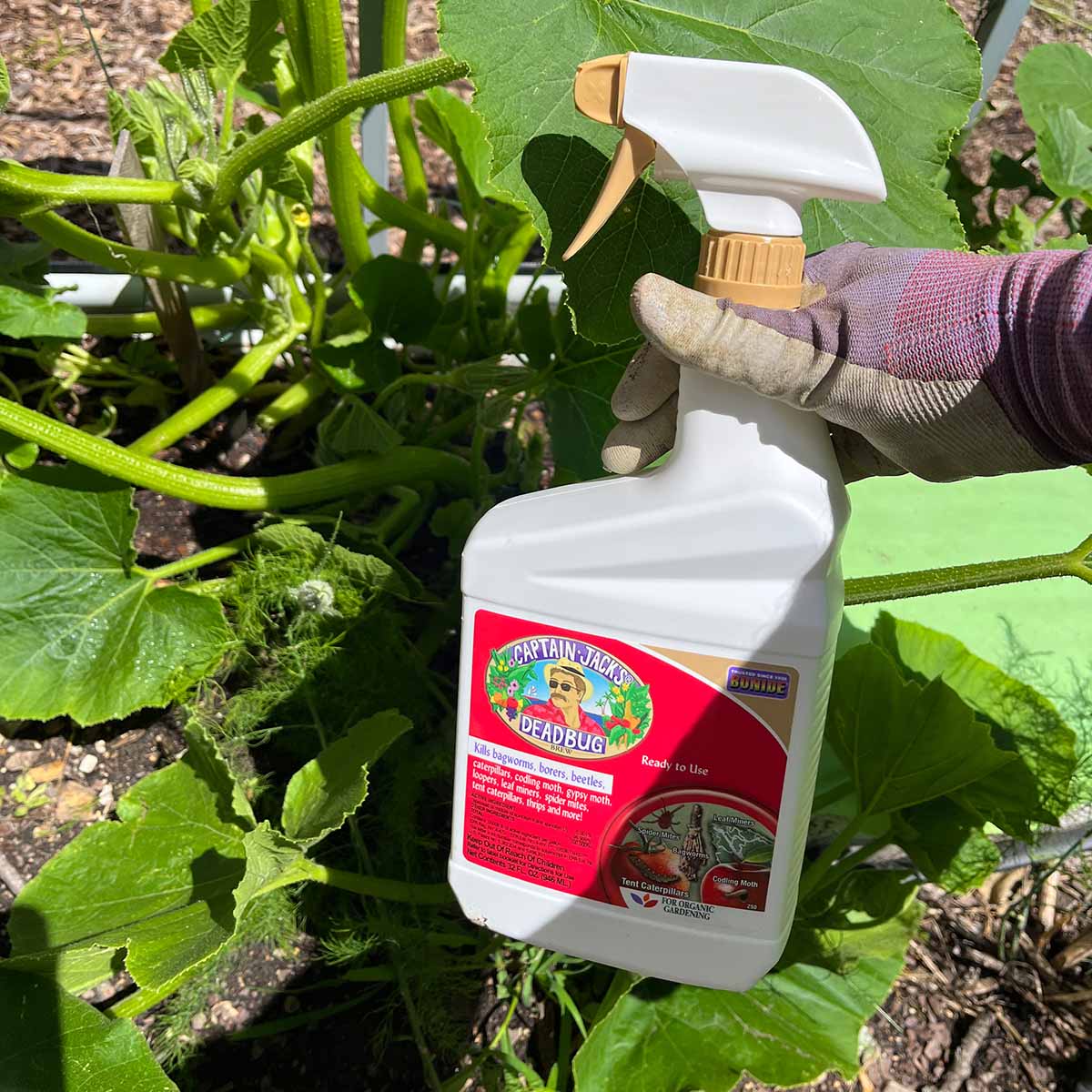
Most branding for spinosad promotes it as a more general bug killer, like Captain Jack's "Deadbug." The active ingredient is spinosad, which is what you want to look for.
Here are some organic options to buy on Amazon or in your local stores.


How much to buy
I sprayed spinosad on my squash plants this past year as a test for this article. It's a very limited data set, but it seemed to work as well as Bt.
To give you an estimate that you can scale up or down for your own garden, I went through 2 bottles over about 6 weeks to cover these 6 plants:
- 2 zucchini
- 2 sunshine kabocha squash that were 5 feet long at the start of svb season, growing to over 8 feet by the end of it.
- 2 delicata that were under 4 feet the entire time
I sprayed about once a week, reapplying after rain. My garden is in the Chicago area so I only get 1 svb season a year.
When & how to spray Bt or spinosad
Once you spot adult squash vine borer moths (or eggs), you should start spraying your squash plants as a preventative measure. Continue to spray for 2-3 weeks after you don't find any new eggs (since the eggs can take 2 weeks to hatch). I live in the Chicago area and spray from about mid-June to mid-August.
The goal is the same for all types of squash plants: get full coverage along the entirety of the main stem and the leaf stems.
Although the process differs slightly between zucchini (and other summer squash), and vining winter squash.
Where to spray zucchini & summer squash
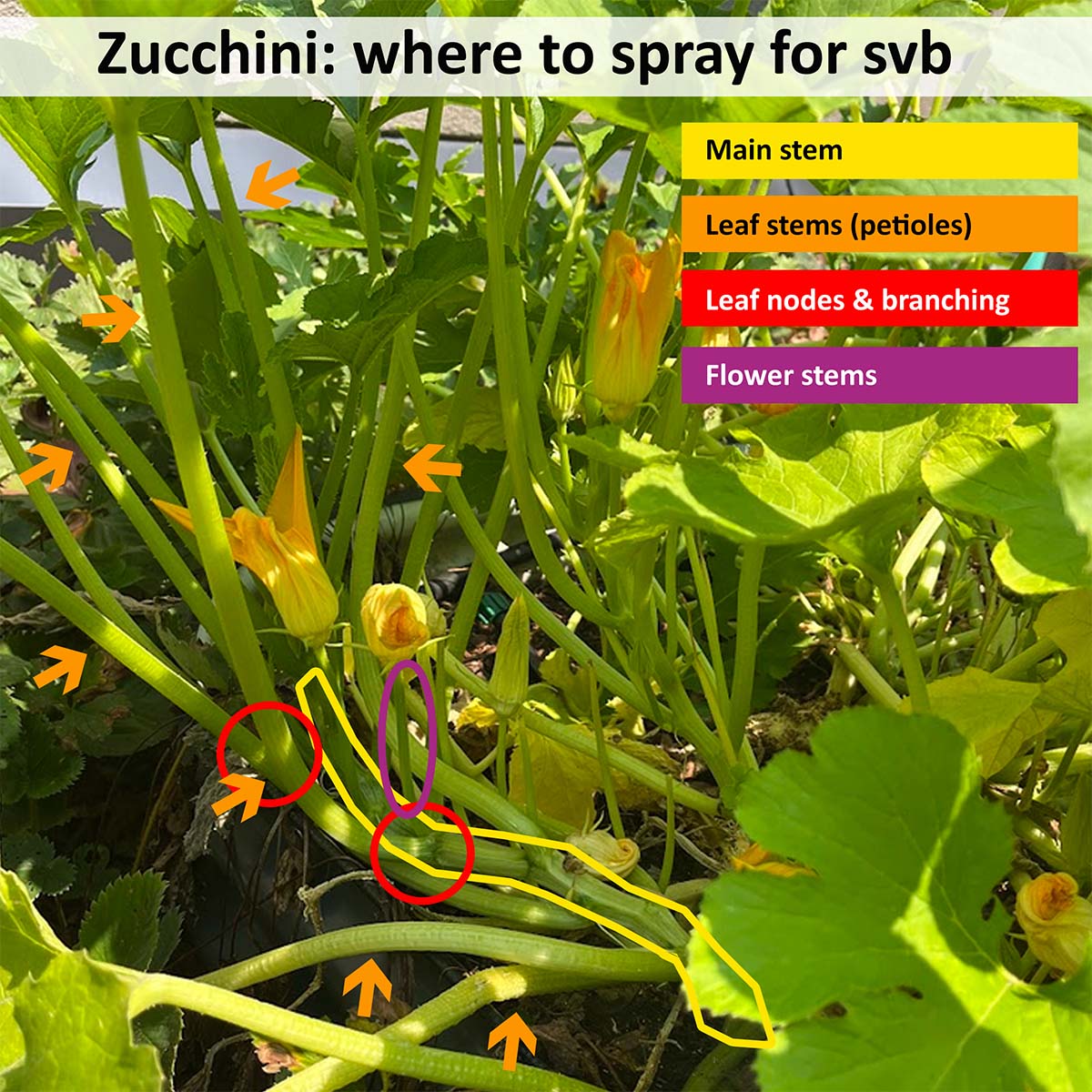
Zucchini plants are bushy and dense. This can make getting to the main stem harder, but it is relatively short. So once you get in there, spray it on all sides, all the way down to the soil line.
These plants have a lot of leaf stems that need full coverage as well. The adult moths prefer the main stem but definitely lay eggs along the leaf stems too.
Since the larva needs to ingest Bt as it begins feeding, spray the leaf stems too.
Also pay extra attention to the leaf nodes, where the leaf stem meets the main stem. These are great hiding spots for the eggs. When larvae get past my defenses, it's usually at one of these nodes.
Lastly, spray the long flower stems. While not a common spot for eggs, they do sometimes show up there.
I end up getting some parts of the leaves while I spray the leaf stems, but I don't spend time purposefully covering the leaves. I almost never see eggs on the leaves so I don't find it worth my time or the chance that a breeze carries it over to another plant.
Where to spray vining winter squash
Winter squash have long, trailing vines that make them easier to spray in my experience.
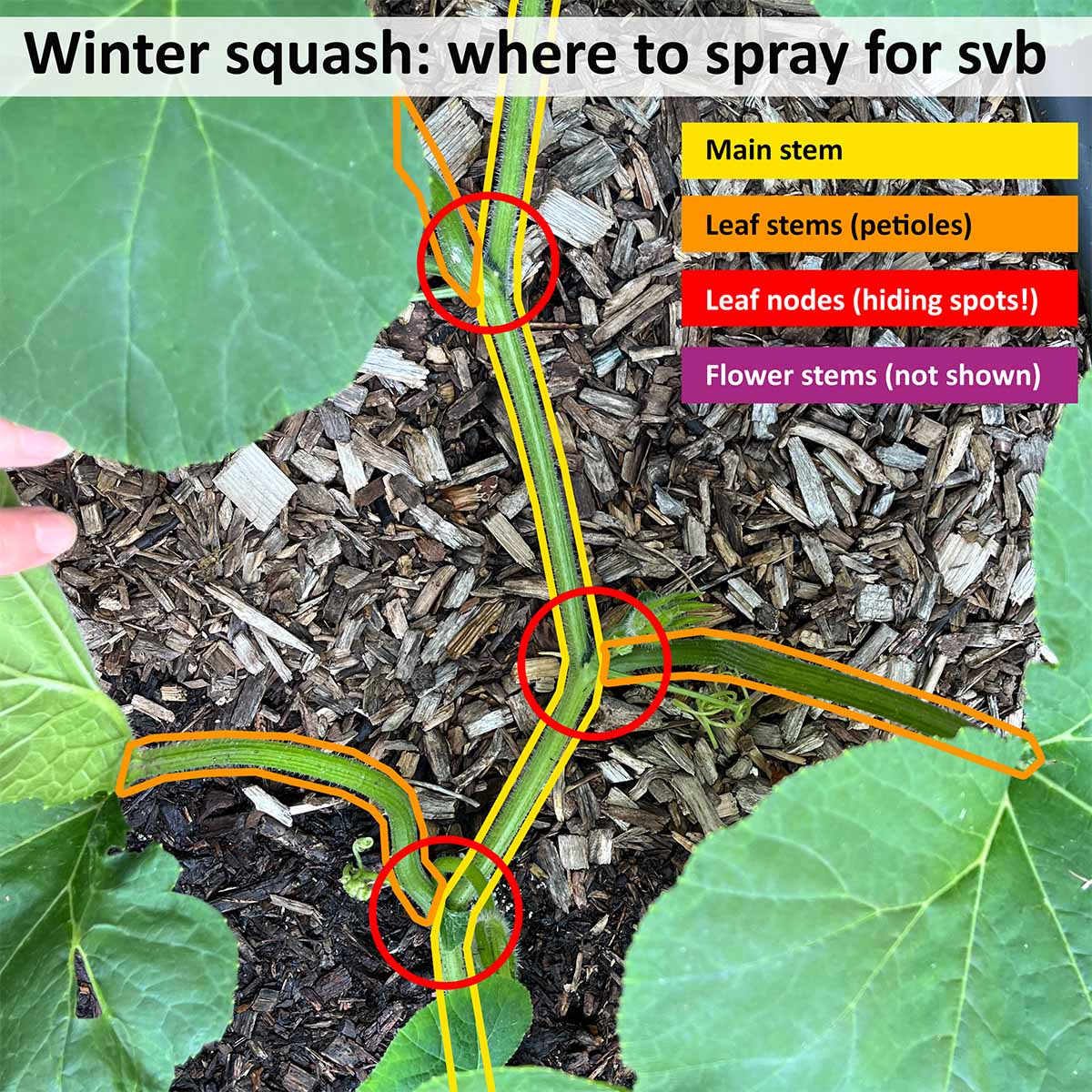
Spray the main vine all the way from the soil line to the tip. If your vine is trailing along the ground, gently pick it up so you can spray all sides.
Note that the vine might be growing roots at leaf nodes that are touching wet ground. If this happens, try to get as much Bt (or spinosad) coverage as possible without disturbing the roots. That way, if a squash vine borer larva gets past your defenses, the extra roots help keep the plant healthy.
Just like with zucchini, you also want to spray each leaf stem and pay extra attention to the leaf nodes (where the leaf meets the main stem). The leaf nodes are really great hiding spots for the eggs.
You can spray the leaves themselves, but I don't. Eggs can technically be laid on the leaves but I only find one or two across all of my plants each season.
Other tips for spraying
Here are some other tips for spraying Bt or spinosad to get the most out of it (and protect our wildlife):
- Cloudy days & evenings: UV light breaks them down, so reducing sun exposure during application can make it last longer (according to LSU AgCenter)
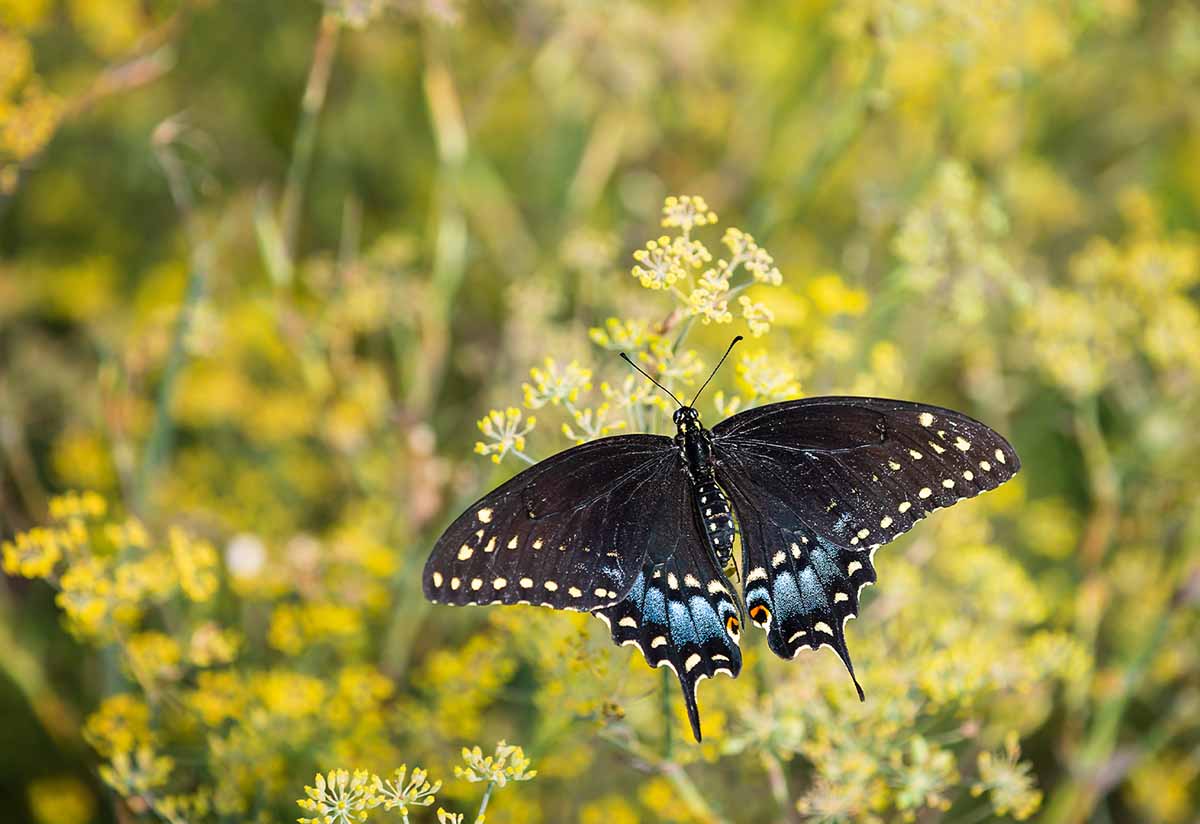
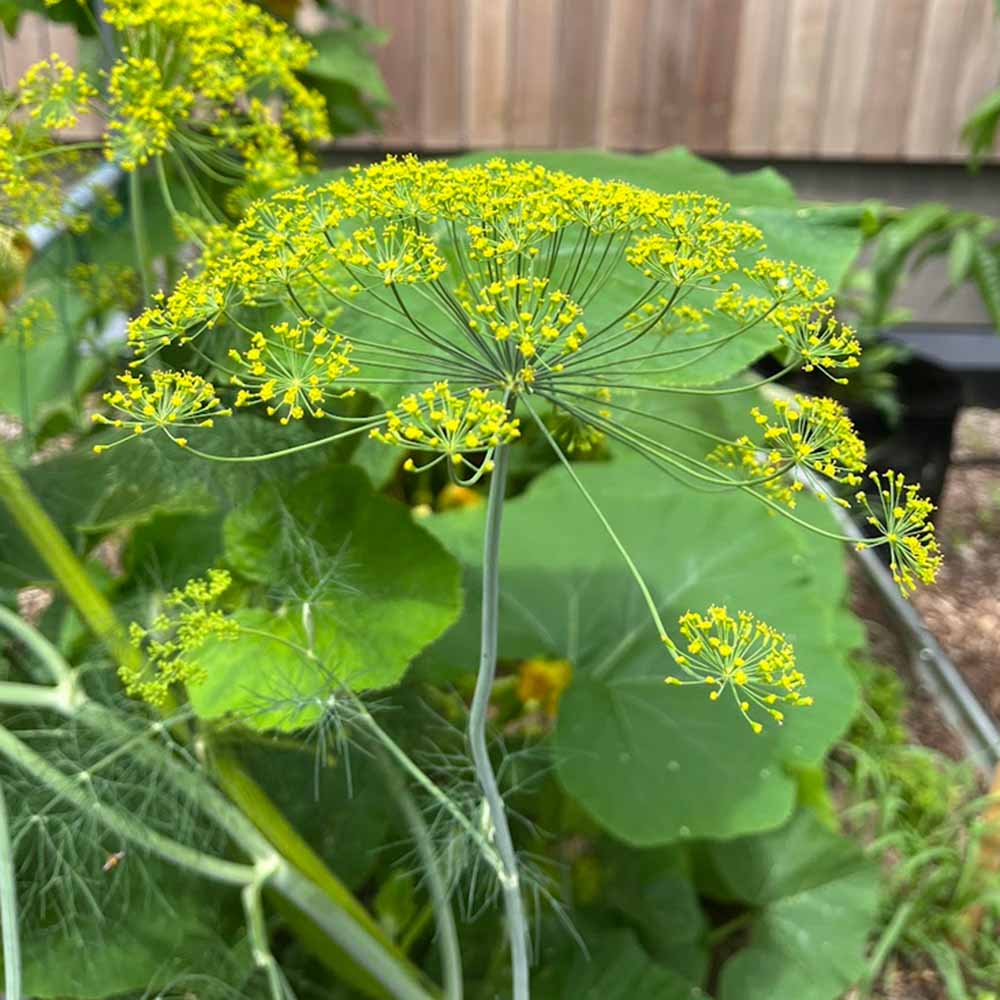
- Protect the butterflies! Avoid spraying where it might drift to other plants that are known butterfly hosts. Both insecticides target caterpillars, and monarchs love milkweed while the black swallowtail likes the carrot family (dill, parsley, fennel, and carrots).
- New growth: squash plants grow fast so new growth will emerge before your next treatment. Since eggs typically hatch in 1-2 weeks, you might need to spray new growth before your next scheduled application.
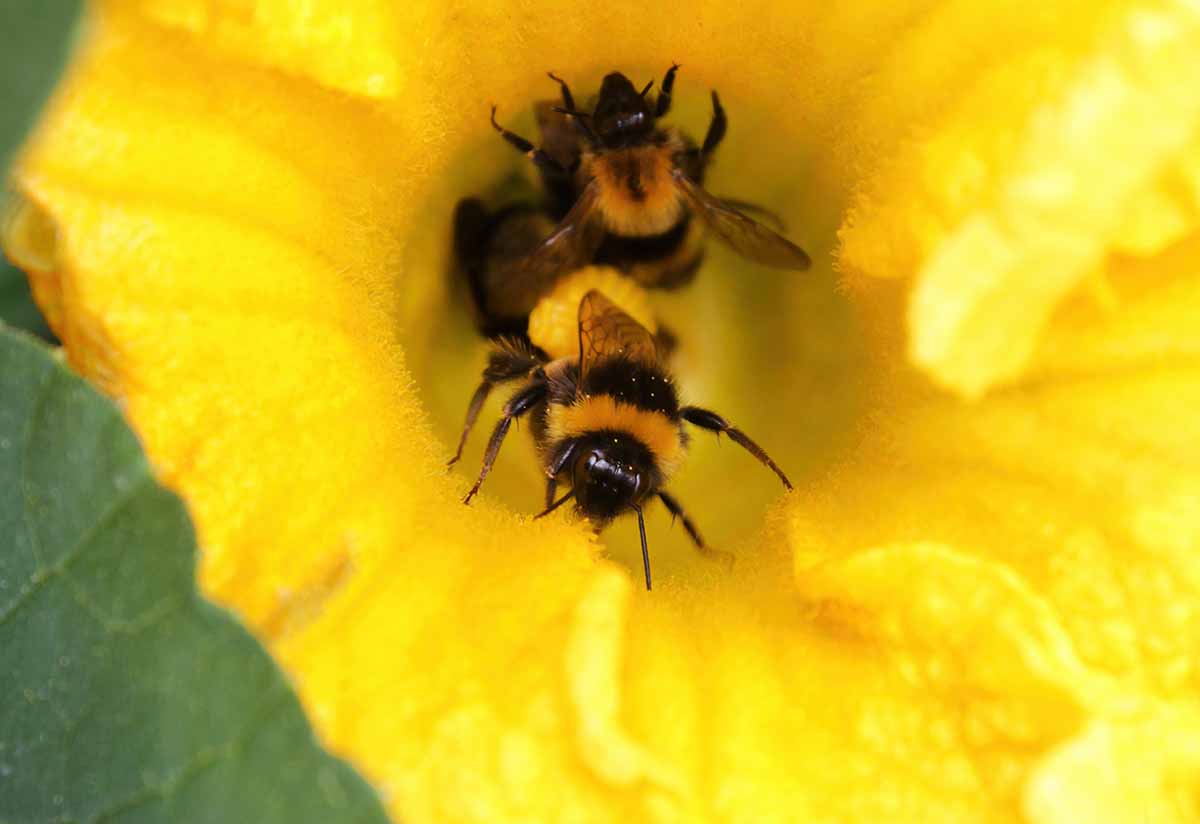
Recall that spinosad is harmful to bees when it is wet, so follow these guidelines:
- Don't spray on blossoms
- Don't spray on windy days
- Spray in the evening, when bees are less active
Spray insecticides based on the label's instructions, as they can be formulated differently. For example, I use Captain Jacks Bt, which says to repeat applications every 5-7 days, or more often with heavy pest pressure.
Once larvae get inside, spraying the plant won't help kill them. But even if you see larvae in the stem, you still want to keep spraying. I know this sounds like I just contradicted myself! However, the adult moths might still be laying eggs and they take up to 2 weeks to hatch.
An alternative: only use sprays when you can't get into the garden
If you don't want to spray regularly, you can use the spray only for times when you won't be able to check on your garden. For example, you could spray under the following conditions:
- Going to be so busy you'd miss multiple inspection days
- Expecting a heat wave that will limit your time in the garden
- Going away on a vacation (remember the sprays do break down, but spinosad lasts longer)
Why you might still get squash vine borers after spraying
If you find a borer even after you've diligently sprayed your plants, it doesn't necessarily mean the insecticide didn't work.
Spraying reduces the chance that a newly hatched larva enters the plant, but several things can leave gaps in that protection:
- Timing: you started spraying too late (and larvae were already inside the stem) or stopped too early (before the last of the eggs hatched)
- Coverage: missed spots when spraying
- Breakdown: it broke down faster in the sun than expected
- Rain: it washed away in the rain or from watering
- Dose/contact: the larva may encounter some of the insecticide, but not enough to be lethal
- New growth: the larva hatched on a section of vine that grew between applications
Because of this, I spray the insecticide as backup protection for regular monitoring of eggs. My main form of prevention is to scout for eggs and remove them. Then twice a week I spray Bt (or spinosad once a week).
Even with this, I usually miss a couple. But since I check on my plants regularly, I find frass early enough that there's minimal damage to the plant. When that happens, I inject Bt to kill the larva and the plant easily recovers.
How to inject Bt for a current infestation
When you find an actively feeding larvae, you have two options:
- Cut it out of the stem
- Inject Bt to kill them
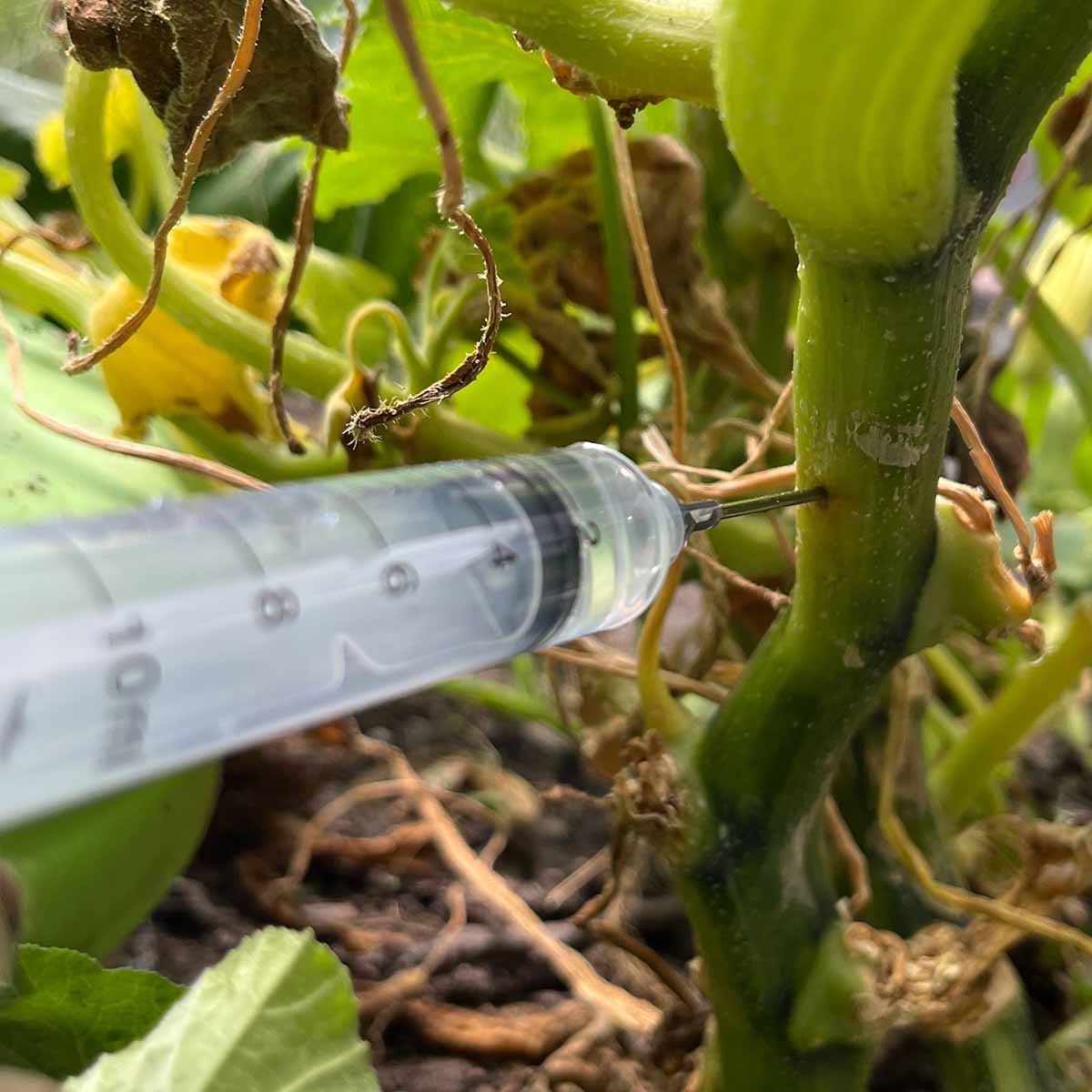
The purpose of injecting Bt into the stem is to flood the area the larva is feeding on. As it continues to feed, it ingests the Bt and dies. This is often recommended as a treatment option by university extension office, like this guide from Virginia Tech.
I personally have better luck injecting Bt than cutting larvae out. That's completely anecdotal and I admit that I sometimes cause extra damage to the stems when cutting out borers, making it harder for the plants to recover.
Injecting Bt is easier than you might think. I know it seems a little intimidating but it's actually pretty straightforward.
Step 1: buy blunt tipped syringes
First, buy a set of blunt tipped syringes (which I got off Amazon for under $10). The blunt tip helps to keep you from accidentally poking yourself!
If you have a pre-diluted Bt solution (which is often the case if they are sold in spray bottles), you can just fill the syringe from the bottle. If you have a concentrated version, you'll need to dilute it according to the package instructions first.
Step 2: Inject into entry hole
Next, place the syringe into the entry hole then slowly push down the plunger. I keep pushing until the solution runs back out the entry hole. For me, that's typically 2ml (as marked on the syringes).
There's no standard 2 ml dose here. I'm simply sharing how much it usually takes me before I see the liquid run back out the entry hole.
After, I take a second pass and in the same entry hole, I angle the syringe in both directions (up the vine, and down the vine), and push the plunger each time. I'm trying to make sure I fully flood the area where the larva is eating.
Step 3: Inject further up or down the stem (optional)
Lastly, when I find extensive tunnels, I point the syringe up (or down) an inch or two in the direction of the larva. Then I push the tip of the syringe into the vine and flood it with some more Bt.
A note on this: the syringe plunger might feel stuck, like there's no space for you to push into. This means the tip is clogged with the plant material (which happens occasionally when punching through the hard stem.
If this happens, remove the syringe and find a safe spot to unclog the syringe. Be sure to point it away from you (and anyone else).
Does preventative Bt injection work?
Some home gardeners inject Bt into the stem of summer squash, or along the main vine in winter squash as a preventative measure.
Preventative injection has been tested, but it didn't outperform foliar treatment. In one field trial, Bt foliage sprays were either equal to, or more effective than stem injections as a preventative measure.
Because of this, I don't personally see a compelling reason to routinely puncture a healthy stem to inject Bt for prevention. However, other gardeners swear by it. If you are interested, perhaps try it on some, but not all, of your squash plants for your own experiment.
Can you inject spinosad?
I couldn't find any studies around injecting spinosad, although it is well researched as a foliar spray.
I also couldn't find any university guides that recommend injecting spinosad, even when they support injecting Bt or even spraying spinosad. Even if it works, I'd avoid it for a couple of other reasons.
Because of this, I stick with Bt for injection. There's just better evidence and guidance behind that option.
Do the insecticides get into my squash?
Neither Bt nor spinosad is used as a conventional systemic insecticide. The goal of a systemic insecticide is for the plant to absorb it and move it throughout its tissues.
While both of these are considered non-systemic, that doesn't necessarily mean zero plant update under every condition. Studies indicate that Bt and spinosad stay localized when used as a foliar spray.
For example, if you spray a Bt on the stems or leaves, it generally stays there rather than absorbing and moving throughout the rest of the plant. This is good for us, our beneficial critters, and our harvests.
However, research has documented that roots can uptake and spread Bt and spinosad through the plant, when they saturated the soil with it.
Sadly, what I could not find is the study I actually wanted: what happens when you inject Bt?
If you're interested, the National Pesticide Information Center has a pretty thorough guide these insecticides and their safety (for wildlife and humans):
Which method is right for you?
The choice is dependent on your current garden situation and pest pressure. I usually choose the lowest level of intervention I can realistically keep up with, then add another layer if the pests are really bad or my schedule gets too busy.
Lowest pesticide use: scout & remove
If you have enough time to check on plants daily (or every other day), you can get away with using little or no pesticide. Keep in mind this takes a lot of time. For my 10 plants it would take anywhere from 30-60 minutes each time I checked over the plants.
- Check for squash vine borer eggs and remove them
- Look for tiny entry holes and frass to catch larvae you missed
- If larvae get inside, cut it out carefully to do as little damage to the stem as possible.
This takes the most hands-on time but you may be able to completely avoid insecticides.
Targeted treatment: scout & inject only when needed
You can still manually scout for the eggs if you want to avoid spraying pesticide. Then if you miss any, inject Bt into the entry hole to kill the squash vine borers without having to damage the stem by cutting it open.
Most protection: scout, spray, and treat missed larvae
If you are sick of these buggers and want to get an actual harvest, use Bt as a preventative spray and a treatment option.
- Spray Bt or spinosad once you notice adult moths or eggs, continue as needed until you see no more larvae activity (2-3 weeks after the last eggs appear)
- Continue to remove eggs by hand (if you have the time)
- For any larvae you missed that get into the vines, inject Bt into the entry holes.
If you go on vacation, consider spraying spinosad which should last at least a week, and up to two weeks. Whereas Bt breaks down faster in the sun, usually needing 2 applications a week. If it rains, both Bt and spinosad need to be reapplied, however.
Summary & more squash guides
No method catches every squash vine borer. That's why I have a routine every summer:
- I physically remove eggs to prevent squash vine borers from hatching in the first place (by checking daily or every other day)
- I spray Bt as a backup defense for eggs that I may have missed
- On my daily checks, I also look for holes with frass for any larvae that evaded all of my tactics
If you catch them in time you can easily save your plants!
More squash guides
- Squash vine borers: identification & life cycle
- Squash vine borer eggs: how to find & remove them
- How to save your plant from squash vine borer damage (immediately!)
- When to harvest butternut squash: ripening stages



Leave a Reply