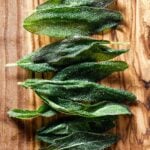
Fried sage leaves
Fresh sage leaves are pan-fried with just a little olive oil, finished with salt. The sage flavor mellows out in a perfectly crunchy, salty, garnish.
Servings: 20 sage leaves
Calories:
Equipment
- 1 small pan
Ingredients
- 20 sage leaves or any amount you want to use
- ¼ cup olive oil see note
- 1 pinch salt
Instructions
WASH & DRY SAGE LEAVES
- Make sure your sage leaves are very dry. Ideally, wash them them a couple hours ahead of time, dry them, and leave in the open air to further dry. This helps them fry up quick and crispy.
FRY THE SAGE
- In a small skillet, heat the olive oil on medium-high heat. Pro tip: use an infrared thermometer to test the oil surface temperature - your target is 350℉. Test if it's hot enough by frying just one sage leaf. If should bubble and stiffen up in about 60 seconds. You should have some wiggle room to take them out before they burn. Too hot: If the edges burn fast, lower the heat. (Too hot and the oil can impart bitter flavors).Not hot enough: if the leaves are crisping up in a minute, the oil should be hotter.
- Fry the sage leaves. I like to fry about 10 leaves at a time. Then I can watch each one and take them out when they are done. Set on a paper towel to drain excess oil (excess oil will make them lose crispiness).- They should be dark green (not brown), and start to stiffen up. If you take them out and they are completely limp, they won't crisp up as they dry. If they are turning brown, they are overcooked.
- Salt the sage leaves immediately after removing them from the oil. I like table salt because sea salt crystals always seem to fall off the leaves, without enough to cling to.
- Save the olive oil for roasting vegetables or making a salad dressing. It's now sage-flavored and delicious.
- These are best served right away, but can retain crispiness for about 24 hours in a paper-towel lined sealed container. Alternatively, if they are crushed on top of a dish, they don't need to be perfectly crispy and you can keep them for days.
Notes
Olive oil for frying: contrary to old advice, olive oil is a great option for frying. It actually holds up well to high heat with a smoke point higher than the ideal deep frying temperatures, according to the Culinary Institute of America.
Fresh sage: the varieties with thicker, fuzzier leaves are best for frying (and it's what you'll find in grocery stores). For gardeners, thin-leafed varieties like pineapple sage won't fry easily as they are too thin.

Scan QR code for full recipe page with images & more helpful tips