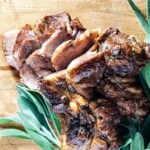
Apple cider braised pork shoulder
Cook pork shoulder low & slow in the oven with apple cider, onions, and fresh herbs. Cook to 185F for slicing or 205F for shredding.
Servings: 6 people
Calories: 354kcal
Ingredients
Braised pork shoulder
- 3 pound pork shoulder
- 1 tablespoon kosher salt
- 2 tablespoon brown sugar
- 2 tablespoon olive oil
- ½ yellow onion, sliced
- 3 garlic cloves, chopped
- 2 cups apple cider
- 2 teaspoon apple cider vinegar
- 3 bay leaves
- fresh thyme 5-10 sprigs
- fresh sage 10-12 leaves, on stems
- ½ teaspoon black pepper plus pinch of cayenne, optional
Apple cider gravy
- 1 cup pan drippings fat strained off
- 3 apples
- 1 tablespoon apple cider
- 1 teaspoon cornstarch or more as needed
Instructions
OVERNIGHT
- Salt the entire outside of the pork shoulder the night before, wrap it in plastic wrap and refrigerate it (can do this up to 2-3 days before, if desired).
SEAR & COOK AROMATICS
- Preheat oven to 250℉ (for slow cooking to ensure super tender texture in 4-6 hours) or 275℉ (if you don't have time to wait, but fat and collagen might not fully break down).
- Sprinkle the outside of the pork shoulder with a little more salt and then rub with brown sugar. (The sugar adds flavor and helps sear the outside). Add some oil toe the pan and sear the outside of the pork shoulder - it should only take 3-5 minutes per side. Remove from dutch oven and set aside.
- Add onions and garlic to the pan and cook until the onions start to soften. Pour in cider & vinegar and deglaze the pan (scrape it with a wooden spatula to remove stuck bits). Toss in the herbs, no need to remove stems, and bring liquid to a low simmer.
- Add pork shoulder to the pot of braising liquid.
BRAISE the PORK SHOULDER
- Transfer the dutch oven to the oven and cover with the lid, leaving the lid slightly ajar to let steam escape. This keeps the max temp inside the dutch oven around 185℉, preventing the braising liquid from boiling. Boiling is bad - it cooks the meat too hot and too fast, making it tough.
- It should take roughly 3-4 hours for sliced meat and 5-6 hours for shredded meat. You want the pork to get to 160℉ and then stay between 160℉ and 180℉ for at least 60 minutes (as a rough guess - the longer it's in this range, the more the collagen breaks down for tender meat).If it is cooking too fast, lower the oven temp by 25℉ and it will slow down considerably.
- Cook until the pork shoulder until it feels really tender when poked with a fork. As a guideline, 185℉ is a good temperature if you want to slice the meat, and 205℉ is better if you want to shred the meat.Don't have a leave-in thermometer? No problem, just check the temp periodically, losing heat as you open the oven will only help the meat (as it slows down the cooking).
- Remove pot from oven, let roast cool in the braising liquid for 30 minutes (if you have time, otherwise, take it out and set aside).
CIDER GRAVY
- Strain the pan drippings to remove the herbs. Add the onions back into the drippings (if desired). Separate the fat.
- Heat 1 tablespoon of the fat in the dutch oven. Add chopped apples and cook until they start to soften. Add in the pan drippings. Heat until warm. Taste the gravy, if it's too salty from the drippings, add water or more apple cider - then thicken it in the next step.
- To thicken the gravy, mix corn starch with a cool liquid (apple cider or water) until blended and smooth. Then slowly stream the cornstarch-liquid into the gravy, stirring constantly. This is pretty foolproof and you shouldn't have any risk of clumps - the corn starch will clump if added directly to the hot pan without pre-mixing.
- If the gravy isn't thick enough, add more cornstarch (AFTER pre-mixing it with cool liquid again). If it's too thick, add more pan drippings, apple cider, or broth.
SERVE & SAVING LEFTOVERS
- Serve the braised pork shoulder with gravy on the side. Top with fried sage leaves if you're feeling fancy.
- Refrigerate leftovers. To reheat, you can add sliced (or shredded) meat with the gravy and gently warm in a pan on the stovetop.
Notes
Apple cider: apple cider has a more concentrated flavor than apple juice. If you're looking for the distinct cider flavor, don't substitute in apple juice.
Apple cider vinegar: this adds some more acidity to the drippings to balance the salt and fat. You can substitute a red or white wine vinegar if you don't want to buy apple cider vinegar.
Nutrition calculated assuming all fat from the pork shoulder is consumed, even though some is skimmed off in the pan drippings. It also assumed all of the apple cider is consumed, even if you don't use all of the drippings.

Scan QR code for full recipe page with images & more helpful tips
Nutrition
Calories: 354kcal | Carbohydrates: 27g | Protein: 28g | Fat: 15g | Saturated Fat: 4g | Polyunsaturated Fat: 2g | Monounsaturated Fat: 8g | Cholesterol: 93mg | Sodium: 1274mg | Potassium: 680mg | Fiber: 3g | Sugar: 22g | Vitamin A: 63IU | Vitamin C: 7mg | Calcium: 42mg | Iron: 2mg